‘A matter of social justice’: The old men of 1972 who got pay equity right

Norman Douglas, Jack Marshall and David Thomson, three of the politicians who participated in the Equal Pay Bill debate in 1972
The MPs who passed the Equal Pay Act in 1972 could hardly be described as radical liberals, but they were light years ahead of this government, argues Marilyn Waring, convenor of the People’s Select Committee on Pay Equity.
In the 1969 general election campaign, both the governing National and opposition Labour parties had committed to introducing equal pay legislation in their manifestos.
Keith Holyoake was prime minister. Jack Marshall had spent 18 years in cabinet and had been deputy prime minister for nine years, and a highly successful minister of trade and attorney general. He did not want to be minister of labour. But in 1969 Holyoake gave Marshall “the most demanding, frustrating and thankless job in cabinet”.
Yet those three years saw two extraordinary steps in social legislation, led by this minister of labour. The first of these was the Accident Compensation Act, based on the report from the extraordinary visionary Sir Owen Woodhouse. Not all of Woodhouse’s recommendations made it into law. The most notable of these was his proposal that injured non-earners – especially those who ran households – should be compensated, and costs such as childcare reimbursed. That was a step too far for that parliament – and for all of them since, of course.
But pay equity was not a step too far, and that came next.
On January 26, 1971, a Commission of Inquiry into Equal Pay was appointed, to address “how best to give effect to the principle of equal pay for male and female employees”.
The commission made it very clear that there was a difference between equal pay and pay equity. They wrote: “We found ourselves unable to accept the proposition that the principle of equal pay for male and female employees … did not include the removal of any element of sex discrimination from the rates of pay for work exclusively or predominantly performed by women.
“We do not believe these groups of workers can be ‘swept under the carpet’ and left to have their position clarified and determined by market forces and potential conflict. For work, which is now exclusively or predominantly performed by women, the remuneration should be fixed as though a male with similar skills, responsibility and service were performing that work.”
The commission knew that the equal pay legislation in Australia did not include these workers, and they consciously rejected that option for New Zealand. This position would be reflected in the Equal Pay Bill introduced on August 29, 1972.
By now David Thomson was minister of labour. Keith Holyoake had stepped aside, and the leadership was contested by Jack Marshall and Robert Muldoon. Marshall won, becoming prime minister with Muldoon his deputy and minister of finance.
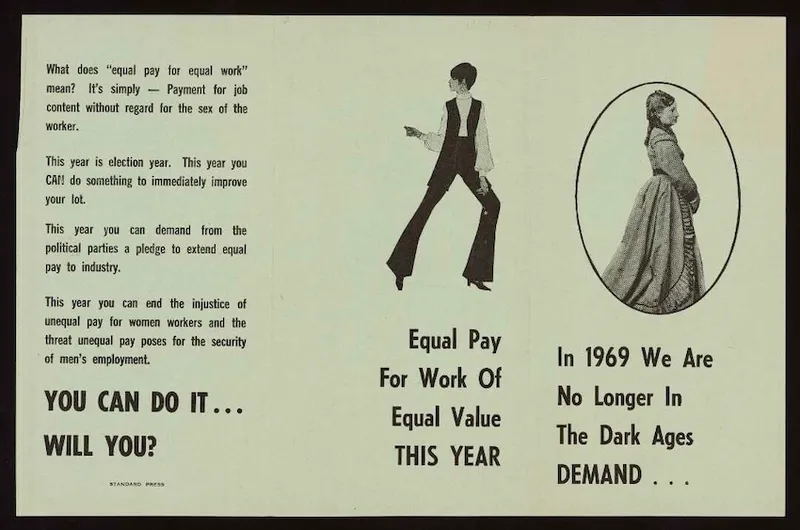
When the bill was introduced, Thomson advised the House, “Men and women should receive the same rate of remuneration for work which calls for identical or substantially identical degrees of skill, effort, and responsibility and which is performed under identical or substantially identical conditions.” There would be a suite of other legal changes to discriminatory legislation: amendments to the Apprenticeships Act 1948 to ensure equal rights for women; to the Machinery Act to permit women to clean machinery and operate gas and oil engines at the same age as men; to the Shops and Offices Act, making it lawful to employ both sexes as shop assistants and to employ women in restaurants at times when only men had previously been allowed to work; and to the Factories Act, removing provisions that made it illegal for women to work on Sundays, holidays and half holidays and removing overtime restrictions on women workers.
The bill was introduced under urgency, and there was to be a general election on November 25. The opposition asked if the bill would go to a select committee to hear submissions, and if media would be able to be present. Back then, “open to the media” was not a common occurrence. Prime minister Marshall agreed it should be a public and transparent process. “This is a significant forward move in the social legislation of this country, and it will be recognised as a landmark in our social history… It’s a matter of social justice.”
There were not many contentious issues between the parties, but the commission had suggested that the key was “the extent to which the work or classes of work call for the same or broadly similar degrees of skill, effort and responsibility”. The bill as introduced used the word “identical” instead of broadly similar. On report back from the select committee, the wording had become “the same or substantially similar”. Thomson reiterated the difference made clear by the commission: “The bill applies to all work performed by women, including work in the female-intensive industries where few males are engaged.”
This parliament, of over 50 years ago, absolutely understood the need for a comparator outside a female-intensive industry. In the committee stages of the debate, backbenchers on both sides refer to the “mythical man”.
What about Muldoon? Those of us who knew and worked with him could see precisely what was going on in his interventions. In the introductory debate he said: “we believe it is proper that (equal pay) should happen, but … the consumer will pay for the additional wages that will go to women. Manufacturers have said the CPI will go up, but their views differ from those of government officials.” In the second reading he said, “Prices will go up. It will be inflationary. Women will be priced out of their jobs. Factories will close down.” But he had a crack at the only opposition to the bill, from the Employers Federation. Employers said it would cost $200-$240 million: the Department of Labour said $100m, Treasury said no more than $110.
All debate was under urgency, but it was short, and mostly about the timetable for implementation. The best interventions came from Labour’s Norman Douglas, who said women “will no longer be considered as a reservoir of cheap labour”. He explained: the “principal argument against equal pay is based on economic factors … rather than the moral principle, (which is) of paramount importance. Right down through history, we have heard the same old argument. Removing children from mines and factories, the eight-hour day, the 40-hour week, annual holidays for all workers.”
Yes, Norman – we are still hearing the same old argument. I can easily imagine this 2025 mob would have argued that it hurt their budget deficit to pay out slaveowners to end slavery.
In the years that followed the act’s passing, the Arbitration Court showed it didn’t understand pay equity. Finally, in 2013, the Employment Court court in the Kristine Bartlett case bothered to read the parliamentary debate in 1972 and got it right, which was affirmed by the Court of Appeal the following year.
More than 50 years after that debate, the government got it wrong. I served in parliament with most of the 1972 MPs. I would never have described them as radical liberals, but they were light years ahead of the current government in their understanding of pay equity.

Marilyn Waring
Marilyn Waring is Professor of Public Policy at AUT and a former National MP.


