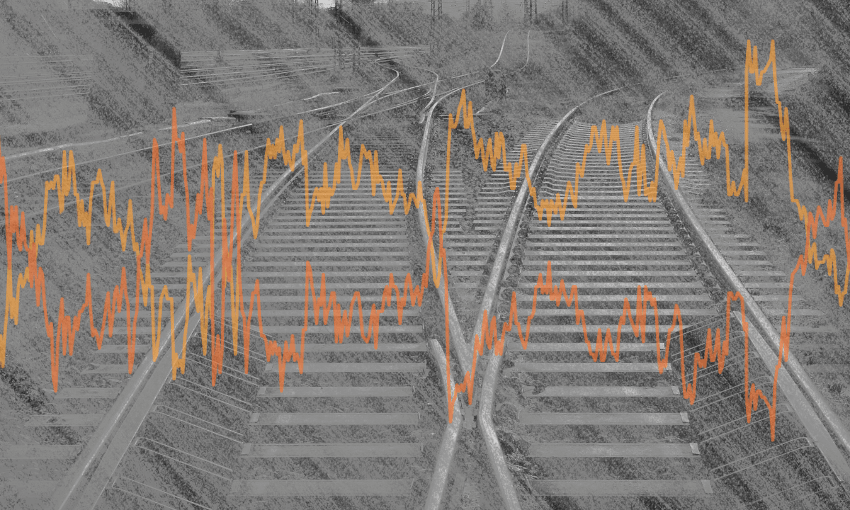



Is the country on the right track, or the wrong track? Pollsters have been asking this question of New Zealanders for 35 years, and the results trace a fairly regular pattern – one that won’t reassure the current government.
Polling of this kind normally spells electoral death. No government in the last 35 years has survived once most New Zealanders have come to think the country is “on the wrong track”. Yet this is the situation in which Christopher Luxon finds himself. Contrary to the promises of his 2023 election campaign, he has never been able to convince a majority of New Zealanders that the country is “back on track”.
Such poor polling has put an end to the hopes of three of the last four governments. Since 1991, pollsters Talbot Mills have – in various guises – asked the public a simple question: is the country on the right or the wrong track? And the results trace a fairly regular pattern.
For much of the 1990s, the public was relatively content under the reign of Jim Bolger, National’s “Great Helmsman”. But things went south soon after he formed his 1996 coalition with Winston Peters, and in the run-up to the 1999 election, as much as 62% of the population thought things were on the wrong track. The coalition promptly lost power.
By the early 2000s, Helen Clark’s Labour government was enjoying similarly rosy ratings – until the global financial crisis hit and people tired of her party’s direction. In the middle of 2008, over half the population were picking “wrong track” over “right track”. Clark lost that year’s election.
Her successor, John Key, and his lieutenant Bill English bucked the trend, in the sense that they kept the country in a good mood right up until – and during – the 2017 election, rendering Labour’s triumph that year all the more remarkable. Famously, though, that positivity did not last.
After sky-high pandemic-era ratings, reaching almost 80% approval at one point, Labour’s popularity crashed amid the cost-of-living crisis. By September 2023, over half the country felt matters were on the dreaded “wrong track”. And so they turfed Labour out.
So it is a big problem for Luxon that, aside from a very brief honeymoon, his government has consistently elicited a “wrong track” reaction from around half of all voters. Its ranking briefly rallied earlier this year, perhaps reflecting summer vibes and the first evidence of economic recovery, but it is unlikely that this lasted. An early March poll from another polling firm, Freshwater Strategies, had the “wrong track” vote on 55% and rising.
What does all this mean for the election? Clearly, the case against the government has been well established: the opposition parties have convinced the public that the government is favouring landlords and tobacco companies with tax cuts, unfairly targeting Māori, and failing to fix the economy. The rest of the time, the opposition has sensibly refused to interpose itself between Luxon and his public, letting his perceived charisma deficit do the job.
Normally, this might be enough to spell doom. Oppositions don’t win elections, as the saying goes: governments lose them. But normally it takes more than three years before the electorate feels the politicians they are evicting have had enough time to prove themselves. New Zealand hasn’t had a one-term government since 1975, and even then matters might have been different if Norman Kirk hadn’t died. Before that, one has to go back to 1960 to find a single-term administration.
No doubt this is partly why, despite the country’s appalling mood, most polls give the coalition at least a 50-50 chance of being returned to power. Negative sentiment is locked in a battle with the natural desire to allow a government more time.
That leaves the left needing to lift their vote share by another few percent. And that is not going to happen of its own accord. Although it now looks unlikely that a vigorous economic recovery will come to National’s aid, it is equally unlikely that the economy will significantly deteriorate, especially if Donald Trump rapidly walks away from his war in the Middle East.
Some left-wing NGOs, meanwhile, are trying to lift voter turnout, especially in light of the government’s moves to make registration harder. But it would be unwise for the left to pin too much hope on a massive surge in enrolments. Efforts last decade to locate the “missing million” of voters bore little fruit. And if people are to be convinced to vote, they have to feel like they’ll be voting for something.
If the left wants a chance, it needs to channel the ambient public anger embodied in the “wrong track” results – channel it, and turn it into hope. The Greens and Te Pāti Māori, whatever form the latter takes, will undoubtedly supply ideas and inspiration. The big question mark, as ever, concerns Labour.
The party is not unaware of the need to give voters something to cling to, some policy offering beyond a minimalist capital gains tax and a Future Fund that invests in Kiwi start-ups. The “small target” strategy of not getting between Luxon and his unadoring public has only so much road to run.
The party’s view, however, is that, given current economic turmoil, it’s not yet clear how much money any incoming government will have to play with, and consequently what a responsible opposition could promise. Nor does it think that, political obsessives aside, most voters are tuned in enough to hear what it has to say. Which may well be the case. But the result is that everyone is left guessing as to whether the party, and with it the wider opposition, can capitalise on the public’s foul mood.