Luxon opens election year without a spark

Christopher Luxon at the 2026 State of the Nation address. Photo: Joel MacManus
The prime minister’s state of the nation speech failed to stir his own party faithful.
There are many reasons for Christopher Luxon to feel optimistic. While the rest of the world seems to have fallen apart over the summer, New Zealand’s economy is finally showing those green shoots he has promised for so long. Job listings are up, bank economists are predicting GDP growth, and business confidence is at its highest level since 2014.
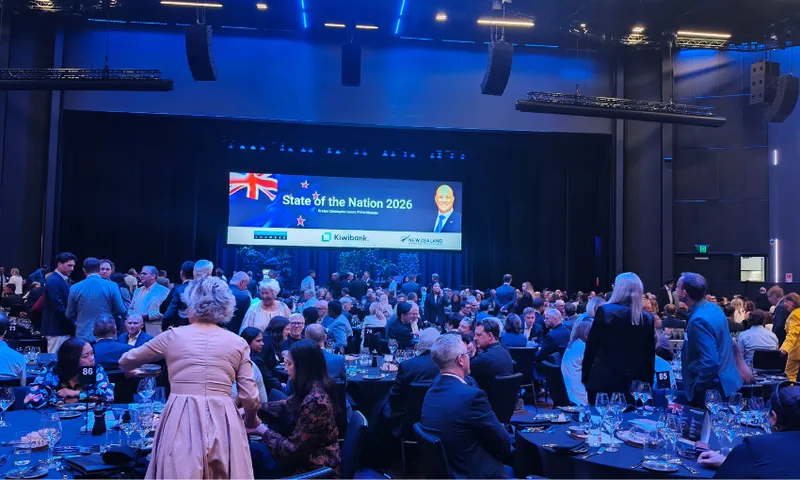
In his state of the nation speech on Monday, the prime minister had the opportunity to highlight those successes and try to reset the narrative heading into an election year. The Auckland Business Chamber provided a friendly crowd, which nibbled on slow-cooked beef cheek with carrot puree and pan jus. It should have been a gimme, and yet Luxon’s speech fell flat.
There was no cheering. No laughter. A smattering of claps broke out at the mention of the free trade deal with India – a reaction that caught Luxon off guard – and there was some perfunctory applause as he concluded. The audience was politely engaged, but far from engrossed.
Even the flashy new venue didn’t seem to make an impact. The state of the nation address was pegged as a “special test” of the New Zealand International Convention Centre, which officially opens in February. It’s an impressive bit of construction, but in its not-quite-open state, it feels eerie. The cafe hasn’t been kitted out, some of the furniture is missing, and it smells like paint. It was hollow, soulless – like Luxon’s speech.
Narratively, Luxon is stuck in limbo, unsure if he can start start celebrating an economic recovery or if he needs to keep up the “we’re all doing it tough” schtick for a few more months. He tried to strike a middle ground, maintaining a sober, subdued manner as he read from his autocue. Mostly, he seemed like a guy who had just got back from holiday and wasn’t quite back into the swing of things.
He opened the speech with talk of growth in the manufacturing and construction sectors, then pivoted to austere references to savings, responsible campaigning, and no splashy election promises. Neither got much of a reaction. Nor did the revelation of National’s 2026 election slogan: “fixing the basics, building the future”, a slightly too-wordy line which he conspicuously inserted throughout. Luxon seems to have found another favourite line, too: he’s really keen on “leaving a legacy of prosperity”.
National’s “bold plan” for the election, as outlined by Luxon, focused on three reforms that are already in progress: increasing Kiwisaver savings, swapping NCEA for a new system, and replacing the Resource Management Act. He was full of effusive praise for ministers Erica Stanford, Mark Mitchell, Paul Goldsmith and Chris Bishop. Luxon’s relationship with Bishop must be on icy terms after a rumoured coup and a captain’s call to water down Bishop’s signature Auckland housing reforms, but he lauded Bishop as having delivered “more reform to the resource management environment than any other minister has achieved in decades”.
On many issues, Luxon can be light on the details, often settling for canned lines and comfortable hyperbole. It keeps him out of trouble, avoiding potential gaffes, but audiences switch off when they realise that most of his words mean nothing. The strongest moments of the speech came when discussing international trade, a policy area that he has genuine interest and some expertise in, and one of the few topics he is willing to discuss in detail – albeit with great caution not to annoy Winston Peters or Donald Trump.
Recent polling suggests the election is on a knife edge. The coalition government is slightly favoured to be returned, but could be with a smaller National Party giving up more power to Act and New Zealand First. That’s the kind of situation where some backbench MPs start getting worried about their jobs.
The problem for National is that die is already cast. Their major reforms are in progress and the economic agenda has been set. Luxon has indicated that there is no big election bribe coming in the budget.
National’s path to victory is to hold on and hope that people start to feel richer by election day. While senior ministers toil away with their all-important reforms, the party needs Luxon to be its chief salesman and showman, loudly celebrating New Zealand’s economic success. It’s a role that should suit him well; Luxon’s great strength in politics is his extroversion, enthusiasm and eternal optimism. But on a pure performance basis, they’ll need him to be a lot better than this.

Joel MacManus
Joel MacManus is a senior writer for The Spinoff. He previously worked at RNZ and Stuff, and began his career at Critic Te Ārohi. His writing explores the political, economic and cultural systems that underpin modern New Zealand. He won the 2025 Voyager Media Award for Best Columnist, Opinion or Critique.


