Fiscal conservatives should be clamouring for cycleways

Huge news: there might be a cheaper alternative to roads (Photo: Auckland Council)
Bikes now get more people into Auckland’s city centre than ferries at a fraction of the cost. But at a national level, they’ve been rejected in favour of roads that barely stack up.
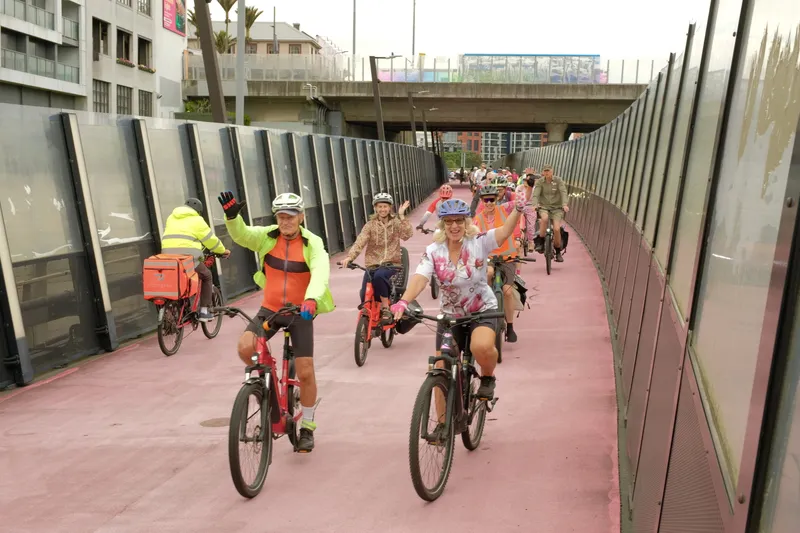
It’s 8.30am and the cycleway running alongside Auckland’s northwestern motorway is congested. E-bike riders swerve around the slower pedal pushers on analogue cycles. Scooter riders hoon past them all in the direction of the city’s most recognisable and beloved building, the fluorescent yellow Grafton Golf Warehouse. The rush hour commuters are a diverse crowd. Lycra-wearing hardouts mingle with suited up businesspeople and students in T-shirts. Hundreds of them arrive here, without fail, every weekday for their commute into the city.
Ask some politicians, and these people don’t exist. National’s Simeon Brown consistently derided cycleways during his time as transport minister, calling them a waste of time and money and making a point of deprioritising them in government plans. “There’s less money going into cycleways, and I think New Zealanders are sick and tired of the amount of money going into cycleways,” he chirped happily while announcing the 2024 National Land Transport Programme.

The overarching theme of the criticism has been that no one uses bike lanes. But cyclists have remained stubbornly material despite the apparent belief in some circles that they don’t have a corporeal form. In Wellington, bike numbers have risen steadily in recent years, more than doubling on one popular route since 2023. Cycling counts in Christchurch have gone up 40% since 2017. In Auckland, the figures are eye-opening. Cycling has risen 5% year on year for three years running and the crowds zipping past Golf Warehouse on the northwestern cycleway are a big part of the story. More people now use Auckland’s cycle network to get to work than its ferry system. According to figures provided by AT, the average number of people entering the city by bike between 7 and 9am was 2,448 in November 2025, compared to 1,841 by ferry.
They do so at a fraction of the cost of other modes. Though some commentators seem to think the cost of cycle paths is outrageous, Auckland Transport is investing $69m of its $1.5bn capital budget in cycling in 2025/26, compared to $70m in ferries, $105m in buses, $285m in rail and $588m in roads and footpaths.
But the real savings come after the cycleways are built. Upkeep amounts to a few cleared branches here or some repainting there. Every other mode costs what’s referred to by accountants as a “shit tonne” of money to run. AT’s opex budget sits at $84.5m for ferries, $181m for roads and footpaths, $351.3m for rail and $558.7m for buses. It doesn’t keep a comparable dedicated operating budget for cycling. Just about all the maintenance for AT’s bike paths is budgeted as a comparatively negligible throw-in on the roughly $240m it sets aside annually for resealing its road network.
Those cost savings might be why the business cases for cycleways are usually so good. The Herald’s Thomas Coughlan reported in 2021 that Auckland’s cycle network returns $6.80 in benefits on average for every dollar spent. That’s dropped recently as some of the cheapest, easiest projects have been picked off, but an AT spokesperson says its current cycling and micromobility programme is still returning an estimated $2 to $3.40 for each dollar invested.
During his tenure as transport minister, Brown made it clear that value for money was his top priority in funding decisions and that’s continued under his successor, Chris Bishop. Given that, you’d think cycling investment would stand out as a cheap way to maximise bang for government buck. Instead it’s committed to spending $250bn, a figure otherwise known as “all of our money”, on land transport over 20 years. Much of that investment will be going toward what The Spinoff’s Joel MacManus has described as “roads that suck”. Even after some flattering rejigging to a few mathematical formulae, the official benefit-to-cost ratios barely crack 1.0 on many of the 17 Roads of National Significance the coalition has signed the country up to.
Cycling advocates are often painted as ideological. They’re accused of refusing to make accommodations for reality and demanding we forge ahead with their pet transport projects regardless of evidence or budgetary considerations. But when Brown announced National’s new Roads of National Significance programme before the 2023 general election, he estimated the entire thing would cost $17bn. Just one of the 17 roads we’re currently committed to — the Northern Corridor – is now expected to cost up to $18.3bn. The government is forging ahead despite that mind-boggling blowout and the increasingly loud warnings it could cause tradeoffs when it comes to spending on stuff like hospitals. It’s doing so despite the fact other transport modes, including cycling, could deliver congestion-easing benefits at a fraction of the cost.
The obstacle to making that kind of cash-saving reprioritisation doesn’t really seem to be evidence or value for money; it’s that it might clash with some politicians’ pre-existing beliefs or provoke outraged caterwauling from commentators and talkback callers. No matter what case cycling puts together, it’s unlikely to change the right people’s minds. It can be enough to make you wonder which side of this eternal transport debate is actually dominated by ideology.

Hayden Donnell
Hayden Donnell is a senior writer for The Spinoff. He previously worked at RNZ, TVNZ and the New Zealand Herald, alongside other media companies that have since closed down or been renamed. His primary passions are local politics and the Big Fresh animatronic fruit and veggies.


