One of Brooke van Velden’s final acts as a politician will also be her most dangerous

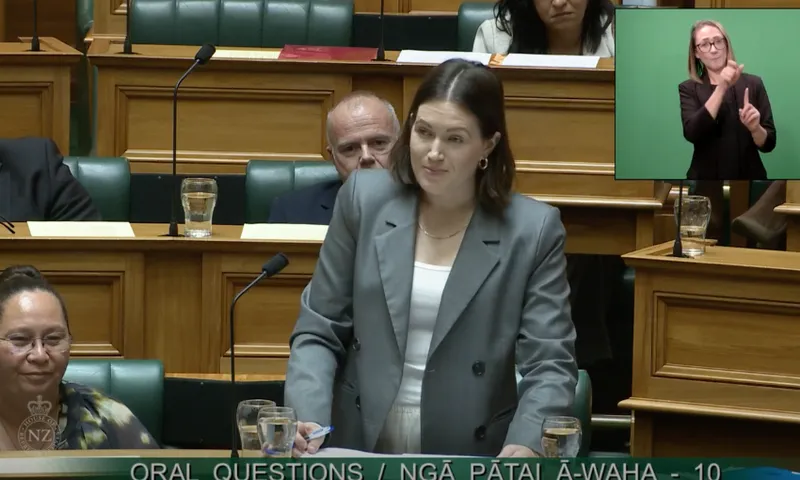
Workplace relations and safety minister Brooke van Velden (Photo: Hagen Hopkins/Getty. hart hat: The Spinoff)
Max Rashbrooke scratches his head at the Health and Safety at Work Amendment Bill, which has been opposed by ACC, business owners and economists, yet persists.
Consider this: you are an Act minister, for whom getting offside with the business community is almost impossible, and yet you have achieved this feat.
Consider this: your bill will put fewer health and safety responsibilities on a four-person abseiling company than a 21-person accountancy firm.
Consider this: you are bringing forward a bill that is designed to lower business costs but will likely do the opposite.
Given all this, what do you do? If you are Brooke Van Velden, the minister responsible for the above bill, the answer is that you plough ahead regardless.
The legislation in question is the Health and Safety at Work Amendment Bill, which Van Velden is trying to get passed this week. Its chief feature, in the words of the Listener’s Rebecca Macfie, is that it “radically reduces small employers’ obligations to keep workers safe on the job”.
Under the bill, firms with fewer than 20 workers – that is, 97% of this nation’s businesses – would be carved out of most health and safety requirements, being required to manage only “critical risks” to their workers. As with much Act policy, this seems superficially plausible: small businesses are stretched, so why not let them concentrate on the biggest risks? But as with much Act policy it is evident, the moment one peers into the engine room, that this is an absolute trainwreck of a bill.
Although “non-critical risks” may not sound serious, they actually make up the bulk of workplace harms. They include musculoskeletal injuries from trips, slips and falls, and psychosocial risks that include mental stress, excessive workload and burnout.
As the New Zealand Institute of Safety Management (NZISM) points out, these two areas are literally the top two causes of workplace harm. Treating musculoskeletal injuries alone takes up fully half of ACC’s work-related rehabilitation bill, totalling $3.6bn a year.
Under Van Velden’s bill, in short, small businesses can stop trying to prevent the most frequent and most expensive causes of harm in the country. The fiscal cost this will impose is unclear because, in yet another reprehensible piece of policy-making, ACC was excluded from targeted consultation on the bill, and the government-dominated Education and Workforce Select Committee wouldn’t allow the agency to do the required modelling. Nothing says “we are committed to evidence-based policy-making” like a refusal to let that evidence even be produced.
Nonetheless ACC has, in internal documents, clearly identified the bill’s dangers, saying it generates “a real and material … risk of increasing deaths, injuries, claims and costs”. The NZISM, meanwhile, predicts it will “cost hundreds of millions more and cause huge suffering”.
Another bizarre facet of the bill is that small businesses aren’t even particularly safe places. According to calculations by Simplicity chief economist Shamubeel Eaqub, small businesses are already one-quarter more likely to injure their staff than bigger firms (adjusting for workforce size). ACC data shows they generate three-quarters of all work-related injury costs.
“Carving them out makes no sense,” says the NZISM’s Mike Cosman. In just one “ridiculous” example, small businesses will no longer have to provide staff with safety boots or gloves, as hand and foot injuries are not deemed “critical”.
Dividing up businesses based on size is also nonsensical. As above, a four-person abseiling business will, despite the extraordinarily dangerous nature of its work, face fewer health and safety regulations than a 21-person accountancy firm, simply because the former falls below the 20-worker threshold. Paul Jarvie from the Employers and Manufacturers Association told the Listener the carve-out “defies logic in terms of where the harms are occurring … No other country does this. It just doesn’t make sense.”
Which brings us to the final, and perhaps most bizarre, aspect of the whole bill: companies, for the most part, don’t even want it. The bill’s sole corporate cheerleader of any significance is former National MP and current Business New Zealand head Katherine Rich.
Others, like Jarvie, think the bill is “a really complicated hotchpotch” that “may unintentionally increase harm, complexity and compliance uncertainty for businesses and workers”. Members of the Business Leaders Health and Safety Forum say the reforms will leave large corporations still legally liable for what happens further down the sub-contracting chain – but without the reassurance that injuries are being avoided.
As a result, big firm after big firm has queued up to tell lawmakers that, if the bill goes through, they will simply use their contracting power to force small businesses to manage musculoskeletal and psychosocial risks anyway. Or they will avoid engaging those firms altogether.
The bigger picture here is that, even under the current laws, New Zealanders are six times more likely to die on the job than Brits, and nearly twice as likely as Aussies. But Van Velden is determined to weaken even further the already-minimal guardrails protecting workers. Her refusal to listen to counter-arguments suggests that, far from being a pragmatic response to so-called red tape, the bill is just an exercise in ideological rigidity.
Conscious of this truth, some National Party MPs have privately made it clear that they don’t really like the bill. But they aren’t prepared to oppose it. So it will be left to a party with more spine – and indeed more common-sense – to overturn one of the worst pieces of legislation in recent memory.

Max Rashbrooke
Max Rashbrooke is a senior research fellow in the School of Government at Victoria University of Wellington. www.maxrashbrooke.net.


