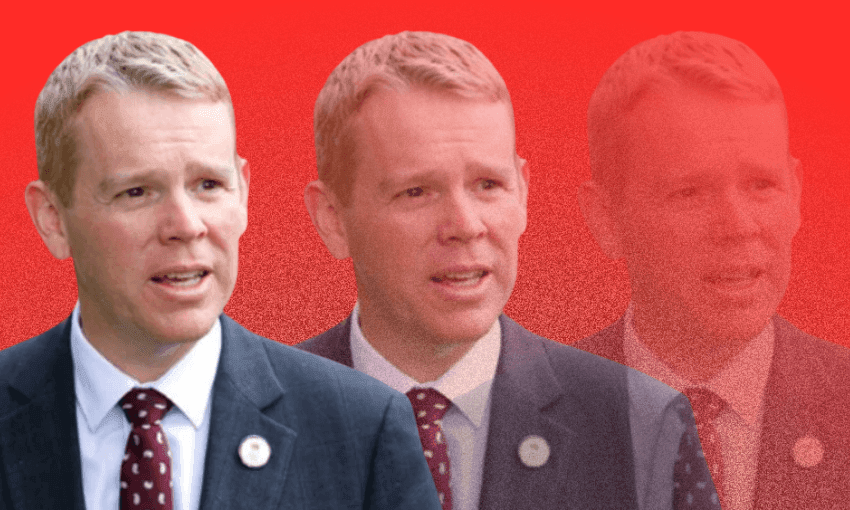



The party’s strategy seems to be staying very quiet and still as its opponents implode.
Chris Hipkins delivered a blistering prosecution of the government in his interview on RNZ’s Morning Report last week. The Labour leader told John Campbell that National had failed to deliver on its 2023 election campaign promise to get the country back on track. “They haven’t fixed the cost of living. Haven’t fixed the economy. Haven’t got Kiwis back to work,” he said.
It’s hard to argue. Unemployment is high and trending up, Moody’s just downgraded the country’s financial outlook and people are taking out mortgages to buy mince. But then Hipkins continued less convincingly. “They don’t have a plan to move the country forward. Labour does have a plan.”
“Does it?” asked Campbell, a note of incredulity in his voice. He’d spent the evening prior looking up Labour’s policy page to prep for the interview. The research mustn’t have taken him long. Only five policies are listed on the page and two of those – free doctor’s visits and a capital gains tax – are interlinked.
That lack of detail appears to be by design. ‘How to Disappear Completely’ is a song by Radiohead and also seemingly a tutorial delivered to every Labour politician that might have been tempted to speak in public before November. Their tactic for the better part of three years has been to stay extremely quiet and still while their opponents bicker amongst themselves and preside over an increasingly broken-feeling state of affairs. Hipkins has remained stubbornly vague when pressed for policy details, preferring to repeat the words “Labour’s priorities are jobs, health, homes and the cost of living” in response to almost any question on any topic.

Labour’s near-total lack of plans, ideas or possibly even thoughts has stymied its political enemies, who’d much rather be freaking people out about a possible future than defending a dire present. The frustration is evident in how National pounces like a pack of ravenous ferrets consuming a hoiho egg every time the party so much as hints at taking a position. Recently, Labour’s revenue spokesperson Deborah Russell gave a semi-positive response to a paper suggesting tax reforms. National’s new campaign manager Simeon Brown blasted out a press release and slew of social media posts arguing she’d accidentally released her real tax policy.
It’s easy to see why he’s so keen to wrench Labour’s policy positions into the material realm. Staying quiet seems to have served his opponents well. In the absence of detailed information on what it would actually do, Labour has climbed steadily in the polls, to the point it now appears to have a good shot of making the National-led coalition our first one-term MMP government. The Greens by contrast have served up a host of ambitious ideas for fixing our smorgasbord of societal crises, from inequality to energy insecurity, and been rewarded with a slow poll decline.
But there’s danger in a success story that stems almost entirely from failure. New Zealand is in the doldrums in an array of areas. Polls show we’re most worried about the cost of living, inflation, healthcare, housing and unemployment. If you boil it down though, our concern above all is change. We want out of an economic and environmental reality that feels increasingly untenable. In that situation, being a cloud of infinite possibility has suited Labour. When you’re weeping in a BP forecourt, a pitch that boils down to “something different to this” is a winner.
The ambiguity works until it doesn’t. Hipkins has promised to release more policy after the government releases its budget in May. If he doesn’t, or if that policy is as comically unambitious as it was when the party went to the polls in the 2023 election, Labour may struggle to retain its position as one of the credible options for people wanting to improve their cruddy current reality.
Even if the party remains on its upwards trajectory and succeeds in November’s general election, it will inherit and own a status quo almost everyone richly detests. As the UK Labour party has learned, being elected on the promise that you’ll change things only to persist with more of the same can become an existential disaster for a party. Without policies that actually give people jobs, fix the healthcare system, lower the price of housing and reduce the cost of living, the first one-term MMP government in history could quickly be succeeded by the second.