All the dropkicks who shouldn’t get to vote

Act says new electoral law changes only got rid of the 100,000 dropkicks who shouldn’t get to vote anyway. If we’re banning people from democracy for not living up to Act’s ideals, why stop there?
Paul Goldsmith made soothing sounds as the media raised questions about the government’s new suite of changes to electoral laws. The justice minister was banning election day enrolments and moving the deadline for enrolment back to the day before advance voting begins. Some would see that as a desperate power grab by a flailing, low-polling first-term government, aimed at disenfranchising a group of voters that traditionally wouldn’t support the current coalition parties.
But Goldsmith said that wasn’t the case. This was just about making sure votes could be counted in a timely manner. He noted it took three weeks to get a final result in the 2023 general election, and argued if it could take even longer in future if we leave things as they are now.
He might have got away with that too, if it wasn’t for the brave whistleblowers in his own governing coalition. As is often the case, Act arrived to cut through the government spin. Its leader David Seymour said the changes would only affect “dropkicks” who refused to get organised. Act’s justice spokesperson Todd Stephenson went further, announcing he was sick of layabouts turning up at a polling booth and having the temerity to vote for parties other than Act. “Democracy works best when voters are informed, engaged, and take the process seriously,” he said. “It’s outrageous that someone completely disengaged and lazy can rock up to the voting booth, get registered there and then, and then vote to tax other people’s money away.”
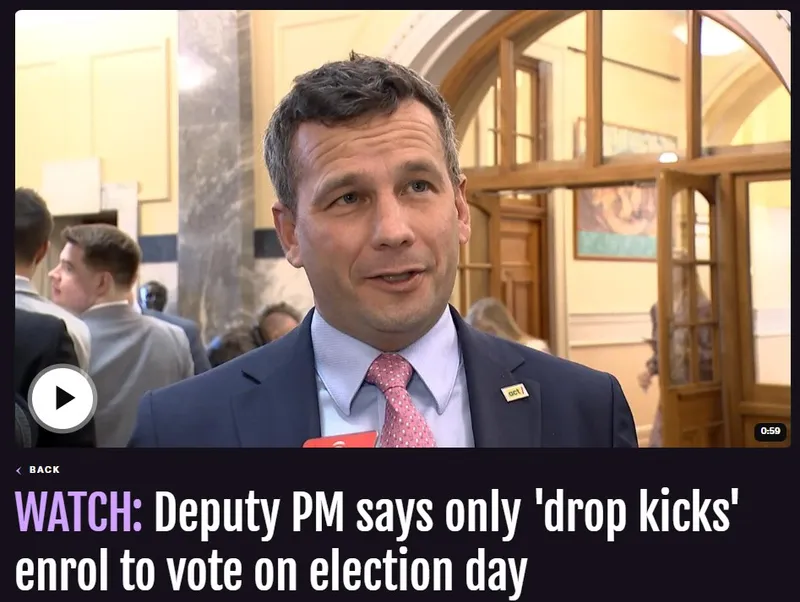
About 100,000 people registered to vote on election day in 2023, including industrious teens who’d just turned 18, or people who’d shifted house and hadn’t been able to register in their new address, and they might bristle at the news they’re dumbasses who can get wrecked. They might even feel a pang of indignation at politicians who are meant to be serving the public trying to carry out a morality test before deigning to give someone the right to have a say on their performance.
But Act has always been clear that it’s a big proponent of democracy. These whingers simply don’t understand that democracy functions best when we only let in the right voters, with an emphasis on right. The party’s problem is scale. If we’re going to disenfranchise people for not being engaged enough in politics, or thinking the wrong way about tax, why stop with just the election-day enrollers? The list of potentially politically disengaged and tax-friendly citizens is long, but it starts with…
Renters
Tenants are more likely to cast a special vote, due to the fact they often have to move when their landlord farts the wrong way and decides to evict them, and if they want democracy they should consider giving up flat whites and using the $60 saving to buy a house in the year 1955.
The poor
Low-income workers are also likely to be less politically engaged, potentially due to their working 12-hour days across multiple jobs. The same goes for people who are unemployed or underemployed. If they’d like to participate in elections they should enter a politically-minded workplace like a Canadian think tank, a large pharmaceutical company, or the gun lobby.
Actually, anyone who doesn’t have a large property portfolio
Almost the entirety of New Zealand’s economy and political system revolves around the country’s housing market. Given that, how could we expect anyone who doesn’t own at least two houses to properly engage in our democracy? The answer is we can’t. If nothing else, they’d be liable to do the unthinkable and vote to extend our tax system to include capital.
It’s probably best to restrict voting to people with at least $2 million in property assets, but preferably a suite of houses in places like Te Ānau, Sydney, Geelong, and Queenstown.
Women
Women may be politically engaged, but they’ve been guilty of voting disproportionately for parties that tax other people’s money away. It’s time to give their votes back to the men.
Young people
Sorry but they need to go too. Not only do the youth historically favour parties that might raise taxes every few decades; they’re not engaged. Only about 72% of people between the ages of 18 and 35 voted in the 2023 election, compared to about 85% of those aged 65 or over.
Māori
Only 70% of Māori voted, and fewer people voted in Māori electorates than in general electorates. Those figures could be due to higher levels of deprivation, or a sense of disconnection from a parliament that just voted to administer one of the most severe punishments in its history over MPs carrying out a haka. Either way, it’s more of that dreaded political disengagement, and by Stephenson’s rules it’s time to go from 70% turnout to 0%.
Wellingtonians
Yuck. Not only do Wellingtonians vote left, but thanks to decades of locking their stock of decaying villas in a 1940s time prison, they’ve got relatively low home ownership rates.
Voters should come from a blue electorate with plenty of propertied citizens like Southland.
People who read fiction
Woke. In dreamland. The perfect voter wouldn’t be able to name a single New Zealand author.
Anyone but the perfect voter
By applying these filters, we should be able to weed out lazy, disengaged and otherwise undesirable people from our democracy. People wanting to vote here should have the decency of being a middle-aged Pākehā man from the Southland electorate with a large property portfolio, a hatred of tax, and a complete inability to even think of a book. In other words, they should look like this…
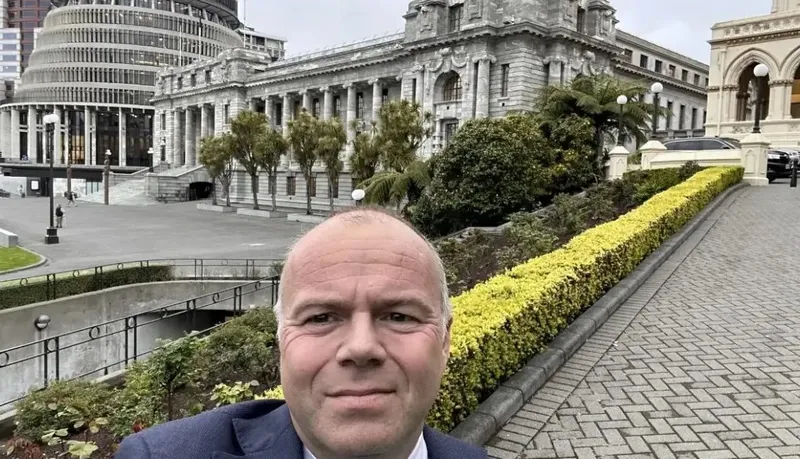
It’s time to get rid of the riff-raff and restrict voting to the distilled essence of democracy. If these electoral law changes are implemented, we’ll truly have a system that adheres to the ideal of one person, one vote. That person with one vote will be Act MP Todd Stephenson. He’ll be in charge, and with that we’ll have eliminated any possibility of dropkicks showing up on election day hoping to have a say.

Hayden Donnell
Hayden Donnell is a senior writer for The Spinoff. He previously worked at RNZ, TVNZ and the New Zealand Herald, alongside other media companies that have since closed down or been renamed. His primary passions are local politics and the Big Fresh animatronic fruit and veggies.


