How an anti-rates lobby group tried to influence a breakaway council budget

Clockwise from top left: John Gillon, Josh Van Veen, Bo Burns, Wayne Brown, John Watson and Greg Sayers (Image: The Spinoff)
Wayne Brown is accusing a group of councillors of secretly pushing the agenda of the Auckland Ratepayers’ Alliance. They strongly deny the claim.
An anti-rates lobbyist provided strategic advice to some Auckland councillors as they came up with a plan to torpedo mayor Wayne Brown’s budget, council documents show.
The mayor is now accusing the councillors involved of “secretly pushing” the agenda of the Auckland Ratepayers’ Alliance, an offshoot of the Taxpayers’ Union, and urging them to declare their relationship with the group.
But the councillor who led the effort to change Brown’s budget said he had no connection with the lobby organisation and everything he put forward to the council was his own work.
Auckland Ratepayers’ Alliance spokesperson Josh Van Veen, who was the mayor’s deputy chief of staff until late 2025, also insisted he had been transparent and upfront, saying what he tells councillors is no different to what he says publicly.
“We advocate for reasonable rates and sensible spending. It is bizarre and hypocritical for the mayor to go after councillors who engage with us given Mr Brown worked closely with the Ratepayers’ Alliance as a candidate in 2022,” he said.
Brown’s annual plan, which included a 7.9% rates rise, passed by 14 votes to seven at a governing body meeting on May 26.
But it had almost been upended earlier in the day by a group of eight councillors who backed an alternative plan for a 5.9% rates rise.
Correspondence released to The Spinoff under the Local Government Official Information and Meetings Act (LGOIMA) shows the Auckland Ratepayers’ Alliance supporting and trying to play a role in crafting that competing proposal.
Van Veen provided advice and council intel, including a specific list of financial modelling documents he suggested the councillors should get hold of. He also seeded ideas for cuts and proposed defences to anticipated lines of attack.
His budget correspondence with the breakoff councillor group began with him forwarding them Ratepayers’ Alliance press releases about high public opposition to Brown’s proposed rates rises.
On April 23, roughly one month out from the budget debate, Howick’s Bo Burns asked for his mobile number for a quick chat.
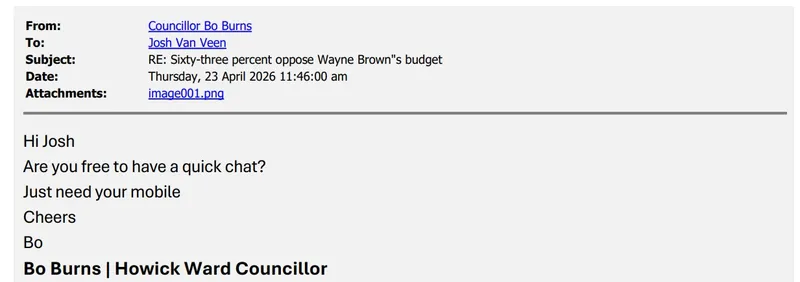
From there, a more collaborative relationship seemed to develop.
On May 20, Van Veen emailed Burns and her fellow councillors, North Shore’s John Gillon, Albany’s John Watson, Rodney’s Greg Sayers, Howick’s Maurice Williamson, Albert-Eden-Puketāpapa’s Christine Fletcher, Waitematā’s Mike Lee and Waitakere’s Ken Turner with a lengthy, detailed list of potential ways to push back on council staff backing a 7.9% rates increase.
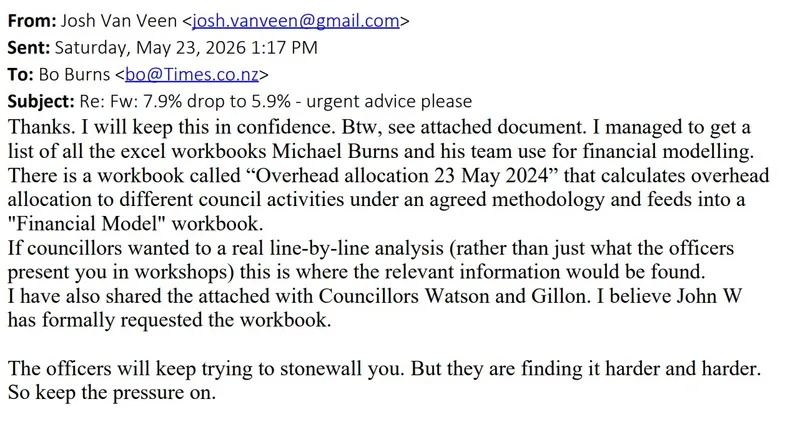
Two days later, Burns forwarded Van Veen her correspondence with council officers, including chief executive Phil Wilson, adding the proviso that it was “not to be shared”.

“I’ll keep that in confidence,” said Van Veen, before pointing Burns towards a 2024 workbook used by the council’s finance strategy team which he said would allow her to carry out “a real line-by-line [budget] analysis” and skirt what he described as stonewalling from council officers.
Defending a depreciation pause
The alternative budget councillors eventually put forward was premised on pausing council’s policy of fully funding depreciation, saving it millions of dollars but increasing its financial risk.
Van Veen sent a number of emails advocating for that pause, including one to Burns attaching a paywalled National Business Review article.
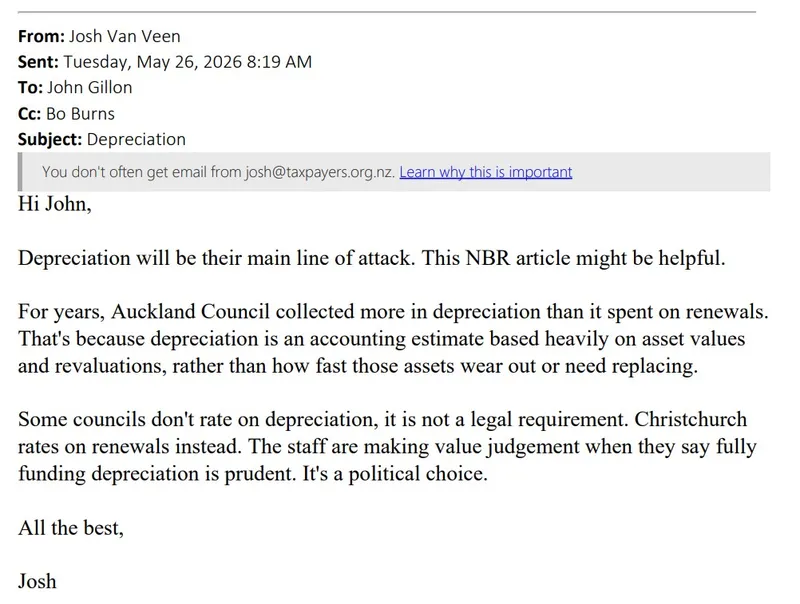
On the day of the budget debate, Van Veen sent an email to Gillon with Burns copied in. It said “depreciation will be their main line of attack” and suggested a potential defence.
“Some councils don’t rate on depreciation,” he said. “Staff are making value judgement [sic] when they say fully funding depreciation is prudent. It’s a political choice.”
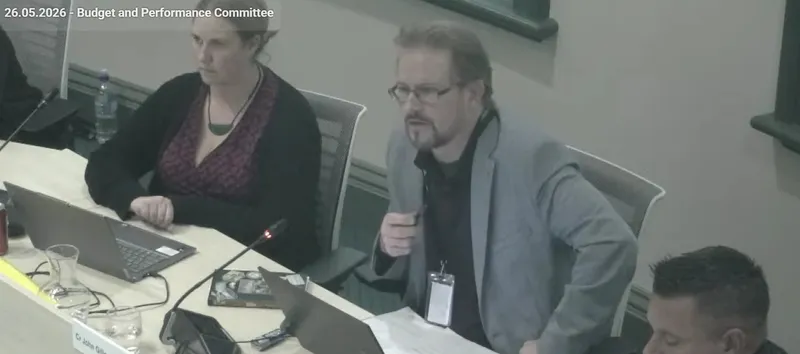
Gillon went on to echo that talking point in the debate, telling colleagues the strategy of fully funding depreciation was a choice made before his time and that there were alternatives. His budget amendments were seconded by Burns.
In a statement to The Spinoff, Gillon said Van Veen’s email was unsolicited. He said he only saw it after the annual plan meeting and didn’t respond.
“There has been no collaboration, no influence, no co-operation between myself and any staff member of the Auckland Ratepayer Alliance [sic]. I have already assured the mayor of this. The Auckland Ratepayer Alliance appear to have supported the stance I took, as did a great number of the public.”
Van Veen was right that opponents would hone in on the alternate budget’s approach to depreciation.
Gillon faced withering questions over the possible impacts of failing to fully fund it, with council’s finance chief Ross Tucker telling councillors it could trigger a credit downgrade.
Councillors, including conservatives like Manurewa-Papakura’s Daniel Newman, said that downgrade risk was the biggest factor in them ultimately voting with the mayor.
Following the vote, the Auckland Ratepayers’ Alliance issued a press release calling him and others including deputy mayor Desley Simpson “so-called centre-right councillors”. Van Veen also wrote a missive to supporters referring to that group as “gutless wonders”.
Rodney councillor Greg Sayers, the budget and performance committee chair, initially voted with the dissenting group and then ultimately abstained on the mayor’s budget after they failed to get a majority.
Sayers escaped criticism from the Auckland Ratepayers’ Alliance. However, the mayor is understood to be unhappy with one of his own committee chairs backing significant amendments to his budget.
A lobbyist with council connections
Brown told The Spinoff he saw the Auckland Ratepayers’ Alliance’s efforts to influence the councillors who opposed his budget as part of a campaign to discredit him by a former employee.
Van Veen worked in his office from 2023, starting as a communications adviser and rising to become deputy chief of staff before leaving following the 2025 local elections.
Some of his correspondence hints at inside knowledge of the council, including his understanding of which financial documents they should seek.
Brown said he “hopes” Van Veen wouldn’t use information he received during his time in the mayor’s office in his new role. “If that were the case, he would be in breach of employment obligations and acting in bad faith.”
Van Veen said he had never breached confidentiality, misled, or misused information. The financial workbook he pointed Burns toward was discovered through the LGOIMA process, he said. “I had no prior knowledge of the document.”
Brown has a history of feuding with the Auckland Ratepayers’ Alliance.
When it asked him to sign up to a pledge to keep rates at the rate of inflation before the 2025 local election, he sent back a two-word reply: “fuck off”.
In his statement to The Spinoff, he called the group “feral”, accusing it of misunderstanding large budgets and disregarding facts. He said the public should be concerned if councillors were in “cahoots” with the group without declaring it up front. “If councillors are asking a list of questions prepared for them, I think it’s fair to their colleagues to disclose who is pulling their strings.”
Gillon rejected that characterisation. “I wrote the amendment myself; sent it to staff for advice and subsequently tweaked it; discussed it with a number of councillors (some of whom supported it, some who didn’t); circulated it to all committee members,” he said.
Council business, private email
Some of the documents sent to The Spinoff indicate councillors are using private email addresses to discuss council business.
Burns repeatedly forwards emails between her business address at her company Times Media, which runs The Times newspaper, and her council address.
Her correspondence with high-ranking council officers on the budget was sent to her Times address before she forwarded it on to Van Veen.
Though Gillon said it was unsolicited, Van Veen’s email to him on May 26 went to his personal address, with Burns’ copied in on her Times address.
It was included in the LGOIMA documents sent to The Spinoff after Burns forwarded the email from her Times email to her council address.
Councillors are allowed to carry out council business via private email but that information should still be accessible under the Local Government Official Information and Meetings Act.
Update, July 31: After The Spinoff’s story was published, Bo Burns sent through answers to our questions, including: “Any emails from Josh Van Veen or the ARA were unsolicited and did not determine my views or voting. The fact that an organisation supports a position I hold does not mean they influenced it.” She said she did not share any confidential council information with Van Veen, and “completely reject[ed]” the mayor’s claim that the ARA was “pulling councillors’ strings”. On the use of her non-council email account, she said: “I occasionally receive correspondence relating to council matters on different email accounts. Where correspondence is relevant to council business, I forward it to my official Auckland Council email so it forms part of the appropriate council record. That is exactly what occurred here. It is a transparent process, not an attempt to avoid scrutiny.”
Update, August 25: Auckland Council withdraws certain statements made to The Spinoff concerning Josh Van Veen, which were included in an earlier version of this article. It apologises to Van Veen for any suggestions in those statements that Van Veen breached his employment obligations, intentionally misrepresented matters, or improperly used his position to pursue a personal agenda. Auckland Council also apologises to Van Veen for any damage such statements may have caused to his personal and professional reputation.

Hayden Donnell
Hayden Donnell is a senior writer for The Spinoff. He previously worked at RNZ, TVNZ and the New Zealand Herald, alongside other media companies that have since closed down or been renamed. His primary passions are local politics and the Big Fresh animatronic fruit and veggies.


