Unity at last: the Opportunity Party is being hated on by both left and right

Unity, though not necessarily the kind she wanted. (Image: Tina Tiller)
Qiulae Wong has called on our political parties to stop bickering and pursue common goals. It’s happened, but maybe not in the way she envisaged.
Ever since it polled 4.6%, every media organisation in the country has been screaming “what the dickens is the Opportunity Party?” in unison. Despite the seeming confusion, its leader Qiulae Wong has been clear about her party’s priorities. It wants tax reform, investment in clean energy and most of all, a change to our toxic political culture. It’s easy to see why. Our politics is riven with bickering, white-anting and open disgust, and that’s just the governing coalition. Wong has made “unity” a bottom line and delivered speeches lamenting the “politics of fear and division”.
Her overarching message has been that politicians need to stop obsessing about what divides them and unite around their common goals. It’s an admirable call, albeit one hampered by the fact Opportunity hasn’t possessed any political power of real influence. At least, that is, until now. Somehow, despite the obstacles in her way, Wong has succeeded in brokering an unusual political consensus. Lately, left and right have united around hating on the Opportunity Party.
The critique from the left has been twofold. First, Opportunity has stolen their ideas, and second, it’s the Act Party in disguise. Green co-leader Marama Davidson said some Opportunity policies were “awesome”, mainly because they were her own party’s repurposed in centrist clothing. “There is nothing that they add to the solutions that we aren’t already offering.”
That message is slightly at cross purposes with others from the left. Labour leader Chris Hipkins argued the party still needs to “figure out exactly what it is they stand for” before being taken seriously. In viral posts on social media, others have pointed out Opportunity’s unusually TOP-down structure, which saw Wong selected as leader following a recruitment process, and the fact that in ex-porn tycoon Brian Cartmell, it shares a donor with Act, National and NZ First.
It’s true Wong got her job after submitting an application to her party’s board. It’s not clear that Opportunity’s process is less effective than the ones employed by our existing parties, which generally leave candidate selections to either Winston Peters or a handful of local devotees who have been driven to the brink of madness by internecine battles over minor points of ideology.
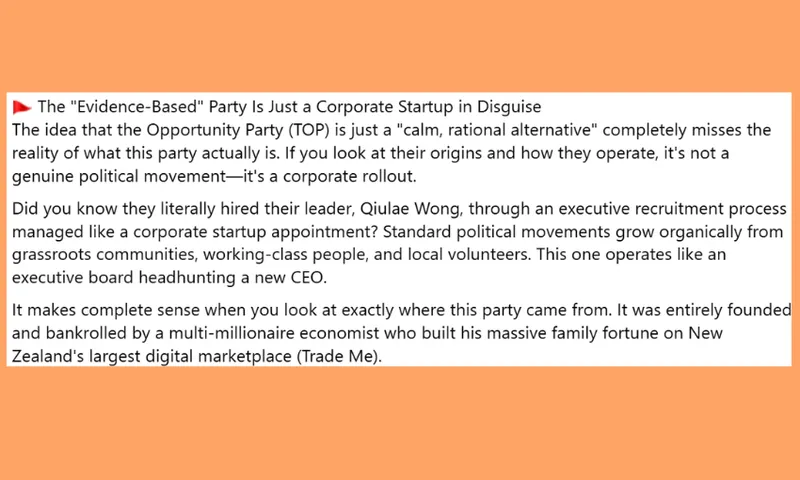
The criticism from across the aisle has been pretty much the equal inverse. In similarly widely shared posts, right-leaning commenters point to links between Opportunity and left-wing parties, noting among other things that former Labour MP Iain Lees-Galloway is its general manager. On Newstalk ZB, Heather du Plessis-Allan has called Opportunity “a radical left-wing party with a land tax and a universal basic income, fronted by a nice lady from Auckland”.
In contrast to Davidson, who accused Opportunity of copying Green policy (good), Act’s David Seymour accused it of copying Green policy (bad). Prime minister Christopher Luxon said he hadn’t given the party any thought before immediately launching into a detailed list of its policies. In a bold rebuke to recipients of Working for Families and NZ Super, he reserved particular disdain for the party’s universal basic income proposal, saying it would make “everyone a beneficiary”.
By carrying out a careful semiotic analysis of these comments, it’s possible to distill them into a single message, which translates as follows: “Oh shit oh no don’t vote for them vote for me.”

Even so, everyone talking about Opportunity has a glimmer of a point. Davidson is right that a lot of its priorities echo the Greens. NZ First’s Winston Peters accusing it of being a “party of consultants” may not be wholly true, but it sure stings. National is correct to say that Opportunity’s platform, if enacted, would represent profound change for New Zealand. A land tax and a universal basic income would reshape our government’s budgets. The party, at least when it comes to policy, doesn’t adhere to the incrementalist, managerial centrist formula.

But in being hated by the left for being corporate shills and by the right for being communists in disguise, Opportunity has one aspect of centrism down pat. Lately, that intoxicating combo has seen several centre parties around the world either getting turfed out of power or descending into turmoil and civil war. Opportunity, in marrying its “adult in the room” rhetoric with an actual policy agenda, may be able to chart a different course. First though, it has to make it to November without being shanked by every other political movement in the country.

Hayden Donnell
Hayden Donnell is a senior writer for The Spinoff. He previously worked at RNZ, TVNZ and the New Zealand Herald, alongside other media companies that have since closed down or been renamed. His primary passions are local politics and the Big Fresh animatronic fruit and veggies.


