Is there any way to satisfy the ever-growing demand for Queenstown housing?

A view of Queenstown from the pine forest around the gondala (Image: Shanti Mathias)
More than a quarter of houses are empty, yet stable housing is out of reach for many residents in ever-booming Queenstown.
It’s only 7am in Queenstown, but on the hills around the lakeside town, building is already getting started. An earth mover flattens a patch of soil. More timber is nailed to a frame. Around the construction is evidence of who stays here: rental cars, building company trucks and lockboxes like limpets on houses, waiting for the next Airbnb guest to arrive.
“Queenstown issues more consents per capita than anywhere else,” says Lisa Guy, a Queenstown Lakes District councillor running for re-election in the Arrowtown-Kawarau Ward. In the year to March 2025, Queenstown-Lakes District Council approved 32 new dwellings per thousand people. By comparison, the average is 16.5 in Selwyn, another fast-growing area, and 10.5 in Auckland, down from a high of 19 in 2022.
Despite the building, the empty Airbnb suburbs remain. “Our demand outstrips our ability to ever supply enough housing,” says Darren Rewi. He is a mayoral candidate and the CEO of Mana Tahuna, a charitable trust that provides pest control, social services and connection between Māori in Queenstown. On census night in 2023, 28% of houses were empty, not even being used by short-term visitors, a sign of how many holiday homes in Queenstown go unused.
For people who live in Queenstown permanently, the result is obvious: unstable, expensive housing. Ruth Gutenberg moved to Queenstown from Germany in 2016. In her first nine months, she moved three times: initially into a temporary room provided by her tourism employer, then into two houses where the head tenants said she couldn’t have people over, and didn’t provide a tenancy or flatmate agreement. By 2023, she was living in the suburb of Kelvin Heights, paying $700 a week for a three-bedroom house. But after the house was sold, she had to go flat hunting again. “I had nightmares thinking about how to find a new house with the dog – I would wake up feeling upset,” she says. When she and her partner eventually managed to secure a tenancy for a suitable house, she was paying $1,200 a week. “All of my partner’s wages go into our housing, and my wages cover our living expenses,” she says. The costs make it difficult to save, or even to consider buying a house. Her landlords still use most of the garage to store their stuff, and insist on accessing the house for personal rental inspections whenever they’re in town, with limited advance notice.
Queenstown Lakes District Council has made some attempts to regulate Airbnbs and other short-term visitor platforms. Resource consent is required if a dwelling will be used for short-term visitor accommodation for more than 60 days, and if the building is used for more than 180 days, the owner must pay full commercial rates.
The jury is out on whether the Airbnb rules are making a difference to the housing shortage. “We have enough homes – it’s just that we can’t access them all,” says Julie Scott, the CEO of the Queenstown-Lakes Community Housing Trust, which was set up and is partially funded by the council. “There are real opportunities when council works through plan changes or resource consents for a new subdivision.” Still, changes like including Airbnb in the resource consent regime and making bookings subject to GST add up, she says. “It’s creating more of a level playing field between throwing your home on Airbnb versus renting it to a long-term family, and seeing it as a good investment to have people in there permanently.”
“Developers often make vague promises about affordable housing, but there are no rules in place to really resist speculation. The minor restrictions which have been proposed [on Airbnbs] don’t seem to be monitored or enforced,” says Simon Edmunds, a Queenstown-based organiser with Unite Union. For many of the migrant worker families in his union, looking for housing is “a total shitshow”. “Airbnb and the empty houses have really intensified what was already a very restricted housing supply for renters.”
The limited number of long-term rental houses and the high number of seasonal and migrant workers makes Queenstown a breeding ground for unscrupulous landlords. Earlier this month, a Queenstown landlord was fined $81,000 on behalf of 117 tenants, who had been crammed into garages and rooms where it was impossible to fully stand up, without meeting basic safety requirements like fire escapes and ventilation.
For others, the housing needs are an opportunity. Housing provider Simplicity Living announced in August that it had bought land in Queenstown to build up to 600 rental homes, with a rent-to-buy scheme in place. “What Simplicity are doing is an ideal example of higher density in Queenstown,” says Guy.
But along with the houses going in comes a need for other infrastructure. With new subdivisions in Shotover Country and Ladies Mile, where the Simplicity project and others are under way, “we need a transport plan, mass rapid transit or ferries”, Guy says. Congestion is a major issue in Queenstown; the series of roundabouts on the highway through Frankton are slow-going all day, and the number of tourists means that traffic is not confined to commuter hours.
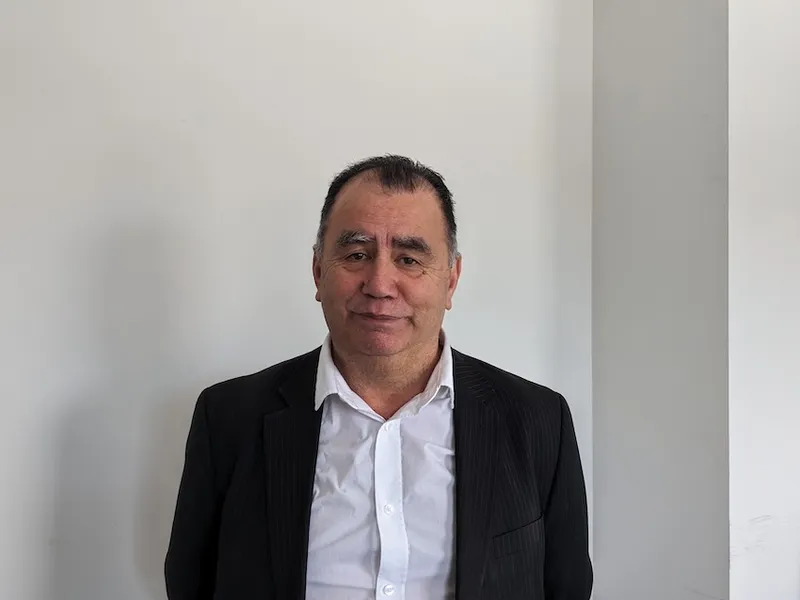
“The government just wants to pour people into this district – because the more visitors there are the better it is for the GST take they’re going to get,” Rewi says. “It doesn’t matter that we haven’t got the infrastructure or we can’t accommodate them or we don’t have the staff to support them.” To him, Queenstown’s housing struggles are linked to the government not sharing enough of the International Visitor Levy and GST gains from Queenstown with the residents who bear the cost.
While supportive of new developments like Simplicity’s, council candidates want better infrastructure too. “There’ll be more cars on the road, more pressure on water, because the infrastructure just isn’t there,” says Jon Mitchell, an emergency response specialist who is running for councillor in the Queenstown ward, after an unsuccessful mayoral run in 2022.
Many people paying a large portion of their income on housing creates other cost pressures, and Queenstown is not a cheap place to live. “We’ve got kaumātua who get an energy bill of over $2,000,” says Rewi. If people are living in a cold house, he says they go and buy cheap heaters, instead of asking the owners to improve the quality of the housing. “In reality, it just sucks power out.”
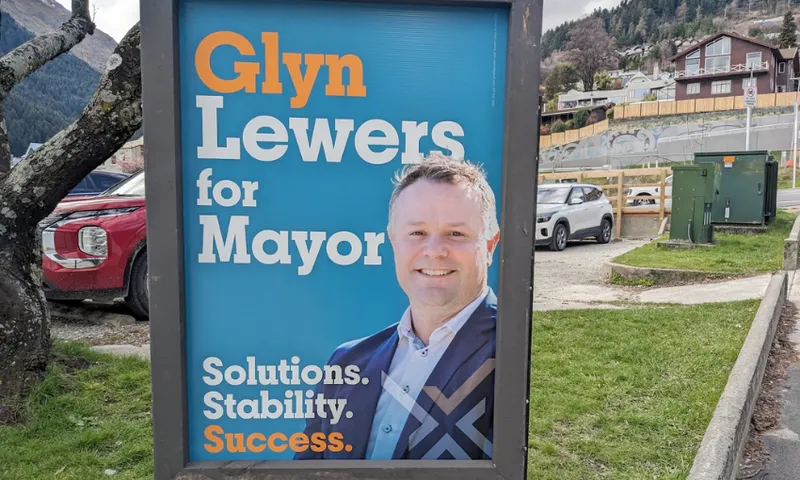
Through the consenting process, the council has some influence about where housing is built, and what infrastructure can go along with it – and funding for that infrastructure is a key part of the negotiation for Queenstown and Central Otago’s regional deal. “We have had a series of councils enable growth without managing the consequences of that growth seriously,” says Mitchell. He disagrees with current mayor Glyn Lewers’ line that the council has to process all the consent applications it receives, without control over the outcome. “Where there are vested interests, there are lawyers who are willing to appeal district plans, putting councils on the back foot.” For instance, Mitchell says, developments around the Kelvin Heights suburb of Queenstown shouldn’t be allowed to place consent applications until water and transport infrastructure, like another river crossing, is there to support building.
Low local election turnout also affects what work the council prioritises. Many of the people most affected by housing shortages – migrant workers, Māori, young people and renters in general – are those who don’t vote in the local elections. Many migrants don’t know that if they are on an indefinite work visa and have been in the country for 12 continuous months, they are eligible to vote. “Queenstown owes the migrant community here its existence,” says Edmunds, the Unite organiser. “Whether they can vote or not is beside the point. They are the people who live here. They are the people who make the city work. They should be part of the equation when it comes to decision making.”
But while some councillors make an effort to connect to migrants – Rewi’s organisation Mana Tahuna supplies food parcels to migrants in need, among others, and Rewi has made the effort to attend migrant worker hui hosted by Unite and the Greens – many don’t. Instead, Edmunds says, the ultra-wealthy have an outsize impact on Queenstown politics. “The discourse in Queenstown is driven by personalities with large amounts of money.
Rod Drury, former Xero executive, has donated $10,000 to Lewers’ re-election campaign. Rewi refused a similar donation from Drury. The regional deal proposal framework includes mention of using private healthcare for public services and a gondola as mass transport – both projects Drury is involved with. “If he wants to be involved, he should run for office,” says Mitchell.
What is working?
At the edge of Arrowtown, there’s a more positive glimpse of the Queenstown area’s housing future. The main part of the historical village adheres to guidelines that keep the area looking a little like it did when it was full of professional gold miners, instead of tourists who have paid to rent a pan and swish it around in the creek. Even the Night ‘n’ Day has toned down its signage.
On a piece of land given to the Queenstown Lakes Community Housing Trust by the council, a range of tidy terraced houses are being built. There are options for everyone: one- and two-bedroom dwellings for the elderly, bigger homes with backyards, and some land set aside in case it works in the future to build multi-storey apartments here. Some of the houses go to social housing, others to rent-to-buy schemes, affordable rentals and assisted ownership. The land remains owned by the trust, making houses much more affordable than the rest of Queenstown: a three-bedroom house (with a 100-year lease on the land underneath) sells for about $477,000, compared to the average house value of $1.6m.
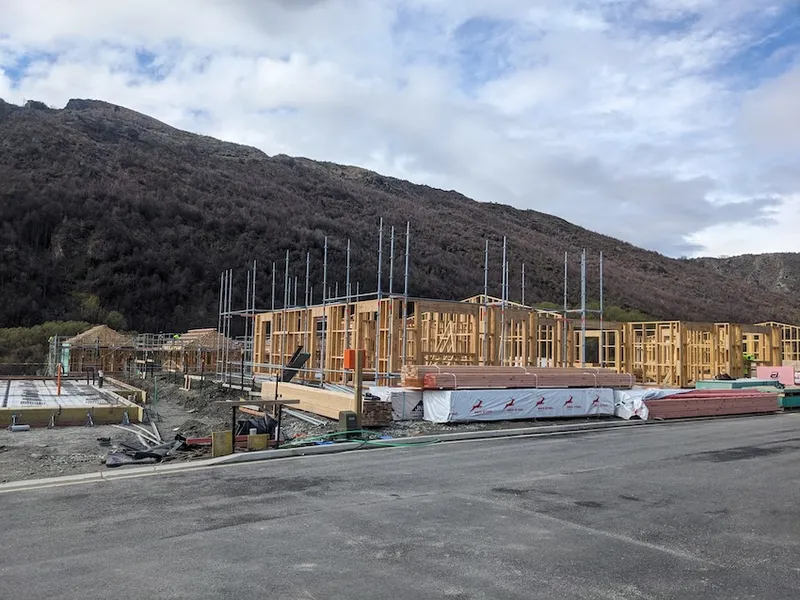
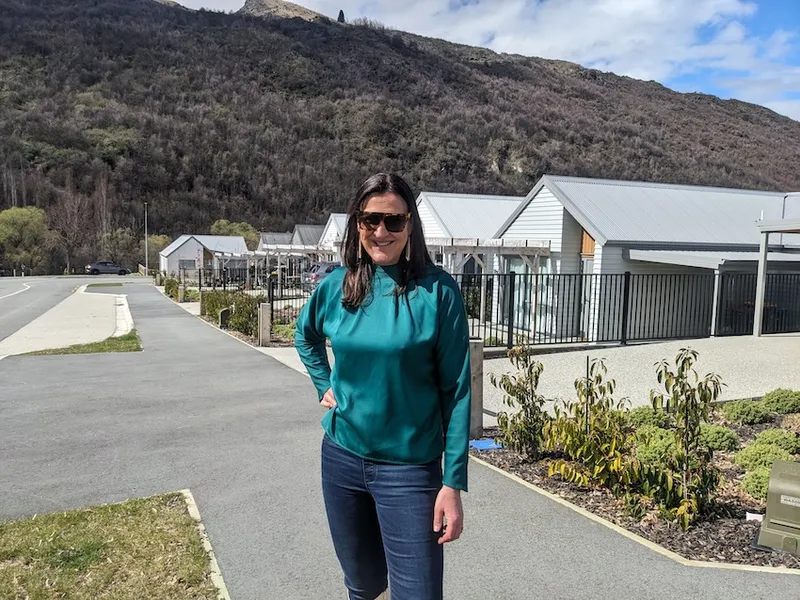
When completed, the Tewa Banks development will have 68 houses, says Julie Scott, the trust’s CEO who is showing me around. There are 1,500 people on QLCHT’s waiting list, all of who meet the requirements: a maximum household income of $130,000, at least one person in employment, not already owning property. The development alone isn’t a solution for everyone on the waiting list, but the trust has several other developments under way. Everyone The Spinoff spoke to for this story had glowing praise for the housing trust. “It’s just great – my one complaint is that with the new houses going in, I can’t see the Remarkables from my kitchen window to see what the snow’s doing,” says Carla, one of the people who have moved into the completed Tewa Banks houses. Her sons, on school holiday, are biking around outside. Carla and her family moved back to New Zealand during Covid, staying in an unoccupied Airbnb apartment, moving around before getting to move into their housing trust home. While much of the area is still under construction, neighbours are already getting excited to decorate for Halloween and Christmas. “I’ve got so many memories of coming here as a kid – it’s cool to have that for my kids, too,” she says.
It concerns Scott that all of the central government’s housing funding goes to social housing, instead of social housing as well as initiatives like affordable rentals and rent-to-buy. “Whilst that arguably hits the highest need, the gap is widening between those who aren’t on the housing register but have no way to get into free market properties and can barely afford rent.”
Scott and the housing trust particularly advocate for inclusionary zoning – a policy by which housing developers set aside a portion of their development for lower-income households. “You have these pepper-potted community housing projects all across the district where a new subdivision has occurred,” Scott says. But it has to be done carefully, says Mitchell, recalling similar efforts in tourist towns like Aspen in the US. “If houses are on the market for cheap, they’ll just change hands for more.”
For nearly two decades, this has happened on a voluntary basis in Queenstown, with developers making a deal with the council. “We have some developers that understand this is what it takes to build a workable future,” says Guy.
“But the council can’t require inclusionary housing,” Scott says. She’s hopeful that a regional deal could make it possible for the council to mandate that affordable housing is set aside. The results could be interesting: a new development in Cardrona, between Queenstown and Wānaka, set aside at least eight sections for the trust. The subdivision is aimed at high-end holidayers keen to own a ski chalet or at least a “luxury rental” – but the only permanent residents now may be two families from the trust’s long list of moderate-income households seeking a home. “It’s crazy – but kind of cool we are contributing to the community in a different way,” Scott says.
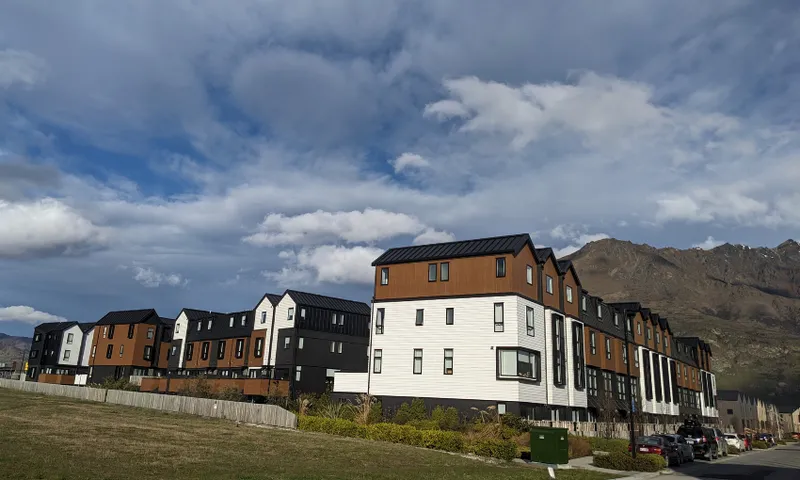
Many in Queenstown also support density, particularly in Frankton, the area around the airport, five kilometres from the main town. Well-connected by bus, with several big supermarkets and the high school, central Frankton already has some medium-density housing, and Rewi and Guy are among the candidates who would like to see more houses there.
When the housing trust first started looking at the land for Tewa Banks, it planned to put 24 houses on 3.4 acres. A decade later, norms have changed enough to nearly triple the initial approximation. “I think that we have a role to play leading the way, educating people on density and that higher density is acceptable,” Scott says.
“We need to develop nodes of intensification,” says Rewi. He would also support a more sophisticated system of developer contributions, as seen in Christchurch, so that the companies profiting from the insatiable demand for Queenstown property are paying for its future, instead of heaping the bill on council.
Housing in Queenstown remains some of the most expensive in a country of expensive houses. But it’s not quite as bad as at the heights of 2022 and 2023, when all the tourists had come back and hundreds of workers were sleeping in their cars. “You’ve gotta have some hope. When I look out my window it’s not so bad out there,” says Guy. She’s hopeful that with a new RMA system, the central government giving the council more legislative tools and improved infrastructure, inaccessible housing doesn’t have to be etched in Queenstown’s future. The diggers will definitely keep digging, the concrete will continue being poured, and migrant workers will keep coming to clean the Airbnbs after the 11am checkout time. Whether those workers will also be spending the majority of their income on rent remains to be seen.

Shanti Mathias
Shanti is a contributing writer at The Spinoff with a focus on Christchurch and the South Island. Email her at shanti@thespinoff.co.nz


