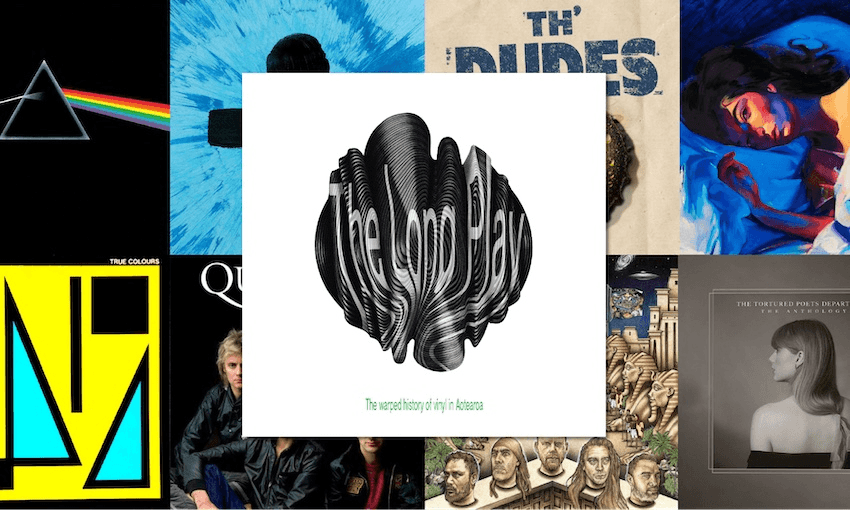



The last time our music charts were dominated by vinyl, David Lange was prime minister. Now a new chart tells the story of the shocking renaissance of vinyl in Aotearoa.
Calculating the charts used to be the answer to a very simple question: what music sold last week? We had singles, we had albums – but that was it. With the arrival of the internet it would become more complex: how to weigh the sale of an mp3, versus a CD or LP? Or the popularity of illegally downloaded music?
Then streaming and social came along and exploded all that for good. Now we have near-perfect realtime data on what people are listening to, from what amounts to the entire history of recorded music, along with a promotion platform which means a song from decades ago can be made wildly popular today. It means Paul Kennedy, New Zealand’s chart guru, has to blend and weigh dozens of sources to come up with our modern charts.
It’s fascinating. It’s also very challenging. This is because the charts were originally meant to be a place that concentrated on what was new and bought. What people ultimately listened to was their business: vast and unknowable. Now it’s the whole game. It has meant new music struggles to gain distribution, because streaming is dominated by what’s known as “catalogue” in the industry – that is, music more than 18 months old. New Zealand was an early adopter in creating catalogue charts a couple of years ago, which helped take the edge off the issue, without solving it.
Fundamentally, it’s a challenge which cannot be intellectually overcome in an environment where the vast bulk of people rent access to music, rather than buying individual units of it.
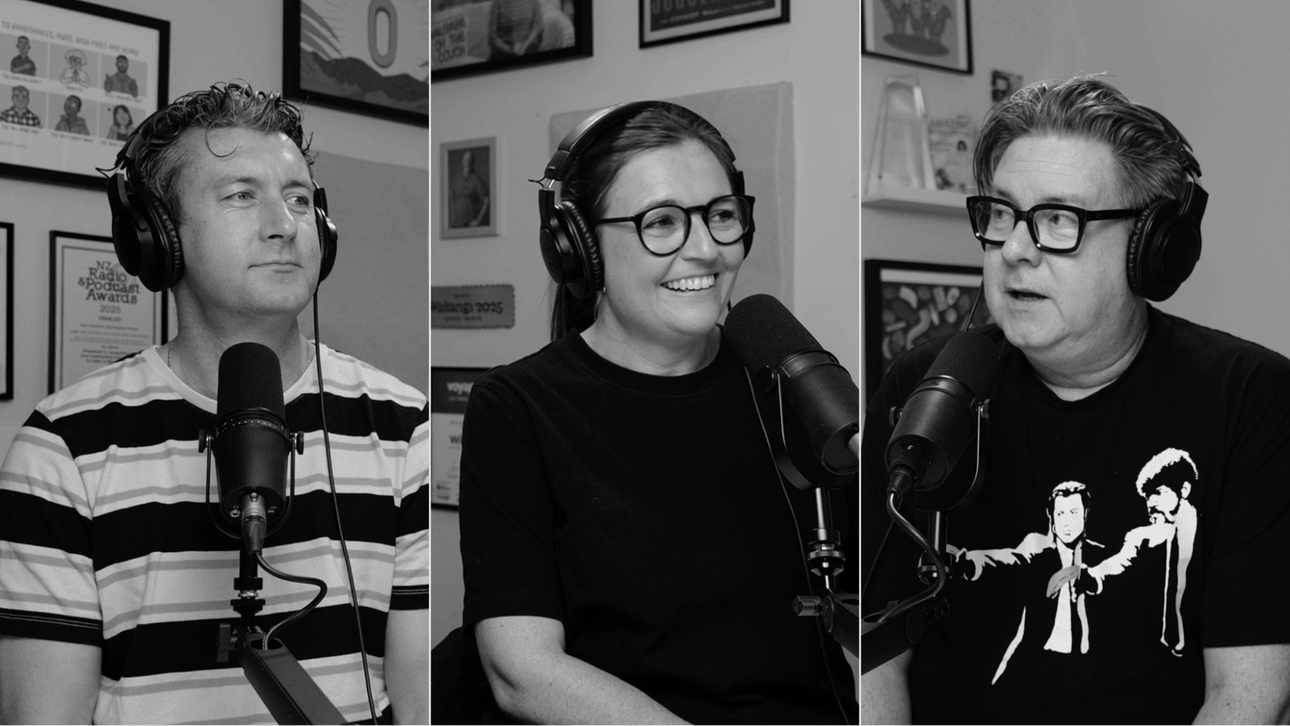
Only, there are still some people who buy music. In fact, far from disappearing, that group has exploded in size, as one format in particular has staged a very unlikely comeback. Vinyl LP sales have increased almost 100-fold over the past 20 years, a phenomenon we document on The Long Play, a new podcast hosted by Charlotte Ryan and co-produced by Daylight and The Spinoff. For the first time in a very long time, vinyl now makes up a meaningful proportion of the album charts.
Yet because modern charts now include streaming data from the likes of platforms like YouTube and Spotify, as well as physical sales, we have never known which artists and albums were driving this change. Until now.
Recorded Music New Zealand, which assembles and administers the Aotearoa Music Charts, did a major piece of data analysis for The Long Play. Exclusively revealed in the series, Kennedy and RMNZ have put together charts which tell the story of the resurgence of vinyl as a format. The charts cover a vast 22-year span, thus taking in the doldrums, during which vinyl was confined to a precious few indie record stores, and the stunning revival, which sees records take up significant chunks of JB Hi-Fi’s floor space.
Here we bring you the debut of these charts, across both individual titles and for artists, both local and international. Below you’ll find the charts, and my observations on the story they tell.
Top vinyl sellers – overall
The vinyl revival would be much diminished without the contribution of Taylor Swift, one of the most popular artists in history. She has incredibly devoted fans, and plays them like a Fender, releasing dozens of variations which pump her sales beyond the already giddy heights they would naturally reach. She is the best-selling artist on vinyl of the last 22 years, a fact which will shock no one.
But it does feel instructive that she takes three of the top five spots, each of them albums released in the past three years – one of those a re-recording! The best-selling album of the past 22 years was released less than 18 months ago. Think on that. Curiously she only has three more entries in the top 50, which really shows just how recent a phenomenon the vinyl revival is, and how much her fandom soared in the post-Covid era.
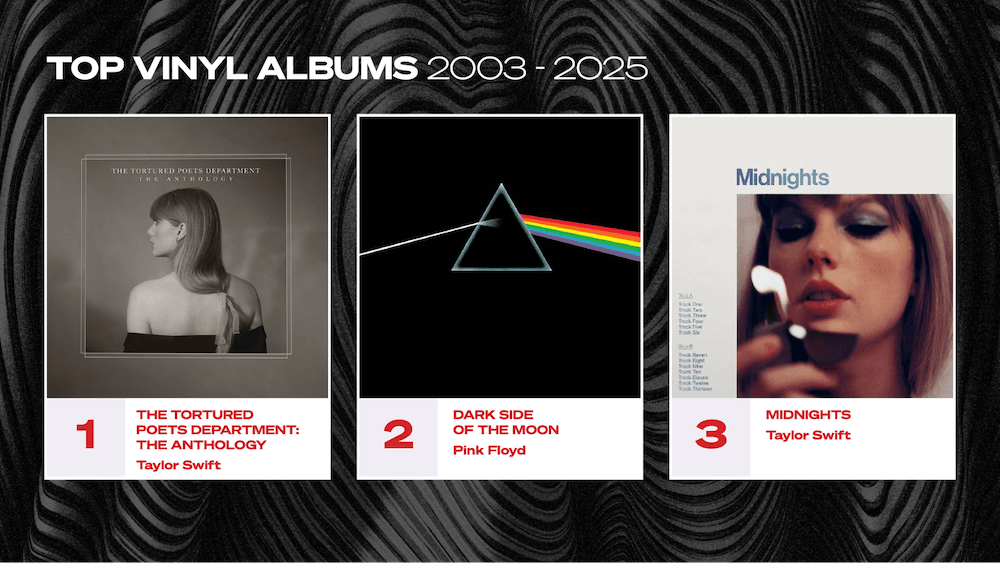
Look deeper into the chart and four distinct themes emerge: heritage classics, pop fandoms, artists with intense cult followings and beloved local acts. The first basket is headed up by Queen, David Bowie and Pink Floyd, whose Dark Side of the Moon might be the longest-charting album across all formats in history. The fact that this trio outrates the Beatles and Rolling Stones suggests that the 60s are giving way to the 70s as the apex decade for cultural nostalgia.
The next is probably the most easily anticipated. Harry Styles, Ed Sheeran, Olivia Rodrigo, Kendrick Lamar and Billie Eilish have huge streaming numbers and play stadiums. Of course they sell. That said, it’s as instructive to see who fits that description and isn’t here. The Weeknd, Drake, Coldplay and Bruno Mars are all huge streamers; none show up here. That might be partly supply chain issues, but it feels like something else.
Who does show up? Tyler the Creator. Mac Miller. Queens of the Stone Age. Big artists – but there are dozens with more followers and streams. What counts for more is the obsessive quality of their fans. That’s always described metal well – a community that makes little sense to outsiders but is deeply loyal and not at all shy about spending money. Metallica, Tool, Iron Maiden and AC/DC as well as adjacent guitar-driven alternative acts like Radiohead, Alice in Chains and the Red Hot Chili Peppers.
What else leaps out? Czarface?! A Wu-Tang offshoot with half a million monthly listeners. Mystifying. The social-powered resurgences of Gorillaz and Arctic Monkeys. There’s also a deeply satisfying local quotient, which I’ll address in the next chart.
Top vinyl sellers – local
The top of this list neatly crosses over with the upper rungs of the big chart – showing both a profound interest from domestic fans, along with a strong ground game from some artists, who sell vinyl alongside merch while touring avidly. Put L.A.B. at the top of that list. No local artist has sold as many records, despite having been formed less than a decade ago. They’ve released and toured relentlessly, and have sold enough vinyl to make the top 10 overall – one ahead of Fleetwood Mac, whose Rumours has been a staple driver of the vinyl revival.
Lorde comes in second, thanks largely to the success of Melodrama – showing our exquisite taste in our biggest global artist, because that album is dwarfed by Pure Heroine on a streaming basis. Virgin had only been out for a matter of weeks when this chart was compiled, but its exceptional release energy did enough to give it a spot in the lower reaches of the top 50 – a couple of spots ahead of Meatloaf’s megaselling Bat Out of Hell, which has been out for the entire 22-year period. Further proof that vinyl sales are peaking right now. The biggest-selling local record of all goes to neither, though – Split Enz’s True Colours tops them both.
The next three artists feel deeply instructive about what makes a vinyl seller distinct from a streaming artist. None of them have ever topped a million monthly Spotify listeners. Between them they’ve headlined Spark Arena just twice in a combined five decades of performing. Yet Fat Freddy’s Drop, Marlon Williams and The Beths have all outsold the almighty Six60 on vinyl. This is not a perfect comparison – Six60 have not emphasised the format as strongly, and currently have only one LP available in their store (two air fresheners and a stubby cooler are in stock, though). Those fanbases might be smaller, but they will buy records any chance they get.
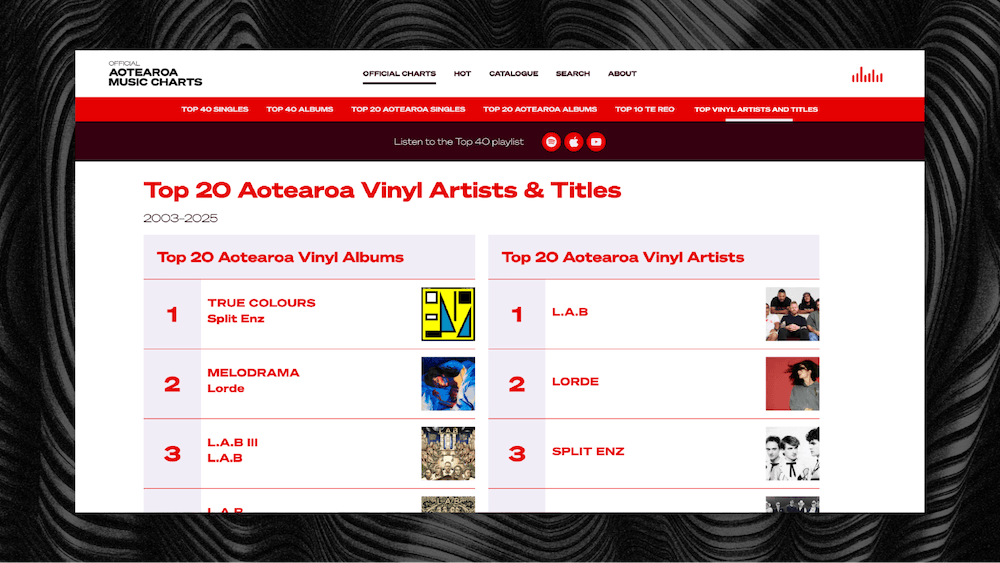
The chart is full of artists like that – the hard-touring and obsessively followed out-selling those which beat them by other metrics. Avantdale Bowling Club, Tami Neilson, Devilskin, Reb Fountain and Teeks all fit that mould. It also helps to work your arse off: Troy Kingi, nearing the end of his epic 10 albums, 10 genres, 10 years project, has another 10: 10th best-selling local vinyl artist this century.
Beyond that you see a local version of the reissue-mania which has helped propel those building collections in the main chart. Th’ Dudes, Home Brew, Shihad and Supergroove have all sold a tonne of records, often propelled by reunion tours.
Yet even the nostalgia circuit has a pleasingly odd shape to it. Along with names which crop up in any sweeping survey of our best and brightest are a clutch of artists who almost never do. The D4, Push Push and Tadpole all made the top 30. It doesn’t quite make sense – but that unexpected, slightly irrational quality is precisely what has driven the vinyl revival in the first place, and makes the gift of this one-time data dump so compelling.
Check out the new vinyl charts in all their glory over on the Official Aotearoa Music Charts website – Top 40 Vinyl Charts and Top 20 Aotearoa Vinyl Charts. Launched in tandem with The Long Play podcast, proudly brought to you by Recorded Music NZ, Coffee Supreme and Holiday Records.