Tauranga finally has nice things, but can it keep them?

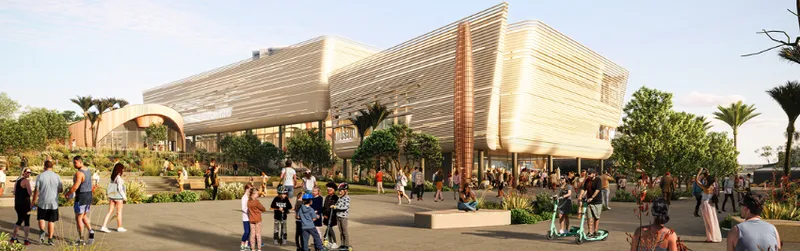
Renderings of the Tauranga Museum and Tauranga Library and Community Hub by Tauranga City Council.
Claire Mabey returns to her home town to find it transformed by flash new buildings, public art and playgrounds. But can the new council continue what the commission started?
I have come and gone from Tauranga many times over the last 23 years. I was born and raised and educated there. In the way of children I didn’t think about where I lived, much. It was just home. Often sunny and sometimes I’d get to see some art when the Tauranga Arts Festival brought theatre and music and dance and writers to town every two years.
By the time I finished school in 2002, I could not wait to leave. I was done with pretending I was a beach person (too ginger to make that work). I was ready to go into the world. Hello, Dunedin. Hello freedom and pubs and lectures. But also, hello art galleries and museums and theatres. Dunedin had what my hometown did not: buildings with art and history inside them.
Over the decades since I left home I have been called back often. For family, for sun, and for the Tauranga Arts Festival where I worked on and off. Being an intermittent visitor to Tauranga meant I noticed how the city was changing. In the 80s and 90s the Tauranga CBD was an eclectic array of independent retailers and hospitality businesses. Suburban malls were yet to suck the life out of the city and at that point the now-infamous traffic wasn’t much of an issue.
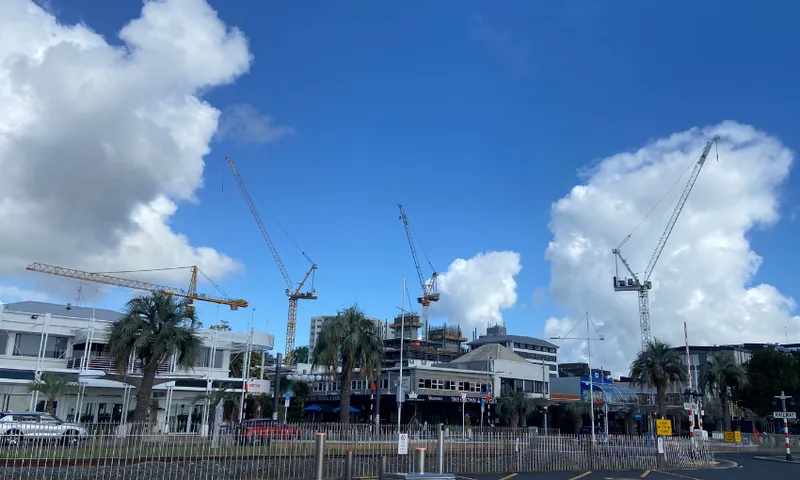
Over the 2000s, Tauranga changed for better and for worse. In 2007 the city got an injection of civic investment in the form of the Tauranga Art Gallery. A former bank was transformed into a light-filled space where artists displayed creativity, imagination and energy. It felt like a game-changer and did, for a while, make the CBD feel alive again. A less successful development was the now infamous Elizabeth Towers: a stack of apartments constructed between 2018–2024, and plagued by design flaws and Covid delays. Not one apartment has sold and they are now withdrawn from the market. To date, the development’s only tenants are Whitcoulls, Farmers and Pascoes Jewellers.
When I went back in the Covid summers, I was dismayed to find a ghost town. Iconic shops had disappeared, cafes closed and the arcades emptied. I heard story after story of non-survivable commercial rents, unreasonable commercial rates and a severe lack of foot traffic. Tauranga’s breakneck development into suburban sprawl saw investment pour into 17 “commercial zones” which rendered the CBD redundant: people could get what they needed closer to home without having to go into town.
Meanwhile, Tauranga City Council was imploding: mayor Tenby Powell resigned in November 2020 after scrapping with councillors. On February 9, 2021, Nanaia Mahuta, then minister for local government, appointed four commissioners – Anne Tolley, Stephen Selwood, Bill Wasley and Shadrach Rolleston – to take the reins. Their mission was to work collaboratively with mana whenua, council and the community to catch Tauranga up on its infrastructure needs and pave the way for “a liveable city of the future”.
I went back to Tauranga this month, again for the Tauranga Arts Festival. It had been a year since I’d been home and was looking forward to that familiar, bone-warming climate, the sparkling sea. What I was not expecting was to be floored by the transformations in the CBD.
Everywhere I looked was evidence of infrastructure and beauty and art. Next to Hotel On Devonport where the festival put me up is the stunning new Tauranga City Council eco-building. It’s all wood and windows and looks out to the stately pōhutukawa trees that lean out over the water. The sun trap at the bottom of the building is occupied by a new bistro called Florence: delicious. I spent money there five times in three days.
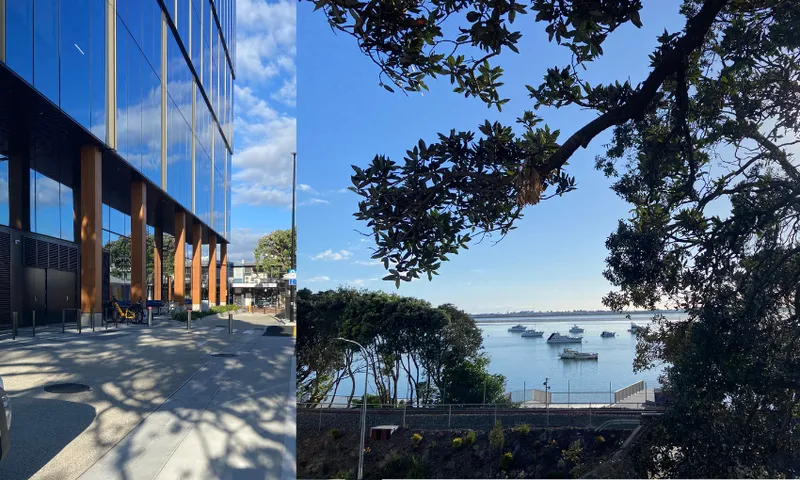
Baycourt, the beloved theatre building, now looks down upon one of the most beautiful library buildings I’ve ever seen. The outer cladding resembles feathers: soaring and strong. Wandering back into the centre of town I saw how the previously desolate Red Square now has a stunning public sculpture called Rauhea, by Peata Larkin, while the pavements underfoot are adorned with koru patterns. Trees and huge pots of plants have brought literal life into the streets. The playground down on the waterfront is striking, bold, enticing! At night it looks like a friendly UFO about to take off to join the huge moon that hangs over the harbour.
By day the playground, and the basketball court next to it, is teeming with families. The tidal steps welcome swimmers into the gentle waters. There’s a pier designated as a manu spot, and a floating sunbathing platform too. The planting and landscaping throughout the waterfront and all the way down Dive Crescent is lush. Past Bobby’s Fish Market (best fish and chips in the country, if not world), the festival’s yellow flags waving in the breeze, the gently curving footpath is lined with green. What a magnificent place to live, I thought.
That’s before I’d even laid eyes on Te Whare Taonga o Tauranga. I was standing on the waterfront admiring yet another new development on the Strand (office buildings, a chic design facing the sea and offering commercial potential underneath) when I looked up and saw a building lit up: a beacon on the hill, gazing down. “What is THAT!” I said to the person next to me – a local who has lived through it all. “Tauranga Museum! Isn’t it wonderful,” they replied.
I had heard about the Tauranga Museum for decades. That we needed one. That there were collections kept safe by mana whenua that needed to be shared with the world. To tell the story of this place and its enormous history. I knew the project had been greenlit by the commission to the tune of $128 million dollars. But being away from home I hadn’t appreciated what that number would amount to.
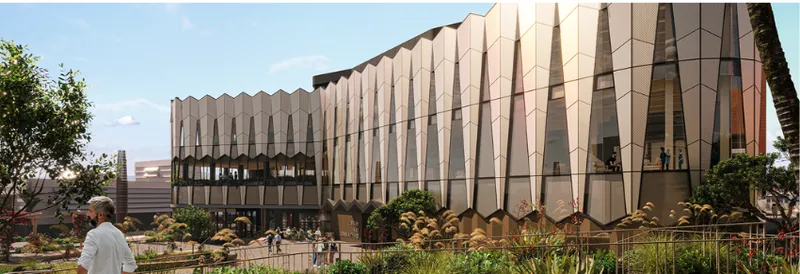
Te Whare Taonga o Tauranga (Tauranga Museum) is due to open in 2028 and Pokapū Hapori me Whare Pukapuka (Library and Community Hub) is due to open in late 2026. They’re both green starred buildings, using sustainable building practices and technologies. Tauranga Art Gallery has been closed for renovation as part of the $306m civic precinct revitalisation project and is due to reopen soon, on November 15.
Tauranga feels on the cusp of great change. It is now the city I wished it was when I was growing up: a place that makes the most of its geography while also celebrating its history and its capacity to bring art and culture to the people.
The CBD is still worryingly empty of shops and businesses. Despite the excellence visible all around, there is grumbling among residents that high commercial rent and rates will still prohibit survival in retail and hospo.
The commissioners wanted to stay: presumably they wanted to see their Long Term Plan through, at least for a few more years, nervous at what might happen if yet another dysfunctional council was voted in. They petitioned the minister to hang on for another term but local democracy won in the end. Voter turnout for the 2024 local election (Tauranga didn’t have an election this year) was 38.7%, pretty poor. Mayor Mahé Drysdale, doesn’t actually live in Tauranga. He lives in Cambridge.
Tauranga still has plenty of challenges. But what the commission did via decisive action was bring forward a historic partnership with iwi and invest in civic infrastructure that makes the CBD both beautiful and compelling. For the first time in a long time, I felt excited for my home town. I cannot wait to go back and spend time in Te Manawataki o Te Papa, the civic precinct, and visit the museum, the library and the art gallery. I just hope the new council can keep up with the vision and the investment the city needs.
Claire Mabey
Claire Mabey is a children's author of The Raven's Eye Runaways, The Raven's Eye Rebellion, and a picture book Cass and the Beast illustrated by Jill Calder. For a long time Claire worked on literary festivals and is the founder of Verb Wellington. She lives in Te Whanganui-a-Tara with her partner and son.


