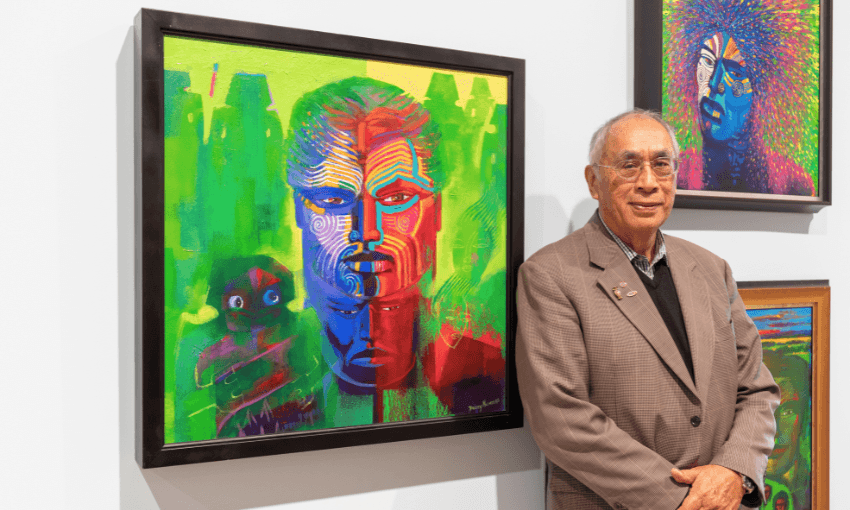

A sweeping new survey at Toi Tauranga traces five decades of artist Darcy Nicholas’s practice, offering rare insight into the spiritual, artistic and ancestral foundations of his life’s work.
It feels both fitting and long overdue to witness a major survey of Darcy Nicholas’s work. Growing up catching glimpses of his paintings in schoolbooks or in the corners of art classrooms, the full scale of his practice has often felt scattered. Many works were held in private collections, tucked away in archives, or carried only in memory. The new exhibition at the reopened Toi Tauranga changes that.
The exhibition presents half a century of drawings, jewellery, paintings, carvings and sculpture. It gathers the breadth of the senior Māori artist’s lifelong practice into one room and one moment, finally allowing us to understand the true extent of his contribution.
Nicholas holds a significant position in the broader landscape of Māori art. He is among the artists who helped widen the visual language of Māori painting in the late 20th century. Younger artists draw courage from seeing a survey like this. The lessons are not only technical. The exhibition demonstrates spiritual commitment, endurance and the value of an unwavering voice. Nicholas has always emphasised the importance of artists finding their own message for the world. His body of work is exactly that.
This is the first attempted comprehensive survey of Nicholas’s in decades. Its timing feels purposeful. Toi Tauranga has just emerged from a major redevelopment and opening with Nicholas’s work is an acknowledgement of whakapapa and sustained creative labour. It honours an artist whose roots reach deeply into this region.
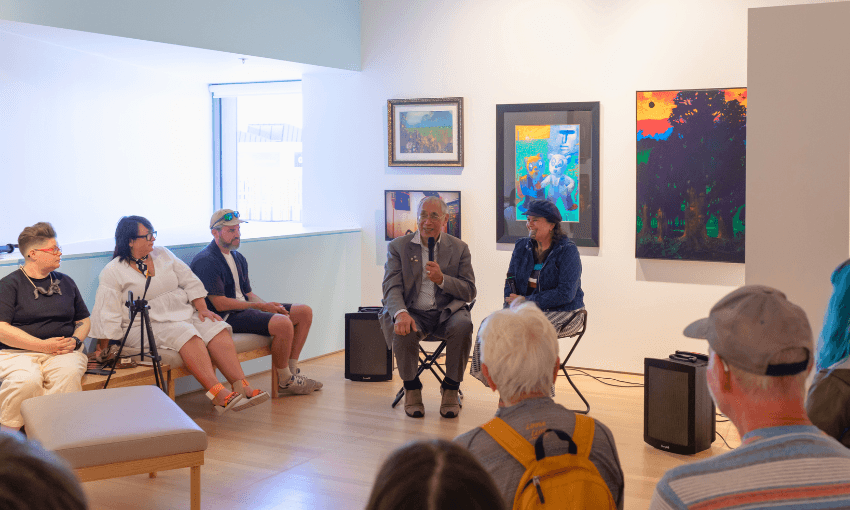
For Nicholas, the exhibition reads as a homecoming, a return to his kāinga. For Tauranga Moana, it feels like the gallery is placing a pou firmly into the ground before stepping into its next chapter.
Nicholas grew up in Taranaki the second youngest of 12 children, surrounded by kuia who held the oral histories of his whānau. He often speaks about being the one on the outside of the circle, watching, questioning and paying attention. The inclination to observe from the edges and notice what sits just beyond sight runs through his work.
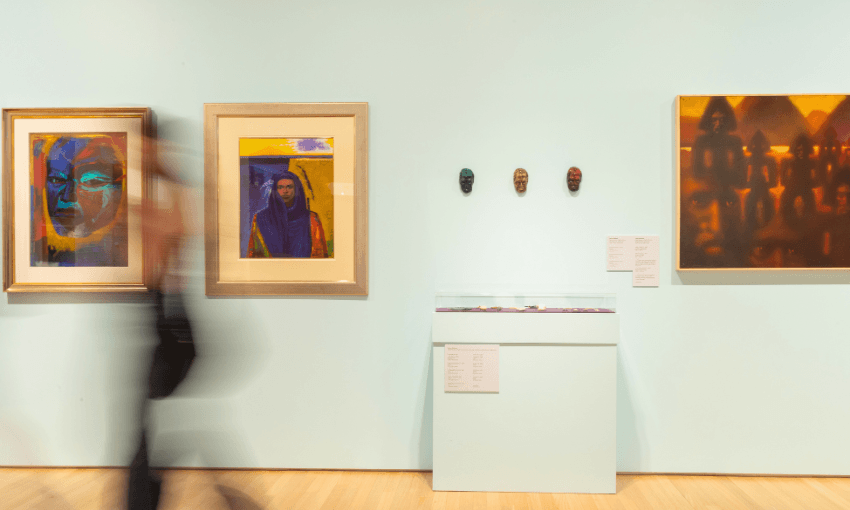
Seeing the range of Nicholas’s work across five decades is striking. His silhouetted figures and luminous horizon lines were taught in high school as part of the Māori art canon, yet nothing prepares you for the emotional weight of standing before so many works at once. The early landscapes, the spiritual portraits painted after his sister Nancy passed away, the carved forms, the jewellery, the guardian shapes and the delicate drawings that reveal the first flicker of an idea all sit together with remarkable coherence. The works centred on whānau and tūpuna are especially affecting. They hold the feeling of every ancestor standing behind you, shaping who you are.
The early landscapes show a young artist rooted in whenua. These are soft and moody horizons, often recalling recognisable sites from the Taranaki rohe. They reveal the beginnings of a shift from depicting land to depicting the energy held within it. The silhouetted ancestors follow. These are some of the most iconic works in the room. Dark, uplifted figures stand against horizontal bands of earth and sky. They are not portraits of single individuals, but more the embodiment of whakapapa and kaitiakitanga.
Later works move into spiritual portraiture, a shift shaped by the grief of Nicholas losing his sister. These works seek connection to wairua rather than likeness. Many begin in black – the realm of Te Kore – before colour emerges like light at dawn. This choice is not simply an aesthetic one. It is cosmological. Nicholas paints from te kore (the realm of potential) and slowly brings the work into te ao mārama (the world of light). His fascination with Tamanui te Rā sits within this process. For Nicholas, a sunrise holds both knowledge and whakapapa. His method mirrors Māori creation narratives in its movement from void to illumination.
Alongside these paintings are carvings and jewellery that show Nicholas’s sculptural instincts. They sit like miniature pou, carrying stories and feelings of travel and connection. The pencil studies are equally important – they show how he tests curves and shapes before they become the figures we recognise.
Continuity sits at the centre of Nicholas’s practice. The mantra of us being the living ancestors is a simple line that reminds Nicholas that we are not separate from our histories. Instead, we are vessels of them, extensions of them, and one day, someone will speak our names with the same reverence we reserve for our tūpuna. This idea flows through the dissolving silhouettes, the horizon lines that blur worlds and the figures that sit between realms.
Humour is woven into Nicholas’s worldview too. He speaks of the storyteller, the clown, who carries truth beneath a mask. Every society has these figures. People who hide parts of themselves in order to move through the world, yet through that masking reveal something deeper about who we are. Some of his figures embody this idea. They are present and withheld at the same time, protective in their obscurity.
What lingers after leaving the gallery is not one artwork or one moment, but an atmosphere. A gentle warmth. A quiet weight. A sense that you have been standing among ancestors, and that they have been standing with you. The soft colours of sunrise, the steady silhouettes, and the calm resonance of Nicholas’s voice seem to follow you out of the room and into the evening. They stay with you like an afterglow – a reminder that some works do more than occupy space. They settle in the body. They return in memory. They continue to guide you toward light.