It’s the last call for New Zealand’s pay phones

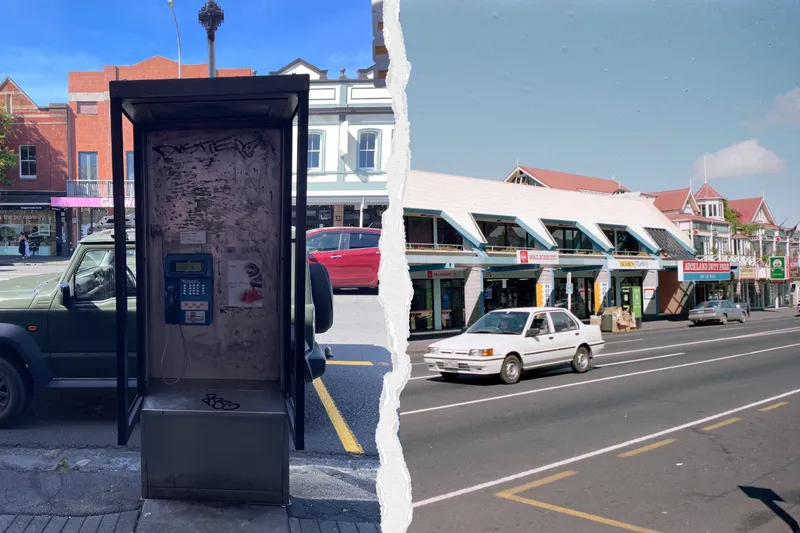
Hurstmere Road in 1994, Jervois Road 1996, Symonds Street 2025. (Images: David Cass, Auckland Libraries Heritage Collections T5051; Diane Stewart, Auckland Libraries Heritage Collections 802-06-27; The Spinoff)
‘The majority of phone booths will be disconnected and stop working in the coming months.’
Tāmaki Makaurau has around 550 phone booths left. There used to be one around the corner from The Spinoff’s Auckland office, but at some point that disappeared. Others have too. Many remain standing, among the around 280 that are still operational in the city (the remaining 270 are there, but don’t work). But they’re not long for this world either. Spark is in the process of removing them. All of them.
Their retirement is a byproduct of another infrastructure development; Chorus is decommissioning the copper lines that connect the nation’s phone booths, with the project accelerating across the country. “This means the majority of phone booths will be disconnected and stop working in the coming months,” said a Spark spokesperson. “As such, Spark will be working to schedule the removal of the physical booths.”
It’s faced with the rather big task of removing an estimated 2,000 phone booths from around New Zealand. The number has been decreasing “gradually” since the plan was first announced in 2022.
Spark has been responsible for operating the phone booths for more than 40 years, originally under the old brand of Telecom. Before that the job belonged to the government’s Post and Telegraph Department (it was abolished in 1987, split into a trio of state-owned enterprises, including Telecom, which was privatised in 1990).
The nation’s history of public phone booths dates back to the 1910s. They’ve been the site of crimes, cricket mishaps and cramming. Some of remaining relics rely on novelty factor. Rakino Island lays claim to the world’s first solar-powered telephone and making calls from it to Auckland numbers is free. Christchurch’s “great telephone box war” saw a 1930s red cast-iron phone box retrofitted in 1990 and installed in Victoria Square.
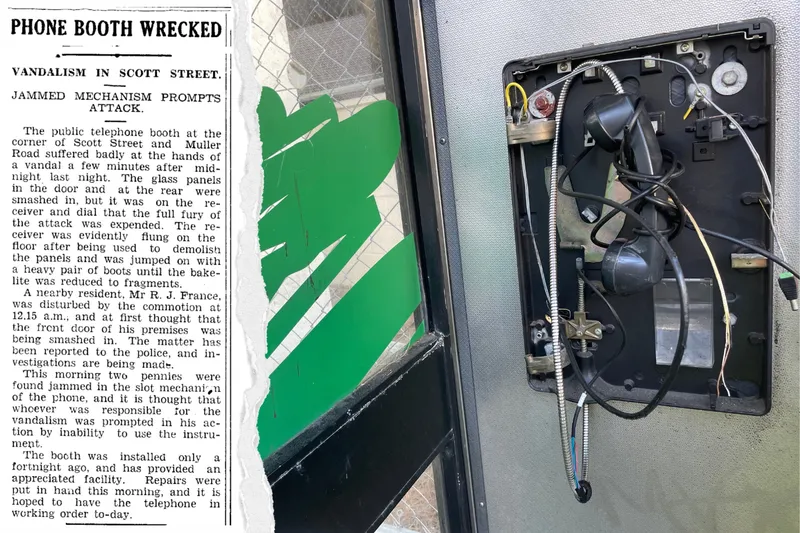
The current state of Tāmaki Makaurau’s phone booths varies from operational to ruin. On Eden Street in Auckland Central the phone casing has been ripped off, revealing the cords and screws. The receiver has been bound and (symbolically?) strangled by a coated cable. The effect is silence.
It’s among many in disrepair across the city, though that’s not a new phenomenon. Smashing up public phones is nearly as old as the service itself. In 1934 The Star reported one Christchurch phone booth had been “wrenched open and badly mutilated” during an attempted robbery. One Blenheim booth was “wrecked” in 1946 with a lyrical Marlborough Express report detailing how “it was on the receiver and dial that the full fury of the attack was expended”. Some young men “looking for fun” blew up a phone booth in Milton using an explosive device in 1979. In 2009 Hamilton had been seeing an increase in “payphone vandalism”, reporting 200 callouts in the space of a year. By 2010, one phone booth in Onekawa had been “damaged at least eight times in four years”. New Zealanders have a lengthy track record of taking their frustrations out on the nation’s network, despite or perhaps because of their functional necessity and public position.
Sometimes they’re the only option – particularly during an emergency. Innovations elsewhere suggest as much. Across the ditch Telstra made calling a domestic landline or mobile from its phone booths free from 2021 (wifi’s complimentary too) and by 2024, 2.58 million free calls had been made in a 12-month period, with emergency calls increasing 20% on the year prior. The anonymity offered by public phone booths may have contributed to this uptick, according to Australian non-profit crisis hotline service Lifeline, particularly for people in vulnerable or violent situations.
The United Kingdom’s distinctive red booths have been disappearing, with only 3,000 left as of last year, down from 40,000 in 2017. In the US, the last of New York’s famous phone booths was removed in 2022 (moved to the Museum of the City of New York). The old guard, once numbering 6,000, were replaced with a network of LinkNYC Kiosks which offer free calling, device charging and wifi.
A similar idea was envisioned for New Zealand. Spark Tūhono Connect was conceived as a “modern alternative” that would provide free calling and wifi. Instead of operating as a user-pays service like our current network, it would be funded by out-of-home advertising – via a partnership with Ooh! Media – in the form of digital screens. The revenue would support an initial investment of $50 million required to build and deploy the new network, as well as ongoing operational costs and maintenance. “The booths need a sustainable funding model – to underpin the infrastructure investment, as well as the ongoing provision of free services,” Spark said. “Phone booths have always required a source of revenue to underpin their operation.” (The government doesn’t provide funding for the service.)
In the case of a public emergency councils could, under the proposal, be able to take over the screens if an emergency happened, facilitating quick public messaging. There would also be ongoing free ad space allocated. While Spark said it received “positive feedback” from councils around the country, the plan has stalled. The nationwide modernisation project was “temporarily” suspended in October. The reason? Tāmaki Makaurau.
“Unfortunately, we have made the difficult decision to temporarily suspend the project as we have not been able to agree a path forward in Auckland, and given the scale of this region, the national programme cannot proceed without it,” a spokesperson said. Spark “firmly” believes that under the Telecommunications Act 2001 it has “the right to install and operate these modern phone booths. However, we have encountered different interpretations of the Act by local roading authorities.” (This includes Auckland Transport.)
Spark said it had sought clarification of the act via the Ministry of Regulation’s recent telecommunications sector regulatory review, which it hoped would “provide greater clarity to councils and roading authorities, and enable this investment to proceed”. (The consultation period closed in September and any outcomes from the review will most likely be revealed at the start of 2026.)
The company said it had engaged in “multiple discussions” over several months with representatives from the strategy and partnerships division at Auckland Council.
In a statement to The Spinoff, Auckland Council confirmed that staff had engaged with Spark on a proposal to modernise the city’s phone booths, which included installing commercial digital billboards on public footpaths.
“Council provided guidance on how proposals of this kind could be progressed,” said Max Hardy, director of group strategy. “At this stage, the key decisions on this sit with Auckland Transport, and no formal application has been made to them. If Spark wishes to progress the proposal any further, council and Auckland Transport staff are open to further discussions and guidance.”
Decision-making in this area is expected to transition to the council in 2026, Hardy said, due to wider changes in transport governance. Announced in September, the remit for most transport functions, as well as all policy and planning, will shift from to Auckland Council from AT, which will be reduced to running public transport.
Hardy said the council is “open to innovative proposals that make good use of public space and deliver benefits” for Aucklanders. “Public space is valuable and in high demand, and we aim to balance different uses while continuing to look for better and more creative ways to use it.”
Spark has also said it’s “open to proceeding with the investment, should we find a path forward in Auckland in the future”. Exactly what that is and when is unclear, for now.
Whatever happens with the Tūhono Connect plan or any other alternatives, the fate of Aotearoa’s old network is sealed. “The phone booths in their current form are going to be removed regardless of whether the modernisation project can proceed,” Spark confirmed. With the technology they rely on being sunsetted, the only option is a full replacement. “A simple upgrade is not possible.”
The nation’s pay phones and copper network aren’t the only things set to disappear. New Zealand’s 3G network will be shut down by the end of the year to facilitate faster 4G and 5G. Further on the horizon, broadcast television is predicted to meet its end in favour of digital distribution. Thank god for the internet then. That’s all thanks to five underwater cables the size of garden hoses.

Emma Gleason
Emma Gleason is a staff writer at The Spinoff and an award-winning fashion journalist. But it’s not just clothes that interest her, you’ll find her exploring tasty cheese, influenza outbreaks and more important things right here. She has experience with some of the country’s leading media outlets as well as the toaster in our kitchen.


