How reforesting the Port Hills could help prevent another devastating fire

To prevent fire, you need trees (Image: Shanti Mathias; fire image via Getty)
Prone to fires and erosion, Christchurch’s Port Hills were once covered in native bush, as hard as that is to imagine now. Dozens of community planting projects are the beginning of a return to a forested future.
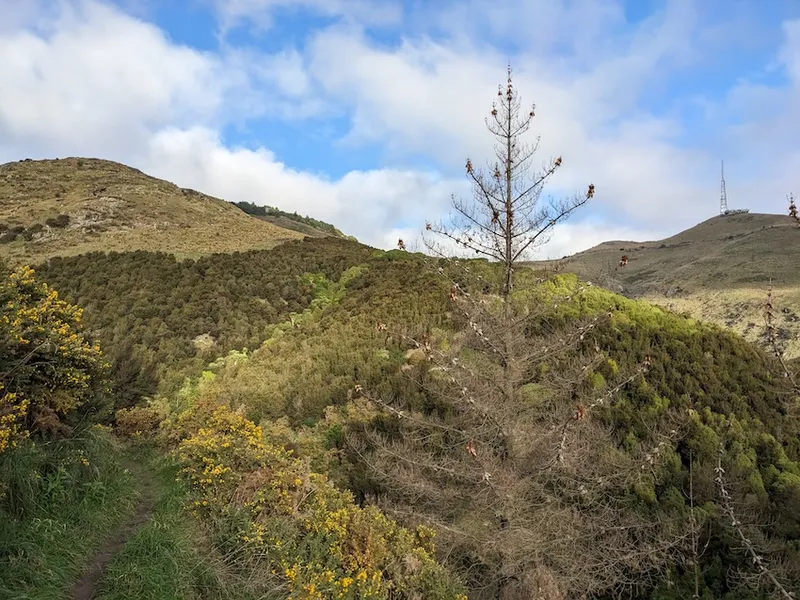
The Port Hills are visible from almost every part of Christchurch, buttressing the southern side of the southern city. The remnants of a volcanic crater, the hills have lines of houses draped up ridges, mountain biking paths through pine trees, lots of open tussocky land grazed by sheep and the occasional little stream channelling through valleys. What they don’t have, though, is extensive amounts of native bush.
While the Port Hills provide recreation to people in Christchurch, they’re also vulnerable. Enormous fires stripped thousands of hectares and destroyed several homes in 2017; slightly smaller fires caused similar damage in early 2024, at the same location. The hills also have lost a lot of biodiversity: there aren’t many birds in the valleys, and there aren’t many invertebrates in the streams. Erosion from the exposed earth causes land slips onto the road, and pours silt into Lyttelton Harbour.
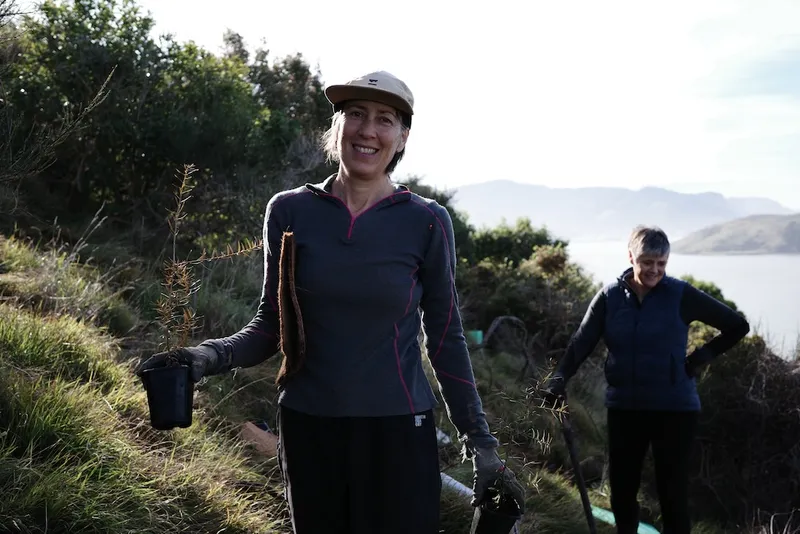
What can help with all of these issues? Planting trees. Sophie Hartnell is the coordinator at Te Kākahu Kahukura, a group formed in the wake of the 2017 fires. I meet her on a sparkly winter day at Allandale, on the southern side of the Port Hills: she’s brought spades, gloves and morning tea supplies for carrying out planting with a handful of volunteers. The TKK model is to provide some overall direction for replanting on the Port Hills, focusing on native species, rather than pine trees. With dozens of partners, it works with conservation organisations, mana whenua and private landowners to get more trees in the ground.
“It’s not about recloaking the entire area in forest, because that’s impossible to sell to people, and it isn’t fire-resilient,” she says. Instead, the vision is to make existing pockets of native forest bigger and more resilient, particularly by adding podocarp species such as tōtara and mataī that can create a tall canopy, and send their roots deep into the land. Hartnell drives me and three other volunteers around the corner, to Penny Mahy’s land: a peninsula sticking into the harbour.
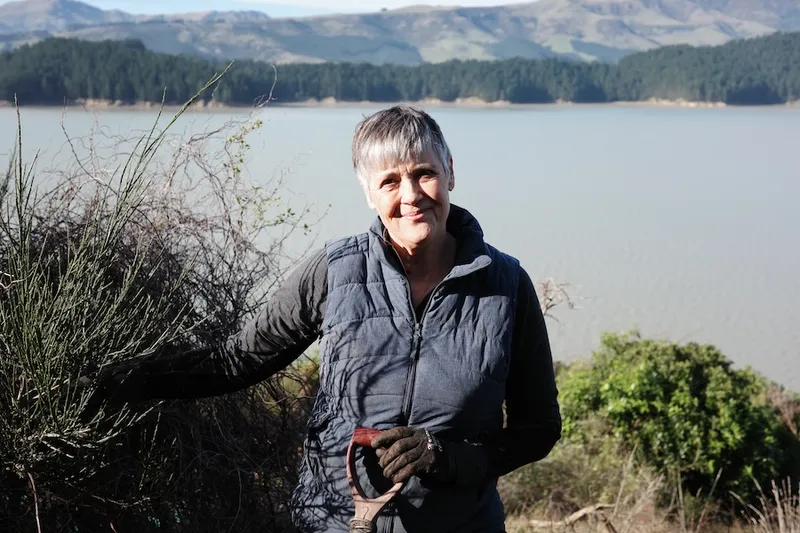
“There were an awful lot of slips when we first moved here,” says Mahy (yes, another daughter of the beloved author Margaret). It’s easy to believe: to get to the planting site, we had to drop off a steep hill, avoiding patches of brambles. Three decades ago, when Mahy and her husband first prevented sheep from running over the land, there weren’t any kānuka, now large enough to duck under, or māhoe with their glossy leaves. There weren’t any large stumps in the ground, and the land had been so heavily grazed that it didn’t seem that much natural generation would help. Instead, there was mostly Mahy: when her kids all left home, she had a grant from the Billion Trees fund.
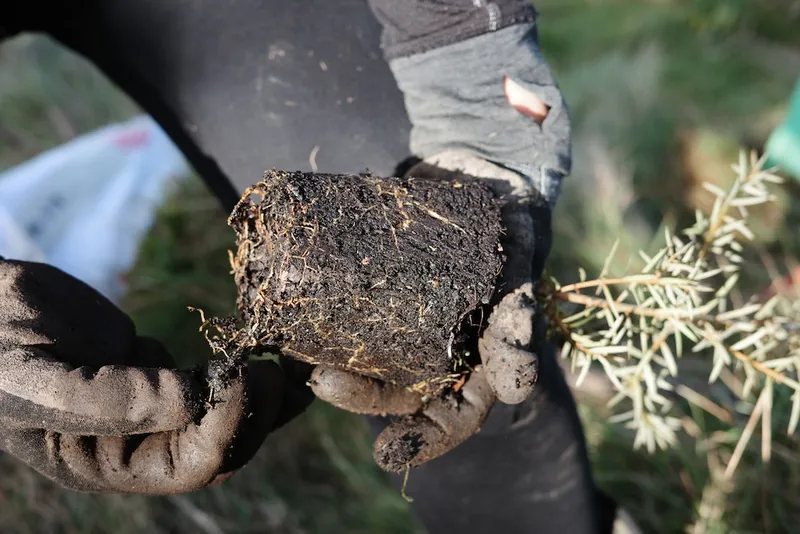
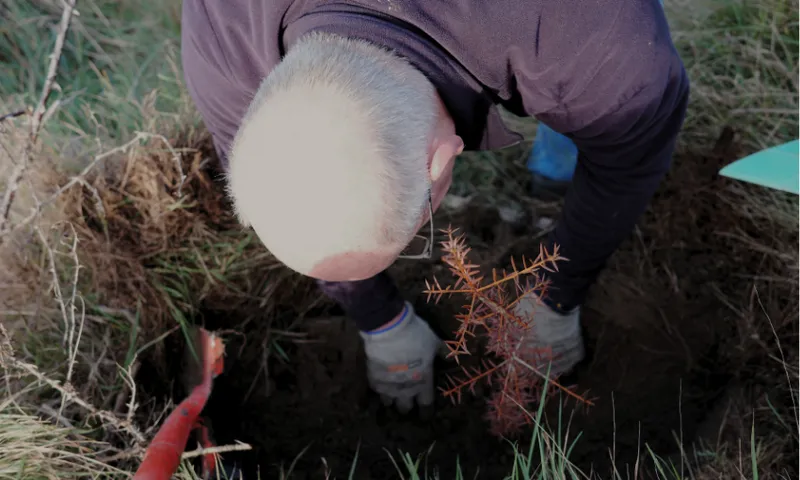
“They only pay for trees that will be taller than five metres,” she explains as she digs a hole. On the exposed northern side of the peninsula, establishing harakeke wasn’t covered by the fund, but lots of the kānuka was. Mahy gently squeezes a tōtara from its seedling pot and eases it into the soil, slides a weed mat over the roots and puts a stake and a green tree guard around it. This will help the little plant hold its own against broom, wild roses and the plethora of other weeds; it will stay humid and sheltered in the guard for several years, until it’s time to take it off. In a couple of decades, this tōtara will arch high above the kānuka, forming a canopy.
Hartnell is TKK’s main paid employee; she works part time, as does an administrator. Most tree planting is done by volunteers. “It’s one giant collaboration,” she says. One volunteer on this mission is Luke; it’s the third tree planting day he’s been to this week alone, and he has another planned for Sunday. “I’m a little bit addicted,” he says. After years of going for walks in the Port Hills and seeing planting day signs, he has joined as many projects as he can since retiring. One of Luke’s regular walking spots is up Worsley track, near where both the 2024 and 2017 fires broke out. “There’s a lot of gorse regrowing there,” he says. “It would be nice if it could someday be planted.”
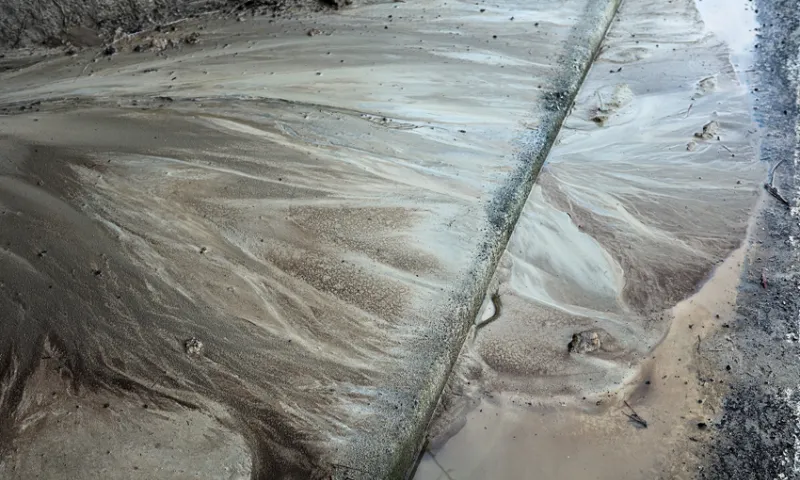
Erosion is a major issue facing the Port Hills; heavy rain often causes slips, and on the way to Allandale, I saw numerous small patches of exposed earth slowly running across the road. “There’s a lot of being out there, just slogging on your own,” Mahy says. She’s planted thousands of trees on her own, so having volunteers is a welcome change. “It’s very disappointing when you see your lovely new trees sliding down the hill.” As more and more bush has grown back across the peninsula, there have been fewer severe slips, even if bad years make it hard to spot an overall trend.
“Since 1840, erosion has gotten worse on the whole peninsula,” says Paul Dahl, speaking in his capacity as trustee of planting projects Manaaki Mai and Hidden Valley Conservation Trust (he also works as environmental lead for Te Hapu o Ngāti Wheke rūnanga, and has worked for regional councils and DOC too). We’re talking at the Rāpaki marae, close to Lyttelton, with the Port Hills on one side and the shifting blues of the harbour on the other. The tide is coming in, slowly creeping over the silt flats. “We have a responsibility for the health of the harbour, the water that flows into it, the soil that’s on it, and then the biosphere that’s around,” Dahl says.
Behind Dahl are some enormous hārakeke and a bubbling stream; further up the valley, the rūnanga has planted over 75,000 trees. “We’re trying to get more streams flowing year-round – that’s a sign of health.” Having trees and native plants to shade valleys means less water evaporates, and also means run-off from animal faeces doesn’t get into the water. Fire safety is a consideration, too: Dahl and his team have been choosing more fire-resistant species to plant at a corner near the marae, where people who have stolen cars often burn them, placing the vegetation at risk.
Restoring biodiversity: removing weeds, providing food
What the wide grasslands of the Port Hills currently lack is biodiversity; focusing on feeding sheep rather than any other species – people included. “We ask: what would this forest be like if colonisation didn’t occur?” says Dahl. “We’d have the matauranga of medicine and food, we’d have kai, we’d have timber to build waka. We look at it now, and that’s our vision for planting those hills.”
Restoring the forest is also about restoring food sources for other species. “We’ve seen fantails and bellbirds coming down from the hillsides, hopefully they’ll do their seed spreading,” Mahy says. While TKK focuses on podocarps, attracting native birds like tūī and kererū requires plants which they want to eat. “There are some remnant mataī up there which need company and succession – whether kererū will cart around their seeds, or whether they’ll drop them and be blown by the wind,” Dahl says.
The goal is always getting to the point where native plants can re-seed themselves – a strategy used in Hinewai, on the other side of Banks Peninsula, a reserve where a patch of remaining native bush has slowly spread outwards, towering over the gorse bushes. “That wouldn’t necessarily work on a north-facing site on Port Hills, it would take hundreds of years,” Hartnell says.
Friederike Espinoza is a PhD student at Lincoln, studying kānuka shrubland, which would have covered significant amounts of Banks Peninsula before it was stripped. She’s focused on how weeds affect kānuka, which can be a big problem for new planting. “Woody species like sycamore, shade-tolerant species like blackberries can be a huge problem – they compete for resources like water and light and nutrients, shade native seedlings and can change the soil composition.”
Crucially, her research has found that the “football field-sized” areas or smaller are much more vulnerable to weeds than bigger, joined-up areas of existing bush. “We have smaller and smaller isolated patches, surrounded by different vegetation – the edge zones are very susceptible to disturbance and invasion.” Her conclusions match what TKK and other planting groups are already doing. TKK’s vision is to join up more of the remaining patches of native bush as biodiversity hubs; with current funding for podocarp planting, the focus is on areas where there is already some bush, like Mahy’s land. That gives new plantings a higher chance of survival.
With the ever-intensifying effects of climate change, there’s no time to lose. “It’s all about holding the soil together, preparing for much hotter, drier conditions and just trying to shade the soil,” Mahy says.
TKK has planted more trees on the shadier south side of the Port Hills than the more exposed northern flanks closer to Christchurch, which get blasted in the city’s hot, dry summer winds. “It’s a lot easier to stay motivated when things look like they’re thriving,” Hartnell says. “I worry a lot about the future and health of the planet.”
TKK has money from Trees that Count and the Cashmere Rotary Club, while the rūnanga is keeping on Kaimahi for Nature volunteers with bits of short-term funding. Along with other groups, they’ve seen income sources change with the central and local government priorities shifting; private money can only go so far to fill the gaps. But a tree’s life is long. “We’re just trying to hold everything in place until we get some funding at a decent scale – it’s not going to work, here or anywhere else in Aotearoa, until we have funding sources that are unpolitical,” Dahl says. “We need to think in generation cycles.”
That’s why, at least, it’s been so important for him to see people volunteering for replanting. “We want people to come back to the forest with their grandkids, and for them to say ‘my grandparents did that.’”
Shanti Mathias
Shanti is a contributing writer at The Spinoff with a focus on Christchurch and the South Island. Email her at shanti@thespinoff.co.nz


