Controversial: Public transport in Auckland is actually pretty good

The trains may still have their flaws but the buses are good.
The idea that Auckland’s public transport is adequate isn’t all that popular. But it’s also quite possibly correct.
When politicians started getting serious about congestion charging in Auckland in 2023, RNZ went to ask people on the street what they thought of the idea. The response was unanimous. “Firstly, we need more access to public transport and probably more affordability for that as well,” said Emily. “Those ideas only work in places where there’s viable alternative transport options,” said Simon. “The alternatives really need to be in the form of very, very efficient and easy-to-use public transport,” said Public Transport Users Association chair Niall Robertson.
The interviewees were repeating received wisdom. As the saying goes, only two things are certain in life: death and Auckland’s public transport network sucking balls. The idea of putting a charge on people driving to work seems, in the words of Emily, “outrageous”, when you’ve only encountered a sparsely serviced network of diesel-chugging buses and often cancelled trains.
But is that actually a fair reflection of Auckland’s public transit system as it currently stands? Though it might be a controversial, even viscerally disgusting thing to say, these days public transport in Auckland is in many respects fine, and in a number of areas, bordering on good.
Clearly it hasn’t always been this way. In 2012, Auckland’s bus system was infrequent and poorly laid out. In large part, the problem came down to planners sharting themselves at the idea of people having to transfer between buses. Routes snaked endlessly around suburbs. The upside was that lots of places were covered. The downside was it took forever to get anywhere.
That changed after Auckland Transport and the transit firm MR Cagney came up with the “new network” over 2012 and 2013. The project was essentially a blank slate redesign of the bus system. Instead of trying to cover every nook and cranny of the city, it focused on creating as many direct, high-frequency, routes as possible, even if it meant people might have to take two buses to get to where they’re going. The aim was to create a “turn up and go” network where you don’t need to check the bus timetable, not because it’s usually completely wrong and irrelevant as has sometimes been the case, but because a bus will always be arriving soon.
MR Cagney’s public transport director Nicolas Reid calls installing the new network from 2014 onward a “complete revolution in the way the public transport system was designed and operated”. “During the period Auckland went from world’s worst to world’s best practice for buses,” he says. The change has been profound and relatively speedy by transport project standards. In 2016, Auckland only had seven frequent transit routes, which Auckland Transport defines as lines where buses run every 15 minutes between 7am and 7pm, seven days a week. By 2022, that number had risen to 29. This year it has 43. AT expects to add five to seven more to get to 50 by 2030. The numbers are startling, and more so when they’re drawn up on a map.
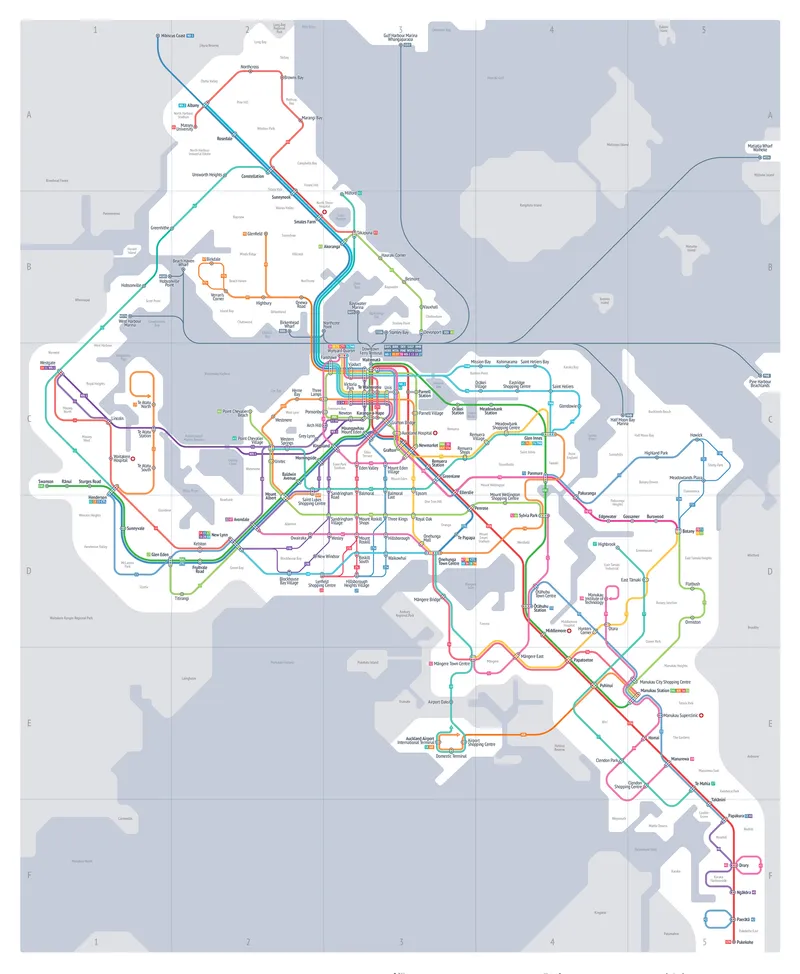
Despite this, as RNZ’s vox pops show, Auckland public transport’s reputation remains in the toilet. Some of that is inevitable. The city’s train network has been beset by delays and cancellations for years, partly because of Kiwirail’s distaste for trains carrying anything other than pure uncut freight, and partly due to needed upgrades ahead of next year’s CRL opening.
But the bus system doesn’t deserve to be tarred with the same brush. Reid says its network is now “easily the best in Australasia”. “People don’t see that because they focus on Sydney trains or Melbourne trams, the stuff they use while visiting,” he says. But those rail networks, while impressive, only cover a minority of those cities, and the bus systems that serve the majority of the population are often quite poor. Auckland’s system is more comprehensive and less appreciated. Reid has some theories on why. “Buses are unsexy and forgettable,” he says. “But also they’re literally everywhere which is why they’re the most important part of the system.”
AT’s public transport service change manager Dave Hilson says 45% of Aucklanders now live within 500m of a rapid or frequent transit route. He thinks the lingering negativity around its buses comes from longer-term residents who haven’t updated their priors. “Old habits die hard,” he says. “Anecdotally, we couldn’t tell you how many people have said our network isn’t for them but will tell you they haven’t used a bus since they went to school.” Hilson also acknowledges AT has a role to play in communicating about its network, and has more to do.
Last Wednesday, a bill enabling congestion charging passed its third reading in parliament. Auckland is likely to be the first city out of the blocks. Traffic jams are costing the city $2.6 billion a year, and mayor Wayne Brown has been vocal about wanting to stop a whole lot of money and productivity being flushed down the drain. There will likely be equity concerns to be addressed. But it’s outdated to argue public transport isn’t a viable alternative. Though there are still gaps, Auckland now has a frequent and well-connected bus system. A functional train system is on the way at some unnameable point next year. Put those together with congestion charging, which has reduced traffic in places like London and New York, and the city may soon be able to realise what has long seemed an impossible dream: an end to its rush hour gridlock.

Hayden Donnell
Hayden Donnell is a senior writer for The Spinoff. He previously worked at RNZ, TVNZ and the New Zealand Herald, alongside other media companies that have since closed down or been renamed. His primary passions are local politics and the Big Fresh animatronic fruit and veggies.


