The world’s social media bans and NZ’s plans explained

Erica Stanford and Christopher Luxon want a ban in place before the election. (Image: Tina Tiller)
National is ‘aiming to introduce legislation’ to tackle digital harm and wants to get it over the line before the election. But it’s been a winding road to get here.
OK, where are we at with this ban business?
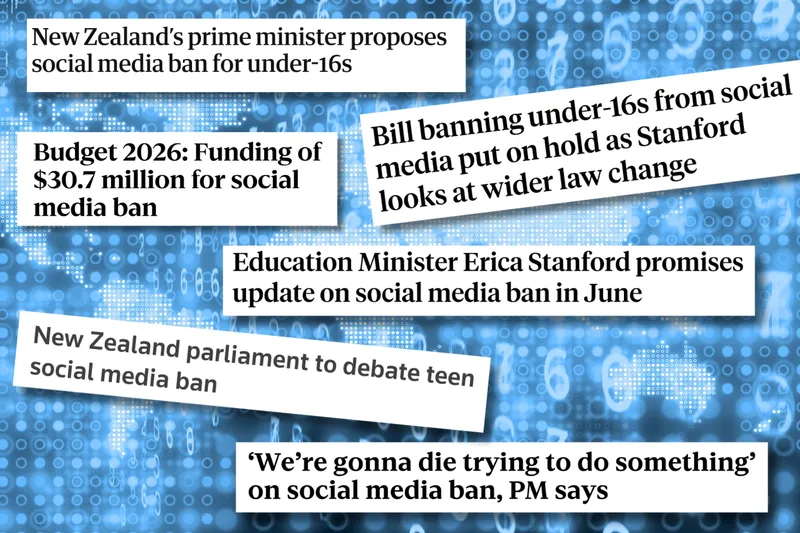
National has been exploring social media legislation for the past 14 months. The Social Media (Age-Restricted Users) Bill was put forward by National MP Catherine Wedd in May, 2025 (aka forever ago in internet years), but it was later put “on hold”. Education minister Erica Stanford confirmed the bill had been “deprioritised” in favour of “wider work” around online safety; she’s spent the past year looking into other legislative measures for “reducing social media harm” for young people.
A parliamentary inquiry into digital harm, initiated by ACT MP Parmjeet Parmar, released its findings in March. Submissions to the select committee threw up a range of viewpoints, with many harms and concerns identified, but with some arguing that age-restricting social media likely wouldn’t be the best way to counter it. The committee nonetheless recommended the introduction of age restrictions for social media platforms.
Meanwhile, politicians have been watching other country’s efforts to protect young people from digital harm. Stanford recently described the global pushback as a “tsunami”. It seems to have given National’s efforts momentum: Stanford has nearly finished drafting new legislation, expected to depart from what was in Wedd’s member’s bill. The final paper is due to Cabinet within weeks and National wants to push through a social media ban for under-16s before the term ends. The budget allocated $30.7 million for policy work around a ban and in a premature start, a job description related to the ban was accidentally listed by the Department of Internal Affairs in April.
Why are we doing this again?
The parliamentary inquiry found risks to young people include harmful content, harmful conduct like cyberbullying and doxxing, as well as harmful contact which, as explained by National MP Carl Bates, can lead to exploitation, coercion and grooming. Children can also be exposed to data breaches, scams and the promotion of tobacco, alcohol and gambling.
Reports and studies have also linked digital platforms to increased anxiety, negative body image, depression, insomnia, attention issues, loneliness, addictive behaviour and self harm – the list goes on. There are also concerns about how the availability of extreme online content is impacting sexual behaviour among adolescents.
Sounds like there are pretty good reasons to ban it. Surely people back a ban?
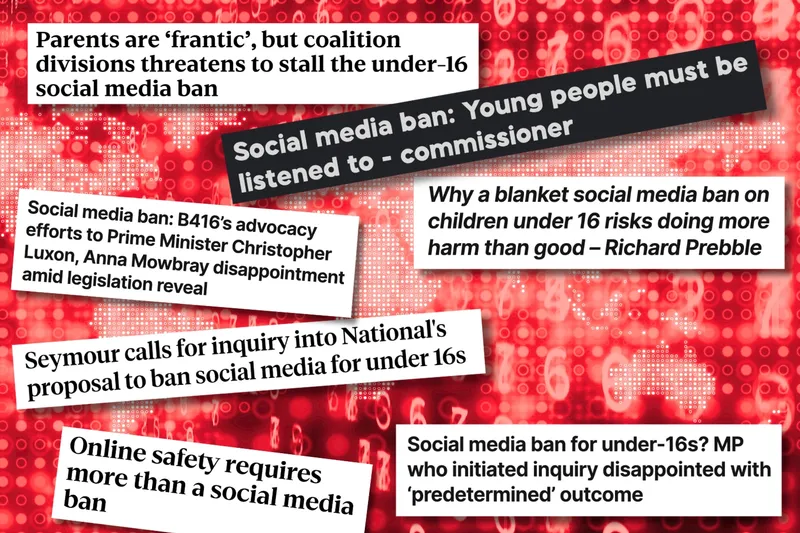
Yes and no. Act, which has concerns about the workability of such a ban, has called the whole thing a “mess” and was unhappy that the inquiry Parmar called for ended up recommending age-regulated social media. Parmar said New Zealanders should be “alarmed” that age-verified social media would lead to increased surveillance. NZ First share Act’s concerns. This leaves National in the difficult position of being determined to introduce a ban but potentially unable to enlist its coalition partners’ support to do so.
It may have to look to the other side of the House. The Greens have warned that a ban will drive young people to less transparent corners of the internet and say rather than introducing age restrictions, New Zealand should be holding unregulated tech giants to account. That leaves Labour as National’s only option for support. Labour agrees there needs to be an “overhaul” of legislation and has indicated it’s open to working with National.
The idea of a ban has riled people outside of parliament too. Critics say there are serious data and privacy risks associated with age verification systems. Others argue that placing the “burden of online safety” on young people and pretending the internet doesn’t exist misdirects attention from the “systemic drivers of online harm”. Instead of kicking young people off the platforms, some argue we should instead insist the tech giants remove harmful content and features.
Who else is banning young people from social media?
Australia led the way, introducing a minimum age of 16 for YouTube, TikTok, Snapchat, Instagram, Facebook, Threads, Twitch, X, Kick and Reddit in December 2025.
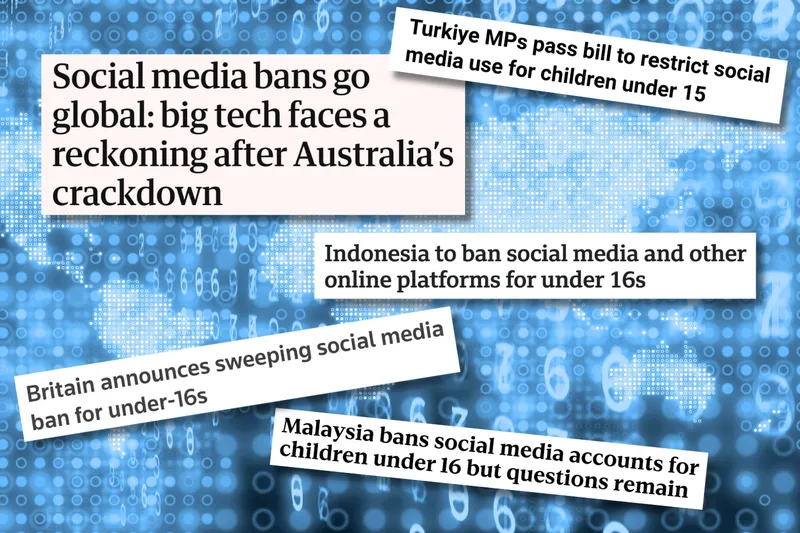
Other countries followed. Indonesia blocked “high risk” platforms for under-16-year-olds. Malaysia introduced a ban last month. Turkey passed legislation that blocks social media and gaming platforms for under-15-year-olds. Spain was the first European nation to announce a ban, Germany is considering a ban for under-13-year-olds and France is progressing legislation through parliament to ban under-15s.
In June, the UK confirmed it would ban social media for under-16-year-olds. Although it’s following the “same model” as Australia, the government plans to go harder, introducing age restrictions for gaming sites, livestreaming and companion chatbots as well. It’s also been trialling digital curfews and is looking to address infinite scrolling. It’s not the only country looking to tackle addictive design features; Brazil has banned infinite scroll and auto-play videos for children.
The Canadian parliament is currently considering a ban, which includes exemptions for platforms that implement satisfactory safeguards. There’s even a push in the US for increased protections; legislation to improve safeguards reached the House of Representatives in June and received cross-party support.
It’s not only politicians tackling social media harms. Meta and Google have faced legal cases, which centred around accusations that platforms can be intentionally addictive and affect mental health. More cases are in the pipeline.
How have the bans gone down?
Australian teenagers weren’t stoked about theirs (two even challenged the federal government). Although 4.7 million age-restricted accounts have been removed or restricted, a compliance report identified “poor practice” and “compliance concerns”. The eSafety Commission, the independent government agency that regulates online safety, found 70% of young people who had an account prior to the ban still have one, often because they had not been asked to provide age verification.
Many of those who have were nonetheless successful in circumventing it, either via VPNs, by using makeup or roping in older family members to help. Some platforms rely on users to self-declare their ages, which can be as simple as writing a different birth date.
Facebook, Instagram, Snapchat, TikTok and YouTube are all being investigated for noncompliance in Australia. Should enforcement proceed, penalties could be as high as AU$99m.
Anthony Albanese has said that “big tech” hasn’t been doing enough to comply with Australian law. He plans to toughen up the Aussie laws to better rein in these “unaccountable” companies and hasn’t ruled out regulating algorithms.
What about me, a grown up? Do I need to be protected from these platforms?
Well, where do you want to start? The Facebook scams, doomscrolling, or the Manosphere? The pornographic deepfakes of teachers or the graphic online abuse directed at women in the public eye? What about the general corrupted shitscape of these global platforms?
Some of these issues were addressed in the select committee’s report, which recommended establishing an independent national regulator for online safety, banning non-consensual deepfakes and increasing platforms’ liability for harm. It also advised “further exploration and consideration” around regulating platforms’ algorithms.
There is bipartisan support for tackling tech platforms, though the ideas for how to do this vary. A members bill from ACT MP Laura McClure is working its way through the process to criminalise deepfakes. Another from Labour MP Reuben Davidson, which has yet to be drawn from the biscuit tin, seeks to make tech giants accountable for harmful content published on their platforms.
But first, there’s the much-discussed ban for under-16-year olds.
What are the chances the government will legislate before the election?
Well, Prime Minister Christopher Luxon seems pretty keen to make it happen. “We’re going to die trying to do something,” he told Newstalk ZB. Whether that means he’d lay down his life to protect young people from the proven harms of unregulated tech platforms, or that he’d be dead before any meaningful change happened remains to be seen.
Correction: This story has been updated to make clear that submission to the select committee threw up varied viewpoints.

Emma Gleason
Emma Gleason is a staff writer at The Spinoff and an award-winning fashion journalist. But it’s not just clothes that interest her, you’ll find her exploring tasty cheese, influenza outbreaks and more important things right here. She has experience with some of the country’s leading media outlets as well as the toaster in our kitchen.


