
Why is Gen Z shying away from both sex and birth control? Madeleine Chapman explores in today’s extract from The Bulletin.
To receive The Bulletin in full each weekday, sign up here.
The drift away from ‘the pill’
Gone are the days when women seeking consistent contraception (or to bypass periods) would, more often than not, start taking the pill. First introduced in New Zealand in 1961, the pill has been a highly popular contraceptive option. But as Emma Gleason reports for The Spinoff this morning, pill use has fallen out of favour around the world in the past two years.
The trend continues in New Zealand, where the number of oral contraceptives dispensed last year was 182,996, down on 218,279 in 2020. As Nikki McDonald reported in June (The Post, paywalled), the biggest fall in use was from 20-29-year-olds, which plummeted 23%.
Broadening the horizons
Fewer people* are taking the pill in New Zealand, but many are simply switching to other contraceptives. Gleason reports that implants are up, as are hormonal IUDs. Though experts are at pains to emphasise New Zealand’s lack of comprehensive data in this area – “nobody captures all of the data,” says Sexual Wellbeing Aotearoa (formerly Family Planning NZ) medical director Beth Messenger. “Nobody gets a complete picture.” But even so, Messenger acknowledges there’s been a recent shift in preference regarding birth control, as well as motivations for choosing one over the other.
*Pharmac captures data on “quantities dispensed” of funded contraceptives, not prescriptions or people.
A rise in misinformation on TikTok
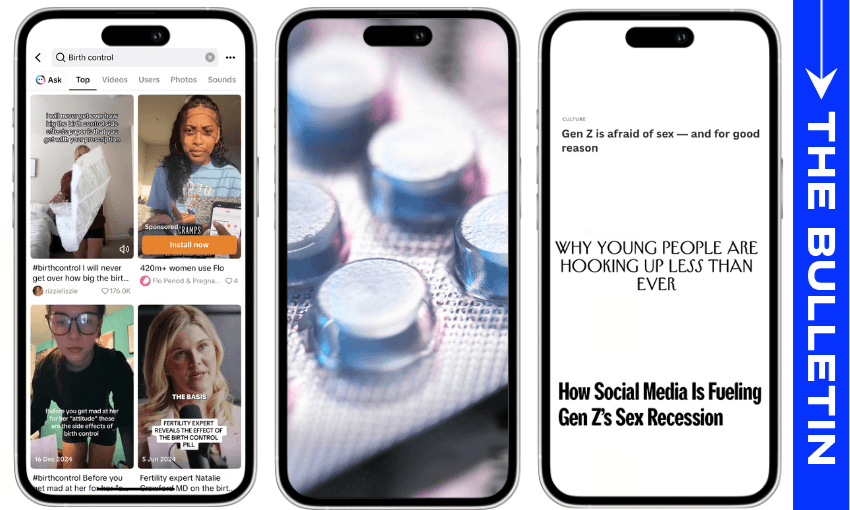
Nearly half of Gen Z use social media for health advice, and the number is even higher for teenagers. A study published in June showed more than half of TikTok videos about contraception included misinformation and a strong bias towards “natural” methods.
“While we anticipated that much of the information on this platform would be incorrect or incomplete, we were genuinely surprised to find that over half of the video creators explicitly rejected hormonal birth control, including the pill, injections, implants, and hormonal IUDs,” said the study’s author Caroline de Moel-Mandel.
Fewer pills and yet fewer babies
New Zealand’s fertility rate (births per woman) is currently 1.57, down from 2.17 in 2010. The decline is even steeper for adolescents, with both teen births and teen abortions declining, reports RNZ.
Globally, Gen Z is less sexually active than other generations. In one study, 37% didn’t have sex the month prior (17% of Gen X had). A quarter of them (adults) haven’t had sex at all. “I think young people are having less sex because of the shift from hanging out in person to hanging out online,” says Michelle Wise, from the University of Auckland. In other words, it’s hard to have a mildly regrettable one night stand if you’re on your computer.
The cost of all this
Last week, Treasury released its Long-term Fiscal Statement, which said New Zealand would need to make significant policy changes in order to avoid net debt of 200% of GDP by 2065. A key factor? Our ageing population. (Oliver Hartwich responded to the lack of political response this week, over on Newsroom.)
The government estimates one in four New Zealanders will be over 65 by 2040, meaning a huge pension bill with fewer working people to service it. And as for the pill? The proportion of the population that is of childbearing age is shrinking. This may be a small factor in birth control uptake going forward; if you can no longer get pregnant, you don’t need to prevent it (though with STI rates increasing for older people, condoms are always a good idea).