
While Nicola Willis wins plaudits for her handling of the fuel crisis, her boss is facing questions about his absence from his government’s biggest test, writes Catherine McGregor in today’s excerpt from The Bulletin.
To receive The Bulletin in full each weekday, sign up here.
Is the PM leading on the fuel crisis?
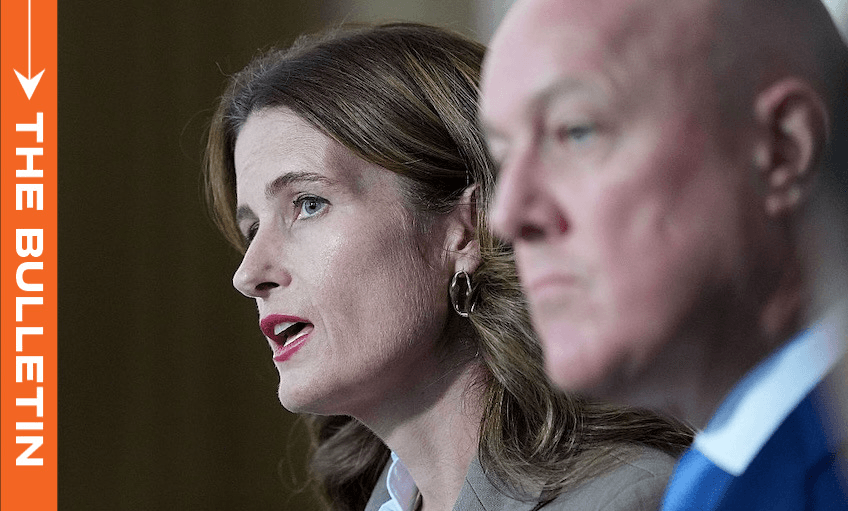
The verdict from commentators over the past few days has been consistent: Christopher Luxon has been conspicuously absent from his own government’s fuel crisis response. “A crisis has the potential to make a prime minister, but Christopher Luxon is missing in action,” writes Stuff’s Jenna Lynch, anchoring her analysis around a symbolic image: while finance minister Nicola Willis and associate energy minister Shane Jones fronted a fuel announcement on Friday, Luxon was in Christchurch at the opening of the city’s new sports stadium. Tracy Watkins at the Sunday Star-Times agrees, arguing the crisis seems “tailor-made” for the business-minded Luxon, yet he’s wasting his opportunity to show leadership just months out from the election.
Marc Daalder at Newsroom also highlights Luxon’s absence on Friday, and his ceding the floor to Willis at the fuel relief announcement a few days earlier. “Arguably,” Daalder writes, “it is Luxon who has been sidelined on the response.” Perhaps the most acerbic commentary comes in the form of a headline to Henry Cooke’s column in The Post, which asks: “Can Christopher Luxon be more than Nicola Willis’ press sec?”
Willis’s moment
The flipside of the Luxon critique is near-universal acclaim for his finance minister. In an editorial, The Weekend Post puts it plainly: “where she is crisp, he is waffly”. The paper notes that on Friday, Willis’s communication style “seemed contagious” – even Shane Jones reined in his “sometimes ponderous verbosity”. Lynch writes that Willis is “across every detail of the response”, leading a ministerial oversight group and the public messaging simultaneously. She has proved “she is highly capable of a prime ministerial-level crisis response. In a leadership void, she has stepped up to the plate.”
“Nicola Willis is having a very good crisis,” writes Cooke. “You may think the Government should be doing more or less or something different, but it is hard to watch her talk about it without getting the sense she is across the issue, concerned about it without panicking, and thinking through several ways the crisis could go from here.”
A narrow political path
Daalder’s Newsroom piece also discusses the challenge for the government in handling the crisis effectively. The obvious political silver lining is that by demonstrating strong leadership, National could boost its chances in November. That will require the public to believe there’s a real crisis to be addressed, Daalder writes. “But over-egging a crisis which may not eventuate carries its own risks too”, such as encouraging panic-buying of fuel. The government “must demonstrate it is leading well in a crisis without talking one into being.”
A different but related challenge is faced by Luxon, whose fortunes could depend on whether he is seen taking charge of the situation. “If there is political advantage to be reaped,” Daalder concludes, “Luxon will need to show up to gather it.”
Don’t mention the pandemic
Another notable aspect of the past 10 days has been the government’s near-obsessive determination to avoid any visual or rhetorical resemblance to Labour’s pandemic response. The Spinoff’s Toby Manhire catalogued the lengths taken at last Tuesday’s fuel relief announcement, including using the Beehive Banquet Hall rather than the more fit-for-purpose theatrette. The three Ts with which the government branded its relief package – timely, targeted, temporary – came with, Manhire noted drily, “zero Covid”.
Thomas Coughlan’s Weekend Herald piece (paywalled) goes further. He reports that Luxon personally intervened before Friday’s press conference to change the language from “alert levels” to “phases” in order to avoid any comparison with the pandemic response. And of course there’s one more way this response differs from Jacinda Ardern’s Covid years, Coughlan says: So far, “Luxon is playing only a supporting role … at least in public.”