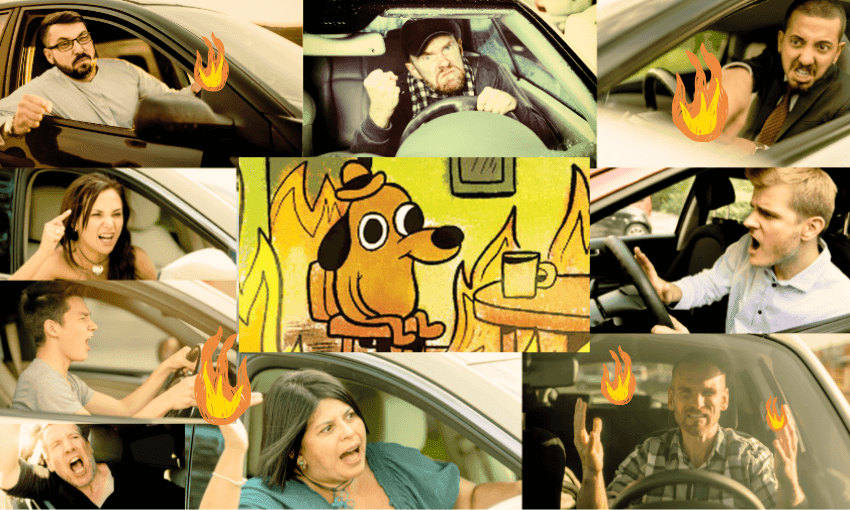

March is notorious for being the worst month to drive in Auckland. But that could be about to change.
Every year, in the month of March, New Zealand drivers perform a mysterious ritual. Every weekday, for many and varied reasons, every single driver in the country tries to drive on the same road at the same time, and it just so happens to be the one that you, dear reader, are driving on.
This irritating dance has become known as March madness (not to be confused with the basketball tournament, although they feature similar levels of yelling). Transport officials speak of it in hushed, fearful tones. News outlets cover it like a coming storm of plague and pestilence.
Like most things, March madness is primarily blamed on the youth. The traffic peak coincides with the time when universities begin and students flood in to attend their first lectures of the year before inevitably getting lazier as the semester drags on.
The university rush comes at a time when road users are already at a high. Schools are back, businesses are well into the swing of things after the summer break, and for some, the end of the financial year on March 31 causes a flurry of activity – particularly for professional services or organisations rushing to spend their remaining budget.
While there is evidence of March madness across the country, the condition affects the most people in Auckland, New Zealand’s largest and second-most-poorly-designed city (after Tauranga). Auckland Transport estimates travel times this month will jump 41% on motorways and 17% on arterial roads.
On Fanshawe St in the city centre, March has the highest traffic flow of any month, with 3,921 vehicles per hour during the evening peak. That’s about 9% more than the annual average of 3,595 per hour.
When you zoom out and look at all monitored roads in Auckland, March looks busy but not unusually so. If 2026 repeats previous annual patterns, March won’t even be the busiest month this year. As Justin Timberlake once said: It’s gonna be May.

Even though the actual increase in cars on the road in March may be relatively small, it has an outsized impact because traffic delays scale exponentially. In heavy traffic, one person tapping their brakes or merging lanes can create a shockwave effect which causes a complete stop miles behind them.
Once the number of cars on any given road goes above a point known as Level of Service D, things start to jam up. “Small increases in volume produce substantial increases in delay and decreases in speed,” Ministry of Transport guidelines say. Above this threshold, a 5% increase in vehicles can result in a 30% to 50% increase in delay. When roads are consistently breaching Level of Service D, you have a real problem.
There are two solutions: first, you could increase the road network’s level of service by widening urban motorways or building new ones. But this is really, really expensive and not particularly effective, because it triggers the induced demand effect; better roads encourage more people to drive which inevitably leads to further capacity issues down the line.
The second option is to disperse the traffic by encouraging people to drive at off-peak times or to use other forms of traffic: walking, cycling, scootering, bus, train, ferry or pogo stick.
The government’s time of use charging bill, which passed its third reading in November and will come into effect later this year, gives local councils the ability to charge drivers a toll for using certain roads at certain times. The idea is that higher charges at peak times will incentivise some people to travel earlier or later to avoid the fees, helping to clear the road for those who don’t have flexibility of travel time.
Cycling is becoming more popular in every major New Zealand city, particularly during March madness. In 2025, Auckland Transport’s monitored locations counted 642,298 bike and scooter movements in March, 25.3% higher than the average monthly figure of 512,567. Some of this can be attributed to the overall increase in commuters, but the disproportionate increase compared to cars suggests that many people are switching transport modes to avoid the chaos on the motorways.
Then, there’s public transport, which can help to ease road volume, but which has its own constraints. Bus networks, particularly, can struggle during March madness. In Wellington city, which has the highest bus usage in the country, it’s not uncommon for buses during the morning peak to be so crowded that they skip some stops because there is no more room.
Where possible, public transport operators run more buses during March, but capacity is ultimately limited by the number of drivers available. The most effective solution ever devised to move lots of people at the same time is the train. There’s a reason startup guys keep reinventing it from first principles.
By the time March 2027 comes around, Auckland will have a vastly different train network. The City Rail Link, due to open in the second half of this year, according to Auckland Transport, will immediately double the number of people who live within a 30-minute train ride of the Auckland city centre. Plus, the new Karanga-a-Hape and Te Waihorotiu stations will provide more convenient access for people heading to the midtown and uptown areas. Trains will be faster, more frequent, with a peak capacity of 19,000 riders per hour (and as much as 54,000 after further upgrades).

The CRL has a great many expectations piled on it. It has become the panacea that will solve all of Auckland’s ills; improving traffic, revitalising the city centre, boosting the economy, making housing denser and more affordable and the city more productive and greener, fundamentally changing New Zealander’s attitudes to public transport and causing a subtle cultural shift to embrace collective solutions that will eventually lead to a popular socialist uprising.
Some of that may not come to pass, but the part about improving traffic is a bare minimum. By next year, the impact of March madness should be less severe. If there isn’t any improvement, people will start to wonder why we spent $5 billion digging a tunnel.