An ode to Each Peach Pear Plum by Janet and Allan Ahlberg

First publish in 1978 this picture book is still going strong.
Made possible by


Books editor Claire Mabey remembers one of the greatest picture books of all time, after the passing of its author.
Each peach pear plum
I spy Tom Thumb
Tom Thumb in the cupboard
I spy Mother Hubbard
Hands up who can recite the rest from here? Janet and Allan Ahlberg’s picture book was first published in 1978 and has firmly implanted flawless rhyme, bears in tweed with shotguns, babies tumbling from trees, Robin Hood at his leisure, the wicked witch and the joys of juicy stonefruit in the heads of young and old ever since.
On July 29, 2025, Allan Ahlberg died, and an outpouring of gratitude for his work has followed. His wife Janet departed the world long ago, in 1994, of breast cancer – but while they were together the Ahlbergs created picture book magic. The Jolly Postman, Peepo!, and Each Peach Pear Plum were among the most popular.
My board book edition of Each Peach Pear Plum is in a sorry state. The spine has all but collapsed and there are smears of uncertain origin on most of the pages. And it’s only seven years old – the same age as my son, to whom this copy really belongs. Julia Marshall, founder of children’s publishing company Gecko Press, told me once that the mark of a successful picture book is that it can withstand 100 reads. I must have read Each Peach Pear Plum 300 times at least and its joys have never diminished.
It’s the first book I remember. A strange sensation of time slippage happens every time I glimpse the front cover, or any of the illustrations – I remember being read to; I remember avidly exploring the world of the book with my eyes, before language even started. Each Peach Pear Plum is responsible for a life-long wish to live among woods and blackberry bushes and fairytale characters, as well as a permanent hankering for plum pie.
But what makes this classic a classic?
Allan Ahlberg knew that without rhythm, rhyme doesn’t work. You have to be able to beat out the lines with a regular thump. That’s where the joy of the language enters the bones. The rhythm of Each Peach Pear Plum is perfect, as is every rhyming couplet. The simplicity of the central hook is brilliant, too – the iconic “I spy” game is turned onto famous fictional characters. Kids love spying, so do adults – we are seekers and finders by nature.
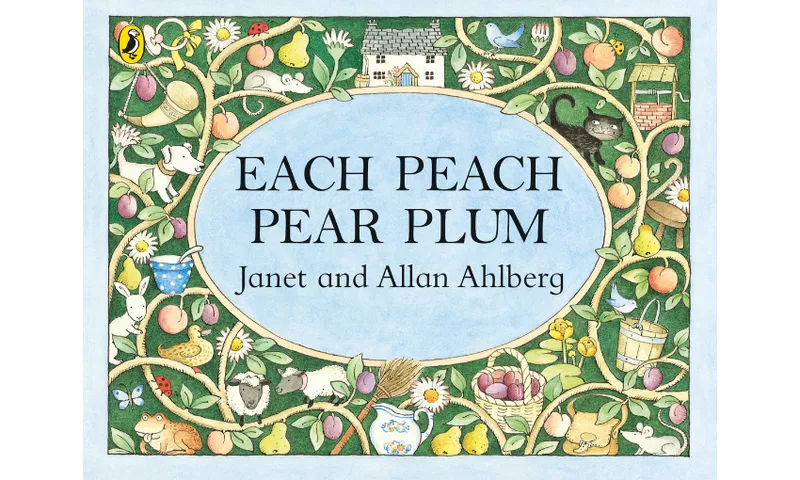
Janet Ahlberg’s illustrations are immediately enticing. They have a William Morris-esque beauty to them: all balance, and pattern and an eye for the aesthetic appeal of leaves and vines and trees. That wee cottage up the top of the front cover says “cosy times ahead” and the vines weaving all around it catching teapots and cats, flowers and fruits, sheep and broomsticks is rich with the promise of fantasy grounded in gentle country life. The blue is the blue of a perfect Summer sky. Janet’s work was lauded at the time, too – her illustrations for Each Peach Pear Plum won the prestigious Kate Greenaway medal in 1979.
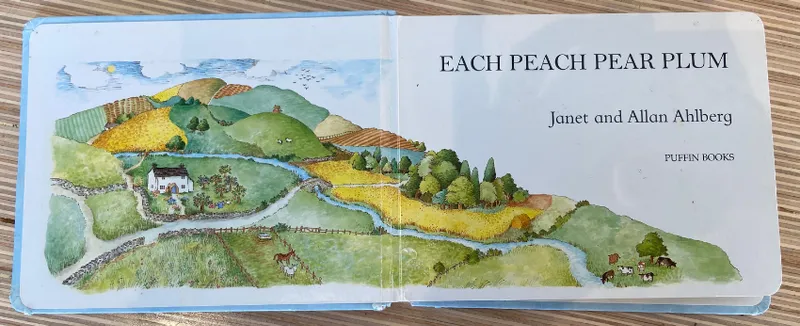
Just as the cover imagery is appealing, there is something marvellous about a book that declares itself in a beguiling set of four words, three of which are fruit. Stonefruits remind us of summer – of warm days, sweet times. The cover image slides beautifully into the endpapers which reveal a rolling landscape into which the cottage is snuggled. The vast empty fields, the wandering brook, the sparse farm animals is a calming scene, ideal for bedtime reading by sleepy parents.
The first scene is of tiny little Tom Thumb up a peach tree with his book. I could not think of a more lovely way to introduce children to the magic of reading and to the potential dangers therein. He’s quite high up that tree – his feet shod in dainty black shoes are dangling over the branch. But this is a story that does not shy away from danger.
As Each Peach Pear Plum progresses from the orchard into Mother Hubbard’s fairytale house and out again into the fields and woods, the full force of the central and magnificent storyline unfolds … an unattended baby is accidentally dislodged from a tree by baby bear’s misfired hunting rifle and is sent floating down the river. Will Baby Bunting be alright?!
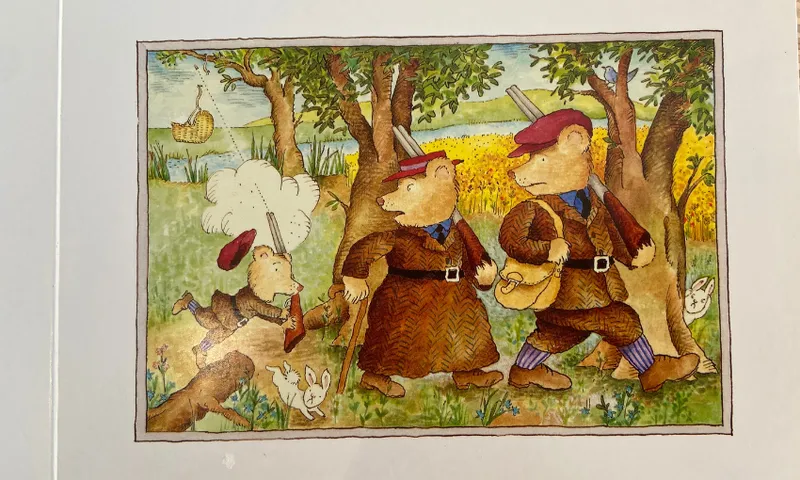
We’re in safe hands with the Ahlbergs. Baby Bunting is of course fast asleep in his Moses basket while Bo-Peep is fetching her sheep and Jack and Jill are tumbling down hills. As in all of the best picture books, the text and the illustrations work together until it’s hard to imagine one without the other. The pictures are rich windows into the world as prompted by the rhyme beside them: those apparently empty fields and woods from the endpapers are built upon, page by page, to reveal that we are in the land of fairytale and it is both charming and action-packed.
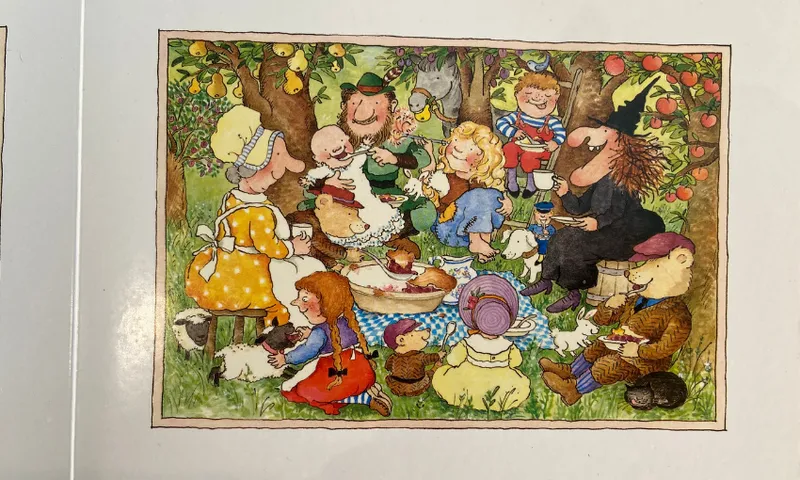
Endings are very hard. Picture books have to have a kind of circularity about them. A sense of an ending – that satisfying full stop – is crucial. They are, or should be, like tiny little novels. The end of Each Peach Pear Plum executes this perfectly. “Plum pie in the sun / I spy …. “ [turn the page!] “EVERYONE!” And there they all are: all the characters of this summery, fruity world eating an enormous pie. Nobody is scared, Baby Bunting is sitting on Robin Hood’s knee with a spoonful of pudding in his smiling mouth. The Wicked Witch looks jolly and entertaining, the three bears have put their guns away.
The Ahlbergs had an eye for aesthetics and an ear for the music of language. Each Peach Pear Plum has sold over six million copies and by my calculations, their timeless classic must have been read at least a billion times.
In a harsh world, Each Peach Pear Plum is a soothing reminder of simple, everlasting pleasures: an abundance of fruit that can be turned into pies; reading in trees; picnics; spying; looking at pictures; and reading before bed.
Thank you Allan, thank you Janet – I hope there’s plenty of plum pie wherever you are.
The Spinoff Books section is proudly brought to you by Unity Books and Creative New Zealand. Visit Unity Books online today.

Claire Mabey
Claire Mabey is a children's author of The Raven's Eye Runaways, The Raven's Eye Rebellion, and a picture book Cass and the Beast illustrated by Jill Calder. For a long time Claire worked on literary festivals and is the founder of Verb Wellington. She lives in Te Whanganui-a-Tara with her partner and son.


