Mountains, memory and Mona Blades: the geology of a novel

Mountains and a mystery involving an orange Datsun are some of what inspired Gina Butson’s novel.
Made possible by


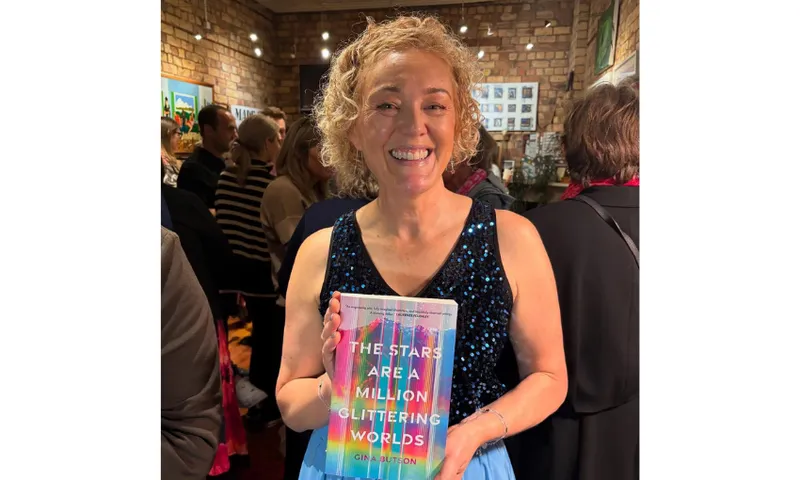
Debut novelist Gina Butson explains the mystery and the mountains that inspired her novel, The Stars Are a Million Glittering Worlds.
It begins with a mountain
Muriwai is formed of mountains. Seventeen million years ago a volcano rose from the sea and formed the Waitākere Ranges. The hills slide back to their roots, slopes slipping seaward to become black sand beaches. Muriwai Beach is made from rocks washed northward on longshore currents from Taranaki maunga and ground down over millennia. I am drawn to the west coast beaches with their volcano-dangerous waters and gannets that slide and stab through the sky.
Whātaitai and Ngake were taniwha who lived in a lake at the head of a fish. Ngake broke free, smashing through the land and out into Te Moana o Raukawa. Whātaitai was not as strong; failing to make it out to open water, he was stranded across the newly-formed intertidal zone. Time passed. One day the seabed shook and lifted itself up. Raised to a place he could no longer breathe, Whātaitai died. His spirit transformed into a bird and flew to the closest peak, Matairangi, to lament the body stretched across the land below.
I have traversed the slopes of Mount Victoria more times than there are pine trees on the hill. I head to the top to look to the harbour in one direction, Cook Strait in the other; possibility in all directions.
Places are formed by nature and stories, by imperceptible movements and seismic trauma. The places we live shape who we are. Both Auckland and Wellington, with their hills and harbours, have been home to me.
It begins years before it ends
In January 2023, I wrote a story and named it for a mountain in Guatemala. But the deep-sea root of the story was something my mother told me a year or so before she died. After my mother was diagnosed with cancer, my parents moved from their house on the inside slope of a volcanic crater to a house on flat land. Their new neighbour, Gary*, had spent most of his 90-something years living in the small fibrolite house next door. As the last seasons of my mother’s life and Gary’s life passed on opposite sides of the fence, Gary changed from being slightly-eccentric to sometimes-aggressive. Once or twice when my mother was alone, he appeared at her bedroom window.
When people die, their stories so often disappear with them. Shortly after Gary died, in 2006, my parents watched as a tangle of plants and a rusted car were cleared from in front of the garage at the rear of the property. Like a time capsule, the garage was opened up and artefacts from the past were revealed. An orange Datsun was towed out. My mother told me this, but the details of the story died with her a year later.
In 1975, before I was born, the New Zealand police interviewed more than 500 people who either owned or drove orange Datsuns. There had been sightings of a woman fitting the description of Mona Blades getting into an orange Datsun shortly before she disappeared while hitchhiking from Hamilton to Hastings.
I don’t think Mum mentioned Mona Blades by name when she rang to tell me about what she’d seen next door. She spoke of the shivery feeling she got when she saw that car. The investigation in the 1970s had lodged in Mum’s memory because she and Dad had owned an orange Datsun until shortly beforehand. We talked in general terms about how cold cases are often solved many years later: there’s always someone who knows the truth but won’t reveal it until the person they’re afraid of is no longer a threat. Or because they’re dying and want to clear their conscience.
The details of that conversation have been lost to time: I have a memory of Mum dismissing the idea that Gary was involved – in her memory, the case had been solved. But I also recall hanging up with a lingering doubt, either of my own or picked up from Mum; a question I’ve never shaken of how that car came to be locked in a garage and never driven again.
Mona Blades’ disappearance remains unsolved.
It began as a short story
I arrived in San Pedro La Laguna in the pouring rain. I don’t know how long I stayed in that town shadowed by volcanoes and lapped by a lake. At a time when I needed escape, it provided me with a home of sorts. After I left, onwards down the country, I received news that the owner of the hostel, Philipe*, had died. I returned to San Pedro. It was 2008.
Finally, I left again and made it to the end of the continent and the end of my trip. The night I began my journey home an earthquake shook the cheap hotel I was staying in. Shortly after I got back to Auckland, a large sinkhole opened up in Guatemala City. The earth is moving all around us, all the time. In the intertidal zone between cities and jobs, I wanted to write about my time in Central America. Philipe’s story haunted me but it wasn’t mine to tell. I didn’t write anything about that time. Not for years.
In 2023, in Wellington, I sat down to write a short story. From the white space of memory, a story set in a hostel in Guatemala emerged. Philipe’s ghost stood quietly in the margins. It was narrated by someone who didn’t have long to live; someone who had lived with their memories and the suspicion of someone else’s secret for years. It was the best story I’d ever written. I was proud of it. It felt polished. It felt like there was more to say.
Writing my novel felt like a process of layering, something formed by time. In the same way the earth builds up layers of silt and sedimentary rock, writing was a layering of words, of craft, of pages; a layering of plot and character and meaning. It began as one thing and became another; a story that lay dormant undersea for years until finally it shook itself into the air.
A novel has many beginnings
My novel, The Stars Are a Million Glittering Worlds, starts on a mountain. It is structured in parts, with shifts in time and place. And, so it starts, again, beside a lake; again, in the sea; in a house. The parts are layered on each other like bands of ice and rock and sand. Places and time and memory stack up on top of each other. Guilt and loss, friends and family, and always the landscapes that shape a life. Gravity pulls, so that the edges of one element blur into the other.
I started writing The Stars Are a Million Glittering Worlds in April 2023, but its roots stretch down to the seabed and across oceans, a story carried and shaped by longshore currents. There was no single inspiration for this book. It is about how our past affects our present. Not one thing, but the drift and accumulation of many things, the big events and small decisions – my experiences and the ghosts of other people’s stories. It is about how we are shaped by where we’re from, where we’ve been and who we travelled with along the way.
*Names have been changed for privacy reasons.
The Stars Are a Million Glittering Worlds ($38, Allen & Unwin) is available to purchase at Unity Books.
The Spinoff Books section is proudly brought to you by Unity Books and Creative New Zealand. Visit Unity Books online today.

Gina Butson
Gina Butson is the author of the novel The Stars are a Million Glittering Worlds, published by Allen & Unwin, July 2025.


