‘One little corner for the children’: New Zealand’s lost children’s book pages

Fragments from some of the children’s book pages that used to live within Aotearoa’s newspapers of old.
Made possible by


Philippa Werry unearths the quirky and star-studded history of the once-thriving children’s book pages in Aotearoa’s newspapers of old.
I grew up in Wellington where the Evening Post ran a page on Saturdays called ‘For the Children’. My first piece published on that page was a 50-word story called ‘The Dachshund Who Ran Away’. I was six and I got five points for it. The aim was to work up to 100 points, then 100 each of stars, marks and laurels.
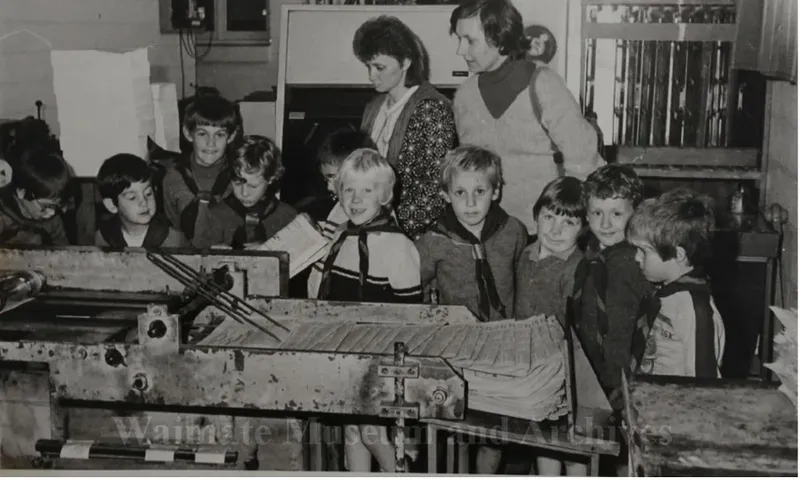
I’m sure some children sent in a few pieces and that was all, but for a bookworm like me, the idea was addictive and I worked steadily through all four levels. I remember sitting at our kitchen Formica table writing stories out by hand. I remember going into the Evening Post offices to have my photo taken (100 points!), being taken to see the huge rollers in the roaring print room, and one of the typesetters giving me an iron slug with my name on it. The reward included a book token, which I spent on The Golden Treasury of Poetry from Whitcombe and Tombs on Lambton Quay.
The Evening Post page might have been unusually elaborate – with its levels, prizes and competitions – but for years, newspapers around the country had pages for young readers and writers. Many people have told me they wrote for them, and some famous New Zealand writers appear in them.
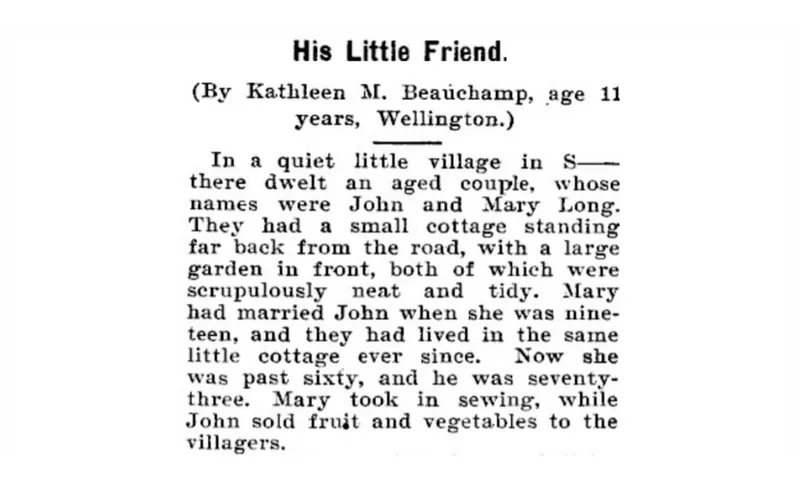
Katherine Mansfield’s first known published work, ‘His Little Friend’ (“By Kathleen A. Beauchamp, age 11 years, Wellington”) was published in the Children’s Page of the New Zealand Graphic in October 1900. Gloria Rawlinson became one of the Sunbeams on the Sun’s page in 1928, aged nine. ”I shall love to have letters from this little invalid of whom I have heard so much,” replied the editor known as The Dawn Lady. Ruth Park, living in Te Kuiti, won the Girls’ Prize for the 1929 Christmas competition in The New Zealand Herald with a story titled “The Waikato Taniwha’s Revenge”.
All the Frame siblings belonged to Dot’s page in the Otago Daily Times. Janet Frame joined in 1932 with the pen name Amber Butterfly and sent in letters and poems, often praised by Dot, until almost its last issue when she was 16. In 1937, Janet’s younger sister June (Dancing Fairy) wrote to tell Dot that their sister Good Queen Charlotte [Myrtle] had died. “We do miss her so much.”
Ruth Dallas described in an interview how she started writing: “When I was 12 I sent work to the children’s page of the Southland ‘Daily News’ … The ‘News’ gave the children of Southland a whole page, both sides, every Saturday, so we had plenty of room and plenty of competition, and I sent in something nearly every week.”
Other writers worked as editors. Elsie K. Morton ran the page in The New Zealand Herald for 10 years, one of the few editors to use her own name. Esther Glen, after whom the Esther Glen Junior Fiction Award is named, was children’s page editor of the Christchurch Sun and later the Press. In 1923, Iris Wilkinson (not yet Robin Hyde) went to work at the Dominion, aged 17, and edited the children’s page of New Zealand Farmers’ Advocate.
Joy Cowley edited the children’s page of the Manawatu Daily Times, a job found for her by supportive teachers when her parents wanted her to leave school. The pay covered her weekly board and left some money over to give her parents at the weekends.
“This, at the age of 16!” she wrote. “I was in heaven! … I ran competitions, published children’s writing and wrote editorials about my imaginary dog called Crackers who was always in trouble. Sometimes Crackers would get to the typewriter and write a story about me. It was all wonderful, and I managed to keep up with schoolwork, and earn University Entrance.”
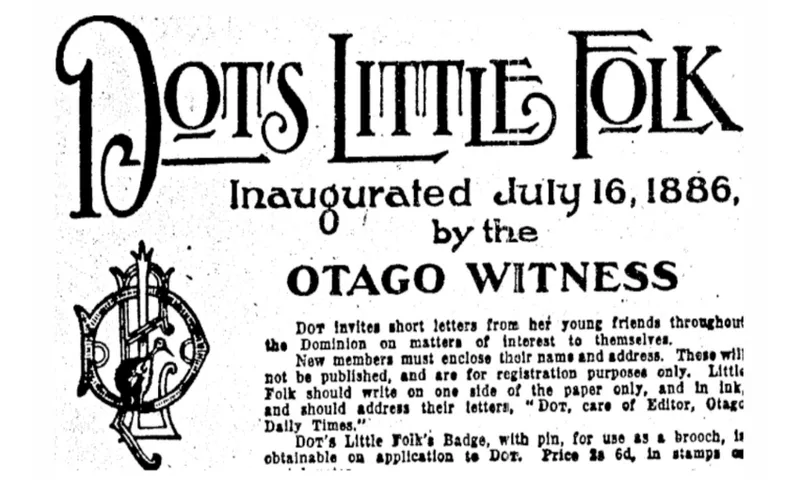
The earliest page was probably “Letters From Little Folk”, later better known as “Dot’s Little Folks”, in the Otago Witness – followed by Aunt Hilda in the Canterbury Times and Uncle Toby in the New Zealand Mail. “The grownup people have all the rest of the paper to themselves,” Dot wrote on 16 July 1886, “but this one little corner is for the children expressly – their story, their poetry, their letters.”
The original “Dot” was Louise Alice Baker, who also wrote the women’s column and several novels. Others continued the page until the Otago Witness ceased publication and then took it to the Otago Daily Times. It was hugely popular and at its height printed several thousand letters a year.
The 1920s and 30s saw children’s pages starting up in even the smallest provincial papers. They were framed as clubs, with certificates and badges – “members of a happy band” as Evangeline, at the Christchurch Star, put it – and they gave children (whose families could afford the paper and postage) an opportunity to express themselves. Not all letters were printed in full, but they were read and replied to in a few sentences. The young writers were noticed and their words and lives validated.
Some pages came with an origin story. Witch Hazel in the Pahiatua Herald said her broomstick had taken a wrong turning, but she liked the town so much she decided to stay. The Wonderland club in the Nelson Evening Mail grew in its first year from 50 members to over 800. Alice had followed the White Rabbit, looking for its gloves, from the Wellington wharves to Nelson, where she was entranced by the bustle of the newspaper office and “decided she would like to run a page herself”.
The editors’ role was to reply to letters, choose contributions to print and fill the rest of the space with poems, jokes, articles, magic tricks, serials, comics, crosswords, tongue twisters, birthday greetings, riddles, activities, recipes, request for penfriends and competitions. Some editors had high standards and could deliver brusque and public feedback. ”You must not get into the habit of using ‘slang’ expressions,” wrote Aunt Roberta in the Manawatu Standard. “Remember, Jack, you are writing for publication in a children’s page.”
Another remarkable page was hosted by Cousin Betty in the Southland Times. The Little Southlanders were very busy. Outside their own page, they had fancy dress parties, put on concerts and pantomimes, visited patients in hospital at Christmas and held bazaars to raise money for charities.
The Northern Advocate had The Young Northlander, edited by Kupe and Princess Raranga. In January 1940, after a year of concerts, fancy dress balls, bottle drives and other fundraising to raise the five pounds each, Kupe brought a party of 600 “Kupe Club” children and 60 adults by train to visit the Centennial Exhibition in Wellington, where they stayed in a hostel in Newtown and got used to hopping on and off trams. In real life, the editors were Ray and Doris Cockfield, who later started a chocolate factory at Onerahi.
Children’s pages flourished for decades, but wartime paper shortages caused many papers to shrink in size. Even Dot’s page came to an end in 1941, although its Old Writers Association continued to hold reunions. The Timaru Herald was determined to keep going. “DEAREST LITTLE PEOPLE,” the editor wrote on 26 April 1941. “We must not forget we are Sunshine Scatterers and now is the time that the world needs our sunshine and laughter. The boys are doing their bit overseas—well, we’ll do our bit at home; and then, when they return, they will be as proud of us as we are of them.”
The Spinoff Books section is proudly brought to you by Unity Books and Creative New Zealand. Visit Unity Books online today.

Philippa Werry
Philippa Werry is an award-winning author of fiction, non-fiction, picture books, plays and poetry, with a strong focus on New Zealand stories and history.


