Sherryl Jordan’s posthumous memoir is a testament to the power of perseverance

Descending Fire was published in 2025. Jordan died in December 2023.
Made possible by

Claire Mabey reviews Sherryl Jordan’s final book, Descending Fire: The Story Behind the Stories.
“This is not a memoir or autobiography,” writes Sherryl Jordan in the author’s note to Descending Fire. “It is more the biography of the people in my books … as real to me as friends I had known all my life.”
Jordan didn’t know for sure that those words were going to be read. She submitted the manuscript of this extraordinary not-memoir to her longtime editor, Penny Scown, who in turn submitted it to Louise Russell at Bateman Books. Russell received it and immediately loved it but before she’d had the chance to say so, Jordan had died of cancer.
There is no question, however, that Jordan intended for this book to go out into the world and find readers. To be published and read had always been one of her deepest desires. Descending Fire lays bare the peaks and troughs of what, from the outside, looks like a smooth and stellar career, and is one of the most generous and intimate portraits of a writer’s life I’ve ever come across. Fans of Jordan’s novels will finish the book with a deepened respect and admiration for the writer who furnished them with so many beloved worlds; and newcomers to Jordan will be instantly drawn to her warmth, her honesty and her life lessons.
Jordan suffered many obstacles in both writing and life. She wrote 12 rejected novels before she learned, in 1989, that Rocco was going to be published. She suffered terrible Occupational Overuse Syndrome (OOS), Chronic Fatigue Syndrome (CFS) and later, two cancer diagnoses, including the bowel cancer that ended her life in December 2023. Jordan’s grit throughout it all is incredibly inspiring: “Persistence was my forte,” she writes in Descending Fire. “Persistence and passion.”
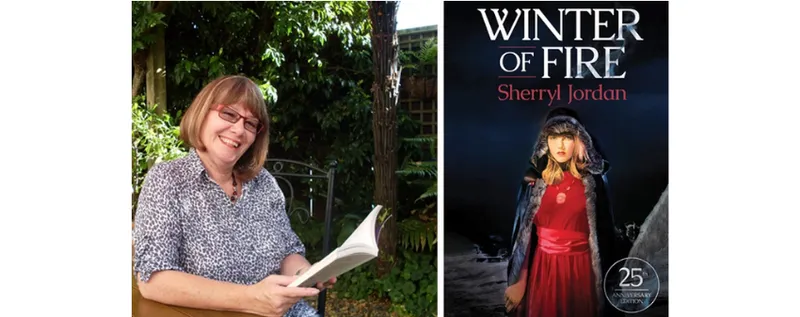
Jordan wanted to be a writer from the age of four. She describes her desire to write as so strong that walking into bookshops caused her pain because she wasn’t there on the shelves. She wanted, desperately, to be published, for the validation of that traditional process to tell her that what she wrote was good. Any writer will recognise that intensity: the agony of wanting to get somewhere that seems so close, so mundane in a way, and yet so far.
And Jordan had to write: throughout her whole life she was bombarded with ideas and characters that came to her in full noise and colour. She had an intense relationship with all of her books, their characters and the worlds those characters inhabited. She felt their joy, their pain and walked with them into witch trials, car crashes, love and terror. Her bond with her creations was so close that she used to have a ritual to say goodbye to them when she knew a book was to be published: she’d wave them out her studio door, willing them to go off and inhabit the imaginations of readers and leave her with the space to welcome new characters in.
If this sounds almost spiritual, it is. Jordan had an enduring and profound relationship with God. She recalls sitting under a hedge as a little girl and “communicating with Someone Else. I think at the time it was a little girl like me, someone I called Dominique”. As she got older Jordan discovered Jesus and fell in love with his story and the “Someone Else” took the form of Christian faith which became an endless well of encouragement and strength. Jordan believed that God meant for her to claim time to write: despite early success as an illustrator, her talent there wasn’t satisfying her incredible hunger to tell stories.
Jordan had no problem with ideas but did, she discovered, have an issue with structure. Rocco was the first book she planned and chopped and cut (literally, with tape and scissors – it was the 80s) into shape. The descriptions of worldbuilding for Rocco are magnificent: she had a particular album of music she’d listen to to evoke the ancient world, she researched tanning pits and ancient cave dwellings. Her delight and joy in the project are palpable. She loved the manuscript so much she almost didn’t send it away for fear it, too, would be rejected. Thankfully, she did send it and in April 1989, at the age of 40, Jordan realised her lifelong dream of becoming a writer.
Descending Fire walks the reader through the creation of most of Jordan’s novels. Readers who are fans of Rocco, The Juniper Game, Winter of Fire, Tanith, Secret Sacrament, The Wednesday Wizard, The Raging Quiet and the rest will be deeply satisfied with what Jordan reveals about how they came to be. Throughout her life Jordan kept a journal and in Descending Fire she shares snippets of it: she recorded the thrill of words pouring out of her and how exciting she found the process. But she also records her consistent and disruptive agonies.
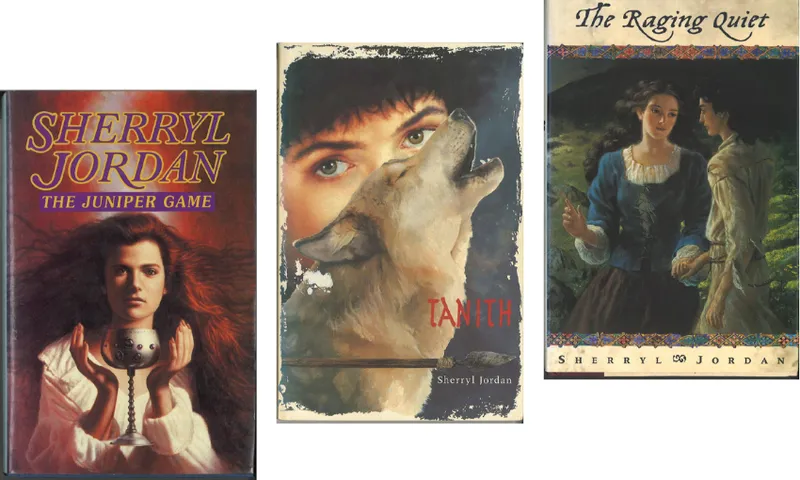
Like many writers, Jordan worried about money. She was blessed (her word) with windfalls: a literary prize of $10,000, for example, that would keep her going and make the work feel justifiable for a while; a golden residency at the International Writing Programme at Iowa University; and with eventual success in the US with books like The Raging Quiet (published in 1999, a stunning novel born from her love of sign language which she learned so she could be a teacher aide to Deaf children) selling incredibly well. But her working flow was interrupted by recurrent OOS caused by the hours and hours she spent handwriting novels, then typing them on a typewriter. The flare-ups set her back for months at a time, caused her to cancel overseas tours and engagements, and led her to wonder just what God was playing at. “God was in big trouble. Huge,” she wrote in her journal in 2018 when a herniated disc, caused by epic hours spent rewriting, nine times, her 17th published novel The Anger of Angels. The pain drove her to suicidal ideation and the deletion of an unfinished manuscript she couldn’t bear being unable to complete.
Jordan’s trials are a gift to readers. Here is a writer who had enormous success both in Aotearoa and overseas. She received fan mail every week (and replied to them all), prizes and rave reviews. However, every single phase of her career is littered with rejection, cancelled projects, extremely difficult editing processes first via snail mail then by email, illness and personal struggle. Writers will empathise with many of her stresses over publishing processes: disappointing covers, arguments about plot and character developments, and where the line falls between children and adults when you’re writing in the young adult genre (Jordan was firmly of the view that young adults were adults and books for them should be treated as such). Writers might also consider the lengthy editorial processes of the 90s and early 2000s to be luxurious compared to today: many of Jordan’s novels went through up to two years of editing before they were published. Today you’re lucky to get a few months.
I think Jordan knew that her not-memoir would encourage generations of writers long after she was gone. She wrote Descending Fire over the Covid years, while living with cancer and feeling herself to be “in a strange kind of waiting room”. The book is written with such energy and honesty that it does feel like a last burst of inspiration with the main character finally being the writer herself.
The final part of Descending Fire is an appendix: a goldmine of writing advice on plot, character, setting, dialogue, point of view and revision. It is the distillation of years and years of work and learning: that persistence of hers, that mantra of “never, ever give up”.
Descending Fire: The Story Behind the Stories by Sherryl Jordan ($35, Bateman Books) is available to purchase at Unity Books. The live event, Descending Fire: Remembering Sherryl Jordan, is on at 10am on Sunday, November 2 as part of Tauranga Arts Festival, tickets available online.
The Spinoff Books section is proudly brought to you by Unity Books and Creative New Zealand. Visit Unity Books online today.

Claire Mabey
Claire Mabey is a children's author of The Raven's Eye Runaways, The Raven's Eye Rebellion, and a picture book Cass and the Beast illustrated by Jill Calder. For a long time Claire worked on literary festivals and is the founder of Verb Wellington. She lives in Te Whanganui-a-Tara with her partner and son.


