


It’s New Zealand’s biggest gold discovery in four decades. It would add billions of dollars to the national economy, but digging it up could kill 650,000 lizards and leave a picturesque landscape scarred for generations.
The goldfield
Wattie Thompson was an eccentric man, but no one could say he wasn’t persistent. He once walked from Bluff to Cape Reinga wearing a sandwich board that said “repent”. And he always believed, long after everyone else had given up, that there was more gold to be found in the Bendigo hills.
Bendigo station, about 20km from Cromwell in Central Otago, is the kind of landscape Rita Angus painted. Grand yellow hills of tussock, occasionally dusted with snow, that feel simultaneously exotic and familiar. Alluvial gold was first discovered in Bendigo creek in 1862, and by 1864 more than 150 miners were working claims along it. In total, about 300,000 ounces of gold were mined from the area. The easy finds ran out within a few years, and though gold mining continued in limited scope until the 1930s, eventually everyone left – except Wattie Thompson.

After returning from the second world war, he eked out an existence collecting gold flakes in a jar, living in a simple cabin among the ruins of the historic goldfield. One of the few luxuries he ever treated himself to was an Air New Zealand sightseeing flight to Antarctica in 1979. He died on Mt Erebus.
The discovery
In the years since Thompson, a handful of mining explorers have revisited Bendigo in hopes of unlocking its secrets, but with limited success. In 2020, Australian company Santana Minerals bought Matakanui Gold, which owned the exploration permits for the area.
Where others had focused on the valley floor, Santana Minerals started drilling along the ridgeline. In April 2021, they hit paydirt: a sample taken at a depth of 40.3m recorded 2.05g grams of gold per tonne of rock. Further drilling revealed a massive, untapped deposit.

“There is more gold in them there hills, as they say,” Santana Minerals chief executive Damian Spring said in 2024 when he revealed the company had identified at least 1.24 million ounces of extractable gold. It was the biggest gold discovery in New Zealand in four decades. At the time, the company estimated the deposit was worth $4.4 billion. The price of gold has more than doubled since then.

The company
Santana Minerals had spent the past seven years looking for gold in Mexico and Cambodia without a significant breakthrough. It acquired Matakanui Gold because the company thought Bendigo had some geological similarities to OceanaGold’s highly productive Macraes gold mine about 90km away.
It is often described as an Australian company, and that’s true in a legal sense, but Santana Minerals’ operations are almost entirely based in New Zealand. The Bendigo-Ophir mine (named after the two closest settlements) is its only major asset. The chief executive officer Damian Spring is a New Zealander, as are most of its staff, and the company is publicly traded on the NZX, so any New Zealander who wishes to can own a piece of the mine.

The investment case
The company estimates it will cost $256m up front to build the mine, plus another $297m to run it. The all-in sustaining cost (how much it costs to dig each ounce out of the ground) is NZ$2,475/oz. With the current price of gold around NZ$8,200, that’s a profit margin of 70%.
Investors in Santana Minerals are speculating that the company will be able to navigate the litany of physical, financial, legal and political challenges on the path from discovery to productive mine. If that happens, the stock price could multiply several times over.
Santana Minerals’ current market cap is NZ$813m, which is significantly less than the value of the gold it has in the ground. This is normal for pre-production mining companies and it reflects the fact that gold isn’t worth much until you dig it up. A fully operational gold mine of this size could be worth $5-6bn (based on the market caps of Emerald Resources and Capricorn Metals, two fully operating gold mines of similar size to the Bendigo-Ophir).
Valuations could rise further if the price of gold continues to rise or if the company finds more gold deposits on its land, which is still mostly unexplored.
The public benefit
An economic impact study by Santana Minerals predicted the project would create 506 jobs in the first year and an average of 350 per year over the life of the mine, with a median wage of $140,000. That would have a major impact on the local economy, with flow-on effects for any business that supplies the mine or its workers.
It would add NZ$360 million per year to New Zealand’s GDP – a cumulative total of NZ$5.8 billion – and generate $1.8 billion for the government through taxes and royalties. That’s a big chunk of money that could make a significant difference for New Zealanders if spent well. It’s enough for a new hospital with a couple of Interislander ferries thrown on top.
The mine
After it announced the gold discovery, Santana Minerals purchased the mine land from two adjacent farms, Bendigo Station and Ardgour Station, for a combined $80m.
There’s a lot of gold at Bendigo-Ophir but it’s at quite low concentrations, which means you need to dig up a lot of dirt to get it.
The company’s plan is to build four open-pit mines. These are generally considered to be more cost-effective and safer than underground mines, but more environmentally destructive. The largest, Rise and Shine, will be up to 1km long, 900m wide and 300m deep.
The mine also includes an industrial cyanide processing plant and a permanent tailings dam to store the toxic byproducts of extraction.

The mine’s construction consent is currently under consideration by the government’s fast track reviews panel, with a decision due by October 29. As it prepares its decision, the fast track panel is considering many concerns, including:
The tailings dam
Parliamentary commissioner for the environment Simon Upton said the “project comes with considerable environmental risk”. The most serious point of concern is the tailings storage facility, a 2km-long hole that will be filled with processed ore slurry (the crushed rock left over after cyanide leaching extracts the gold).
If the tailings leach into the groundwater, it could contaminate Lake Dunstan and the Clutha River. If the dam were to catastrophically fail in an earthquake it could destroy neighbouring properties and cost lives. A catastrophic failure at a tailings dam in Brumadinho, Brazil killed 270 people in 2019 (though that was a more populated area).
Santana Minerals has discussed a variety of steps it can take to mitigate these risks, but safety can’t be 100% guaranteed.
The neighbours
The Bendigo area is a remote but picturesque part of Central Otago which is home to vineyards, luxury accommodation and wedding venues – all businesses which thrive on visual appeal that will be impacted by a massive open-pit mine.
Even if the mine itself isn’t directly visible, some property owners are concerned about the noise, light and interruptions from constantly operating heavy machinery.
New Zealand actor Sam Neill, who owns a vineyard in the Bendigo area, has been one of the loudest opposition voices. “All this land will completely change. Central Otago will completely change. And not for the better,” he said in a short documentary he presented opposing the project.

The wine
Bendigo Central Otago Winegrowers, in their submission to the fast track panel, said “the proposed mine is an existential threat to our ongoing business”, raising concerns that the mine could produce contaminated water or airborne arsenic that would affect the quality of the wine and the reputation of the region as a whole.
The lizards
The Department of Conservation wrote a strongly worded submission to the fast track panel warning that “the scale of impacts on lizards is very high, significant and unprecedented”. Experts estimated the mine would cause “a high mortality rate for lizards, potentially at 400,000-650,000 lizards”. The Kawarau gecko would lose 7% of its natural habitat, and the southern grass skink would suffer “significant medium- to-long-term effects that could impact on its extinction proneness”. Both species have declining populations but are not considered at risk of extinction.

The iwi
A cultural impact assessment by Aukaha, a consulting firm owned by five Otago-based rūnaka affiliated to Kāi Tahu, highlighted strong concerns about the impact on waterways and native flora and fauna. It found there was “very little recognition of Kāi Tahu connection, values and mātauraka” in the company’s reports and recommended that Santana Minerals contribute “dedicated resources and funding” to Māori-led biodiversity initiatives.
The heritage values
Heritage New Zealand opposed the application, warning of a “major loss of heritage values” if the ruins of the old gold mine were destroyed to make way for the new gold mine.
Santana Minerals proposed creating a $5m compensation fund for biodiversity and heritage loss. DOC heritage advisor Matthew Schmidt said that was “disproportionate to the scale of effects on historic heritage that would be lost”.

The government
The coalition government set a target in 2025 of increasing mining-related exports by approximately $1.4bn to $3bn by 2035. The Bendigo-Ophir mine would fill much of the gap almost on its own.
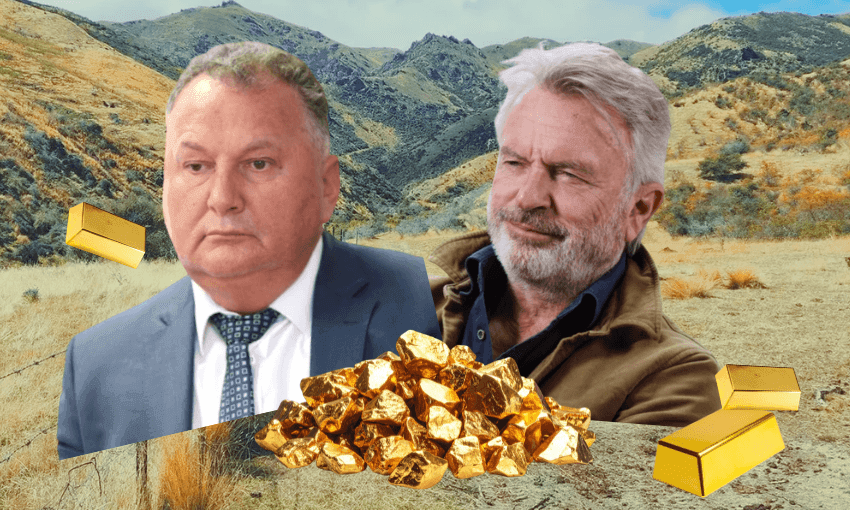
Minister for resources Shane Jones is a full-throated supporter of the mine. He’s referred to himself as a “tenacious advocate for the minerals sector” and has picked public fights with opponents of the mine, including Sam Neill and Sir Ian Taylor. He antagonised protesters in Dunedin by saying “Otago is empty” and dismissed the plights of the native lizards, saying “I’m not going to let juvenile lizards frustrate us at a time of economic challenge and economic hardships”.

The fast track panel’s decision is due out by October 29, just over a week before election day. If the project is approved on schedule, it will be seen as proof that New Zealand has become a more mining-friendly country and will likely lead to more interest from international explorers and developers. It would be a major victory for the government, which has faced significant opposition to the fast track policy but would be able to hold the approval up as proof of concept for the new system generating economic growth.
The hills above Bendigo Creek, where Wattie Thompson always swore there was more gold to find, are about to become the test case for how much of the country New Zealanders are prepared to dig up in pursuit of it.