



Helen Clark and the Waitematā Local Board want to dump Auckland’s growth on west and south Auckland, but in a nice, left-wing way.
At first glance, Waitematā Local Board’s submission on Auckland’s housing future looks pretty progressive. The board supports “resilient and thriving” communities, it begins. It wants to create “quality housing choices for people of all ages and life stages”. So far, so pleasant.
But then, a nimby sting in the yimby tale. Under the headline “on walkable catchments”, the City Vision-dominated board argues the place for those aforementioned resilient, thriving communities is not necessarily the posh suburbs near the city centre that they serve. It says the “walkable catchment” where dense housing should be legalised around the city should be reduced from 1.2km to 800m, citing the area’s hilly topography and infrastructure challenges.
It just so happens that reduction would likely stop development in character suburbs like St Mary’s Bay, where houses go for an average of about $2.6 million and Parnell, where they cost about $1.8 to $2.4 million. The board carries on to say that, because a lot of Auckland’s jobs are located in south Auckland, our councillors should consider putting more apartments over there.

In trying to keep some of Auckland’s richest suburbs in a time prison and divert growth to its poorest, Waitematā Local Board has an ally in former Labour prime minister Helen Clark. Her op-ed for the Herald, published on Thursday, implores the council to change its upcoming housing plan and retain protections on all of Auckland’s existing character suburbs, one of which she happens to live in.
Clark also points to the south as a potential venue for the extra housing the city’s leafy villa suburbs would be shirking, while adding in the west and north for good measure. “Auckland is a collection of metropolitan centres, including Takapuna, Henderson, and Manukau, and people want to live and work near them just as much, or more than, the central city,” she contends.
Together the board and Clark are at the vanguard of a growing left-coded campaign against centrally located apartments. Several of their arguments are specious at best. Clark’s piece says we need special character to protect Auckland’s heritage. But the council is keeping all its heritage-scheduled buildings. Special character areas are specifically designed as a heritage workaround. Most houses within them are extensively renovated. Often owners have built whole new homes out back, leaving only a historic facade in front. “A lot of the special character values of these places have been corrupted by development,” says Jeremy Hansen, an architecture commentator who literally wrote the book on villas.
Both Clark and the board bring up infrastructure as a barrier to housing in our inner suburbs, noting the tendency for Auckland’s aging pipes to overflow when it rains. But Auckland Council has just built a $1.5bn sewer pipe to address those issues. The Central Interceptor is set to open in July and it’s projected to reduce sewage overflows in central suburbs by about 80%. Add in the City Rail Link, and the villa belt is going to be served by some of the best infrastructure in the country.
Clark says special character areas are only 3.6% of Auckland’s residential land. Again, that’s misleading. Character protections cover a huge amount of the city’s most desirable areas. They cut off development in 43% of the residential sections within 5km of the city under the council’s still-operative Unitary Plan, and that figure rises to more than 90% in places like Ponsonby East.
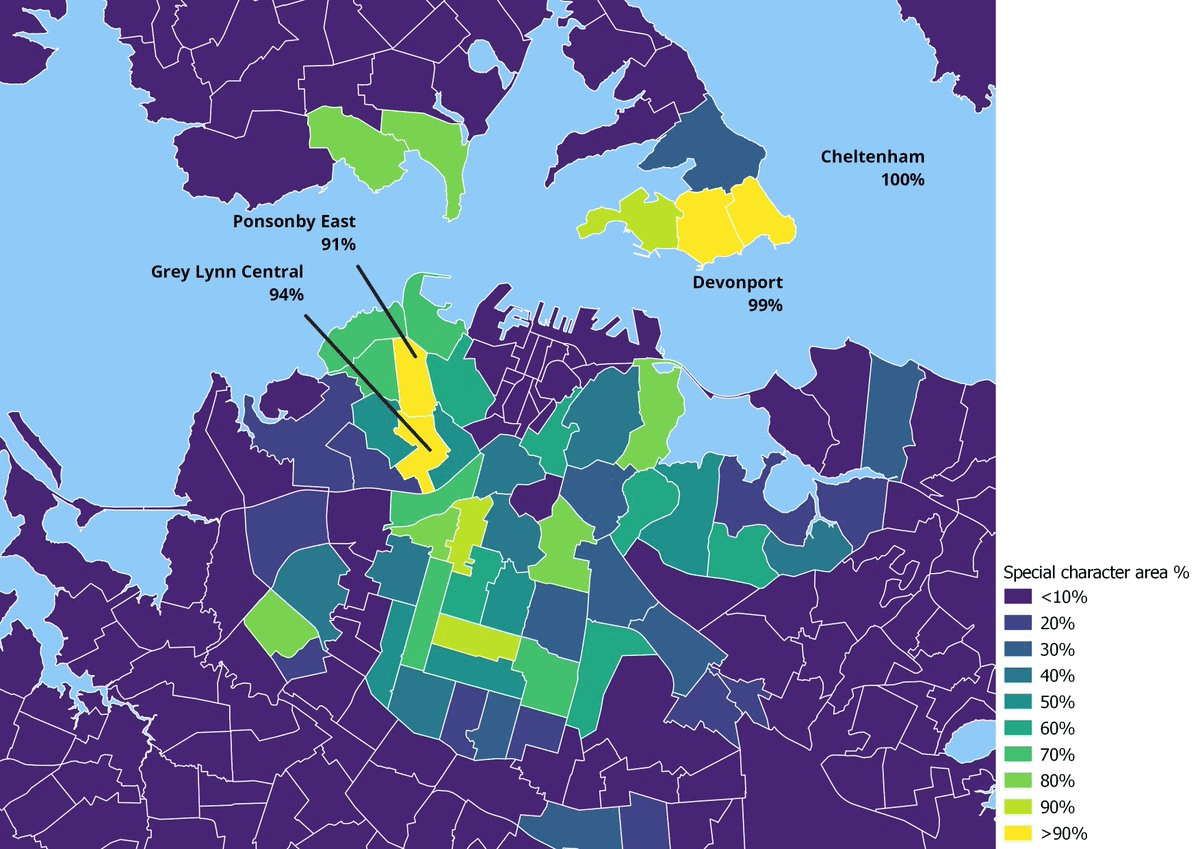
Most of that will be retained under whichever housing option the council goes with in future. It’s only proposing to eliminate protections on 4,735 of the city’s current 20,466 character homes. Those remaining protections come at a big cost in carbon emissions and longer commutes. Though the Waitematā board members say there are just as many jobs out south as there are in their ward, that’s only true if you combine the Māngere-Ōtāhuhu, Ōtara-Papatoetoe, Manurewa, Papakura, Howick and Franklin local board areas. Those six boards are home to 258,000, or 27%, of the city’s jobs. Waitematā hosts 239,320, or 26%, of Auckland’s roles in a fraction of the space. Despite what Clark says, it seems a heap of people want to be close to the city centre after all.

As for the idea that we should be putting more of our houses out in the south and west, we’ve already done that for the better part of a century. Auckland’s special character villas started out as cottages for mostly Māori and Pacific workers. They were clustered close to the city, in places like Grey Lynn and Ponsonby. As the desirability of those suburbs increased, the council cut off development. Demand went up, supply stayed the same, and predictably the areas gentrified, with most workers either being forced out by rent rises or selling to new moneyed owners.
The same pattern has been enforced in dozens of council documents across the decades. Even the Unitary Plan established a “donut city” where housing is allowed in Henderson but not Herne Bay. It’s a self-reinforcing cycle. Commentators like Clark now perversely use the inner suburbs’ high house prices, which were caused by development restrictions, as an argument against more development, saying most poor families couldn’t afford apartments in them now anyway.

Maybe that’s true in the short term. But study after study has shown that allowing development in upmarket areas brings down housing costs across the city, including in low-income areas. Poorer families were forced out of Ponsonby, Grey Lynn and Mt Eden many years ago to make room for residents like Clark or some of the representatives of the Waitematā Local Board.
Even if they won’t all be able to come back, they at the very least deserve a chance at lower rent. Our central suburbs have dodged development for decades and the west and south have already stepped up enough in their stead. As Waitākere councillor Shane Henderson has argued in council meeting after council meeting for years on end, it’s time they did their part.