Echo Chamber: Gaza, blood quantum, and housing in Epsom

David Seymour and Winston Peters dominated Tuesday’s Question Time.
Things got heated as parliament debated some of the most controversial issues in New Zealand politics.
Echo Chamber is The Spinoff’s dispatch from the press gallery, recapping sessions in the House. Columns are written by politics reporter Lyric Waiwiri-Smith and Wellington editor Joel MacManus.
Prime minister Christopher Luxon missed Tuesday’s question time to attend his son’s graduation. In his absence, his two deputies took the main billing: David Seymour, who answered questions as acting prime minister, and Winston Peters, who can’t resist making himself the centre of attention.
The MPs were back in Wellington after a two-week break, a byelection and a resignation, feeling refreshed and ready for a tussle. In the first question time of the new sitting block, they tackled some of the most controversial issues in New Zealand politics, starting with the biggest taboo of all: building townhouses in Epsom.
Chris Hipkins kicked things off by trying to drive a wedge within the coalition, asking whether the prime minister (David Seymour) agreed with the prime minister (Chris Luxon) that the government wanted house prices to increase, or with the housing minister (Chris Bishop) that house prices should fall.
Seymour said it wasn’t the government’s job to set house prices, but that they wanted to make it easier to build houses. “Not in Epsom,” Greens co-leader Chlöe Swarbrick interjected. Seymour’s home electorate has been notably opposed to the government’s upzoning efforts.
Hipkins charged ahead bluntly, asking the same question a few more times with slightly different wording. Up or down? Up or down? Labour’s Rachel Boyack made a series of exaggerated gestures, pointing to the ceiling, then the floor. Seymour refused to take the bait. “We seem to be having a communication or comprehension problem on behalf of the leader of the opposition,” he said. “It reminds me of when I used to tutor Econ 101.” He explained, very slowly, that he wanted New Zealanders to be richer so they could bid higher prices for houses, but he also wanted to increase the supply of houses.
Not giving up just yet, Hipkins asked the prime minister (David Seymour) about comments made by the MP for Epsom (David Seymour) criticising the proposed upzoning as a “significant change to the character of New Zealand’s oldest suburb”. “Is the government’s position that there is therefore housing intensification and more deregulation around building more houses, except in Epsom?” he asked.
Seymour insisted he was merely advocating for the interests of his constituents, that he was fine with tall buildings around the Mt Eden train station but sceptical about three-storey townhouses in other areas. That wasn’t the end of the matter, though. Up next was a patsy question from Parmjeet Parmar about the government’s changes to the RMA. Seymour said he didn’t want councils to “say no all the time” (“Unless you’re in Epsom,” Swarbrick jeered) and that he wanted New Zealanders to “have the right to develop their property as they please” (“Unless you’re in Epsom,” Swarbrick repeated).
As Seymour segued to talking about excessive health and safety regulations, Shane Jones called out, “no more cones”. “Definitely no more for you, Shane,” Swarbrick replied.
Things got even more heated later in the debate when Te Pāti Māori co-leader Debbie Ngarewa-Packer asked whether the prime minister (Luxon) would urge Israel to allow the safe passage of the Global Sumud Flotilla, a fleet delivering aid to Gaza with several New Zealanders on board. Seymour and the Act Party are widely considered to be the pro-Israel faction within the coalition, so it was a chance to test his stance. “We are focused on the wellbeing of people in New Zealand primarily,” Seymour replied.
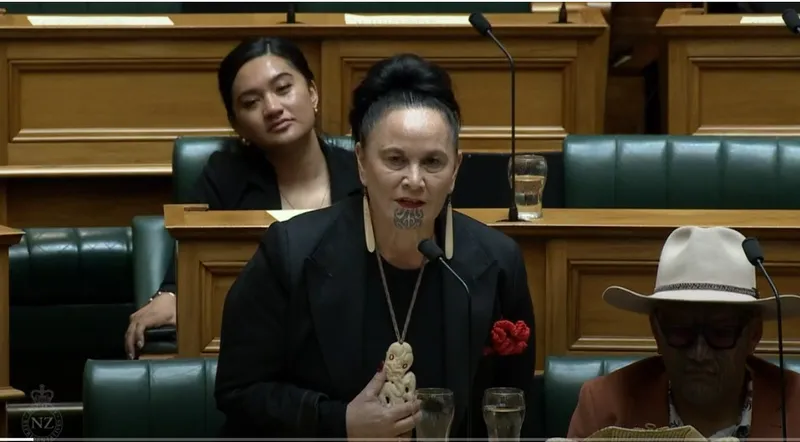
Ngarewa-Packer asked if he accepted the findings of the UN, the WHO and the International Criminal Court that the famine in Gaza was man-made. “If the member believes the most important thing we can do is talk about whether an organisation’s statement is correct or not, I don’t think she is living in the real world,” Seymour said. (“This is why people hate politicians,” Swarbrick said). Ngarewa-Packer asked if that meant the prime minister (Seymour) was disputing the UN’s findings. That caused Seymour to stumble slightly, “Um, aah, what I’m saying is that the government doesn’t have responsibility for what the community thinks.”
Winston Peters, who was visibly fuming throughout this exchange, finally got his chance to speak when Greens co-leader Marama Davidson asked him why the government was taking so long to recognise the Palestinian state, even though “France, Canada, the UK, Australia, Norway and Spain have all opted to do so”. Peters climbed up on his nationalistic high horse, declaring that New Zealand was more democratic than any of those countries, because we gave Māori the right to vote in 1867 and women the franchise in 1893.
“Oh, lucky Māoris! You ‘gave’ us [the vote],” Ngarewa-Packer interjected. “No, no, no, not half-Māori; I mean real ones. Not the Irish Packers,” Peters replied. There was a shocked reaction – Peters had just claimed the co-leader of Te Pāti Māori wasn’t a “real” Māori because she had some Irish ancestry.
Ngarewa-Packer raised a point of order, complaining that references to blood quantum and being “part” Māori were unparliamentary language. Speaker Gerry Brownlee agreed and asked Peters to withdraw. He didn’t, instead arguing that Te Pāti Māori were the first ones to reference blood quantum. Brownlee admitted he couldn’t hear much of what happened and agreed to wait to review the transcript in Hansard. The record was made available later that day, and didn’t pick up any of the comments Peters alleged, which will make for an interesting showdown at the next question time.
One for the record
Things got rowdy during an exchange with Labour’s health spokesperson Ayesha Verrall and health minister Simeon Brown about the cost of elective surgeries. Seymour tried to dob in an opposing MP to the principal.
“A Labour member said ‘money for your mates’ in reference to the government’s procurement process. That member happens to be a real stickler for the rules, I wonder if he’d like to withdraw it?” he said.
Everyone’s eyes turned to Labour’s resident stickler, Keiran McAnulty, who pleaded innocent. “I didn’t say that, sir; it must have been somebody else.”
There was a brief pause. Brownlee looked unimpressed. After a moment, Damien O’Connor rose to his feet: “Mr Speaker, I said that, but I’m not a stickler for the rules.”

Joel MacManus
Joel MacManus is a senior writer for The Spinoff. He previously worked at RNZ and Stuff, and began his career at Critic Te Ārohi. His writing explores the political, economic and cultural systems that underpin modern New Zealand. He won the 2025 Voyager Media Award for Best Columnist, Opinion or Critique.


