The government’s homelessness ‘ban’ may not be as ridiculous as it sounds

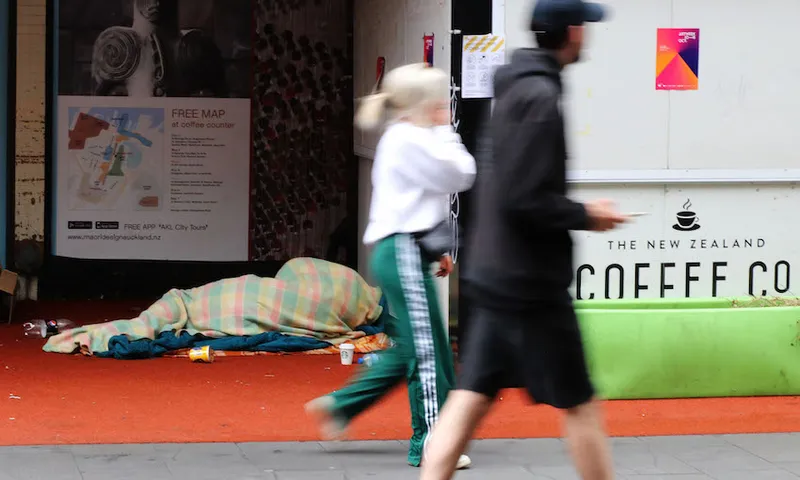
Will the government force homeless people from the city centre to the suburbs? (Photo: David Jensen)
The only cure for homelessness is homes, but responsible policing plays an important role in managing the symptoms.
Given the amount of ink that has been spilled in the past week about the government’s idea for getting homeless people out of city centres, it’s strange to say that we don’t actually know what the policy will be.
Prime minister Christopher Luxon confirmed that “move-on orders” were being considered, but nothing has been presented to cabinet yet. The suggestion appears to have come from the government’s advisory group on retail crime (which is made up of business owners, not homelessness experts). For more on the details of this mysterious policy-that-isn’t-quite-a-policy-yet, check out Emma Gleason’s explainer.
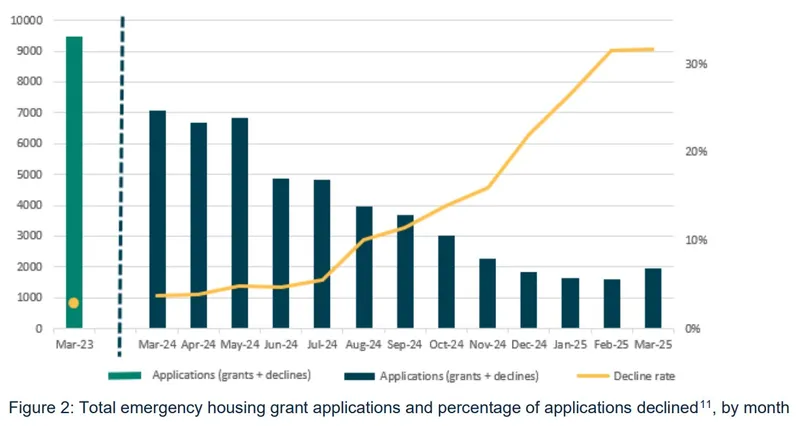
Commentators and sector leaders have widely criticised the proposal for two main reasons: firstly, that it’s cruel, and secondly that it won’t work. Both of those things are undeniably true. Further targeting and victimising the most vulnerable members of society for the crime of poverty is a callous approach, especially when the government’s emergency housing policies have directly contributed to rising homelessness. As for the efficacy, Auckland city missioner Helen Robinson told The Spinoff a ban would be ineffective “because it literally and metaphorically just shifts the problem”.
There is extensive evidence that policing crackdowns don’t work. Research in Los Angeles followed three neighbourhoods where crackdowns on unsheltered camping took place, costing as much as $US6,208 per homeless person per year in police resources, and yet the overall population of homeless people increased over two years. A study in Western Australia found that 89 homeless clients had accumulated 1,021 move-on orders in five years, with no notable improvement in housing rates. A meta-analysis by the US National Alliance to End Homelessness concluded “there is zero empirical evidence that criminalisation reduces homelessness”. On the contrary, it tends to make it worse because it undermines trust in social services providers.
This should all be self-evident. The only cure for homelessness is homes. It’s literally in the name. Move-on orders and camping bans don’t put people into homes. But, extending the metaphor of homelessness as a disease, effective treatment also means managing the symptoms.
From a policy perspective, the cure would mean more funding for Housing First programmes, wider availability of the income-related rental subsidy, supporting greater housing construction for Kāinga Ora and/or community housing providers, and providing easier pathways into emergency housing. (The government has taken some positive steps in this regard, by underwriting loans for community housing providers, and recently announced another 300 Housing First placements – though Auckland and Wellington’s city missioners said that was less than a third of what was required).
Symptom management comes in two forms: addressing the impacts on the individuals and the impacts on wider society. Charitable organisations that provide food, clothes, showers and healthcare don’t cure homelessness, but they help to make the experience slightly less painful. Rough sleeping also affects others in wider society. Widespread, visible street homelessness affects perceptions of safety, comfort, foot traffic, retail sales, property values and the overall culture, vibe and economy of a city. It’s entirely appropriate for governments to treat it as an economic emergency.
Move-on orders aren’t an entirely novel concept. New Zealand police already have legal options for dealing with disruptive homelessness. For example, rough sleepers who block footpaths can be charged with obstructing a public way under the Summary Offences Act. Similarly, police often apply laws against public disorder, assault and theft. Officers are well aware that there is little point in fining or imprisoning people with no money and nowhere else to go, but taking someone back to the station to calm down or sober up has some benefit. Similarly, when a large group is building up in a public place, an order to disperse can prevent a situation from growing out of control.
Several councils also have existing bylaws aimed at reducing the impact of homelessness. (Bylaws are enforced by council officers, but police can be called in as backup.) Auckland and Hamilton have rules against begging in a distressing or intimidating manner. Tauranga controversially implemented a complete begging ban within 5m of hospitality or retail premises in 2019, but revoked it a year later. Nelson banned sleeping on the footpath (specifically, occupying a public space for more than two hours during the hours of darkness), but enforcement has proved problematic.
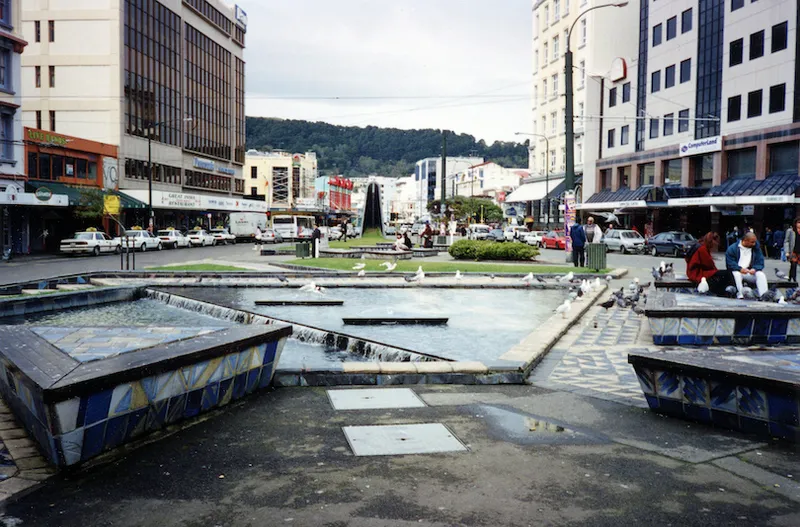
Wellington is a good case study of how bylaws can be used effectively. In the past two years, despite an overall increase in homelessness, the capital has managed to make Te Aro Park and Manners Street, formerly dominated by homelessness and public disorder, feel slightly safer and more inviting for the general public. The council added additional lighting, moved a public toilet that affected visibility, and added pedestrian boardwalks and parklets. Community patrols took a stricter approach to enforcing bylaws against erecting structures in public places, cracking down on people accumulating mattresses, boxes and shopping trolleys, which can quickly become permanent encampments and have an outsized impact on everyone’s enjoyment of the area. That approach could be seen as cruel, but it’s also responsible management of a public space.
Addressing homelessness requires treatment at every level: poverty support services, management of public spaces, and social housing. The problem is that politicians are often blind to one or more of the dimensions. Left-wing governments talk a big game about supporting the street community, but feel uncomfortable with a hardline policing approach, which takes more of a toll on the wider public. Right-wing governments capitalise on public frustration and take a tough-on-crime approach, trying to arrest and enforce their way out of the problem without addressing the underlying causes.
We are seeing that right now in the US, where the Trump administration has taken a particularly aggressive line, ordering federal troops to clear homeless encampments from cities, ending federal funding for Housing First, and threatening criminal prosecution against charities that offer harm reduction services.
Ministers in New Zealand’s government seem to have a range of views. Police minister Mark Mitchell has called homelessness a “lifestyle choice” and wants stricter enforcement to keep rough sleepers away from businesses. Deputy prime minister David Seymour is sceptical of that approach, while housing minister Chris Bishop has increasingly become a proponent of Housing First.
It’s not clear where the government will fall on this yet-to-be-defined policy. If it opts for targeted and restrained restriction against sleeping or begging on the busiest pedestrian streets and nightlife areas (Queen Street, Karangahape Road, Courtenay Place and Cuba Street, for example), combined with more social support services and further expansion of Housing First, it could be a world-leading approach to one of society’s most difficult problems. If it turns out to be a complete ban on homelessness in the CBD and an attempt to police people out of poverty, it’ll be doomed to fail.

Joel MacManus
Joel MacManus is a senior writer for The Spinoff. He previously worked at RNZ and Stuff, and began his career at Critic Te Ārohi. His writing explores the political, economic and cultural systems that underpin modern New Zealand. He won the 2025 Voyager Media Award for Best Columnist, Opinion or Critique.


