Echo Chamber: Spineless, unacceptable, deeply offensive… C U next Tuesday?

Speaker Gerry Brownlee named and suspended Chlöe Swarbrick on Wednesday.
Inside parliament, as MPs and speaker Gerry Brownlee battled over his decision to suspend Chlöe Swarbrick for calling government MPs spineless.
Echo Chamber is The Spinoff’s dispatch from the press gallery, recapping sessions in the House. Columns are written by politics reporter Lyric Waiwiri-Smith and Wellington editor Joel MacManus.
All eyes were on Chlöe Swarbrick from the moment she walked in the door. There was more security than usual in the public gallery; both police and parliamentary security stood on guard, as if they were expecting chaos from protesters. There were none to be seen – the gallery was mostly empty but for a school group.
The Green Party co-leader had ruffled the speaker’s tail feathers the previous day by urging “government MPs with a spine” to back her bill sanctioning Israel. Brownlee, who has typically been a rather passive speaker who lets MPs get away with more than they should, took great offence to this comment and ejected her from the chamber, saying she couldn’t come back until she apologised.
As she returned to the house for Wednesday’s question time, Brownlee began by inviting Swarbrick to withdraw and apologise for her statement. “I won’t be doing that, Mr Speaker,” Swarbrick replied. “Then the member is to leave the house,” Brownlee said. But Swarbrick did no such thing. She crossed one knee over the other and cast a contumacious gaze at the speaker’s chair. This made Brownlee big mad. “Is the member refusing to leave the House? I therefore name Chlöe Swarbrick.”
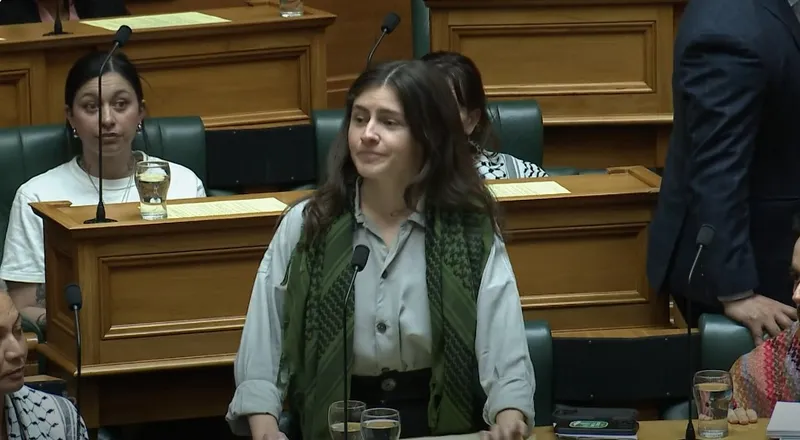
Naming is an innocuous-sounding ruling that is actually one of the most serious punishments an MP can get, a suspension from the House for “grossly disorderly behaviour”. Labour leader Chris Hipkins immediately tried to interject, but Brownlee was on a mission. He called for an oral vote to name Swarbrick. The government benches rang out with “aye” and the opposition, “no”. “The ayes have it,” Brownlee declared, even though the nos were clearly louder. The opposition protested, so Brownlee called for a party vote. The parties voted down government lines, meaning the ayes won 68-54. “The member will leave the house,” Brownlee said triumphantly.
At this, Swarbrick stood up and left her seat – but not without a quick “free Palestine”. “Yasss,” cheered Debbie Ngarewa-Packer.
That was far from the end of the matter. The House then turned to a long debate about what had just happened. Chris Hipkins began with a characteristically pedantic complaint about the exact wording of the motion. “I wonder whether you could indicate to us what the motion that the House just voted on actually was? Because if it was the one that you spoke, it doesn’t have the effect that you think it does.”
Brownlee had no patience for Hipkins’ schtick. In an impressively petulant response, Brownlee hit back with “in that case, I’ll put it again”. The House repeated the same performance – again, the no vote was louder. Brownlee ruled with the ayes, but there was a protest, and another round of party votes yielded the same result as before.
Hipkins then questioned whether the punishment was warranted. It’s common for MPs to be kicked out of the house for the day for unparliamentary comments, but it’s extremely rare for speakers to demand an apology the following day. The only recent example was in 2015, when then prime minister John Key accused opposition MPs of “backing rapists”, prompting a mass walkout. “That was a very controversial matter, and it was at least a week later that the speaker asked him to withdraw and apologise in order to restore order in the House, which had been lost,” Hipkins said.
Willie Jackson, proudly one of parliament’s Naughtiest Boys, wanted to give his personal input as someone who regularly gets in trouble with the speaker. “I think this is outrageous,” he said. “You have kicked me out twice for calling another member a liar, and then I’ve been out of the House for less than 30 minutes… It is incredibly unfair that I can call another member a liar, rightfully get kicked out of the House, and come back into the House within half an hour, with no apology required.”
From across the room, Chris Bishop yelled “you apologised” – which sent Jackson into a fit of righteous rage. “I did not apologise. I did not apologise and I would never apologise.”
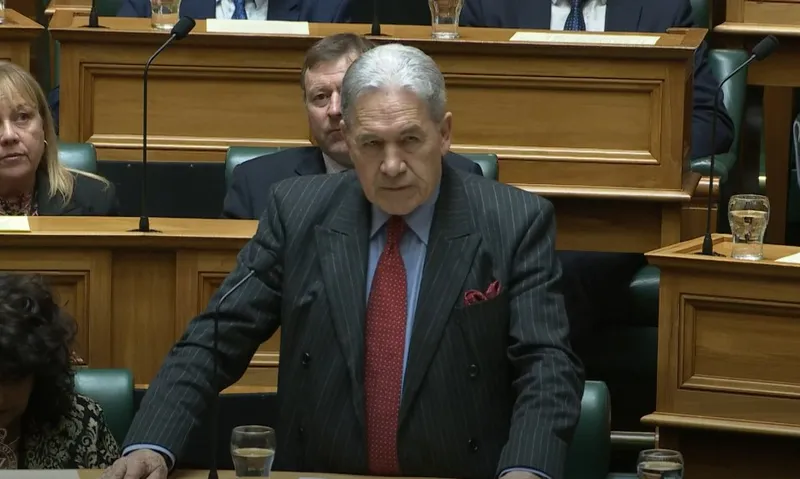
Winston Peters, whose party had now twice voted to name and suspend Swarbrick, then took to his feet to defend her. “I don’t agree with a thing that Chlöe Swarbrick said at all, but this is a robust House where people have a right to express their views as passionately as they may, within certain rules. But I do not think that eviction was warranted.” He compared it to another John Key incident from 2015, when the then prime minister demanded the opposition “get some guts” regarding sending troops to Iraq, and the recent hullabaloo where Brooke van Velden became the first MP to use the word “cunt” in the house.
Debbie Ngarewa-Packer, not one to let Act have such a conspicuous honour to itself, decided to add her name to the list. “There were many of us that were offended by the ‘cunt’ word,” she said. She argued that “spineless” did not reach the same threshold and that the speaker’s ruling appeared to be “suppressing an opinion on the rights of Palestinians”.
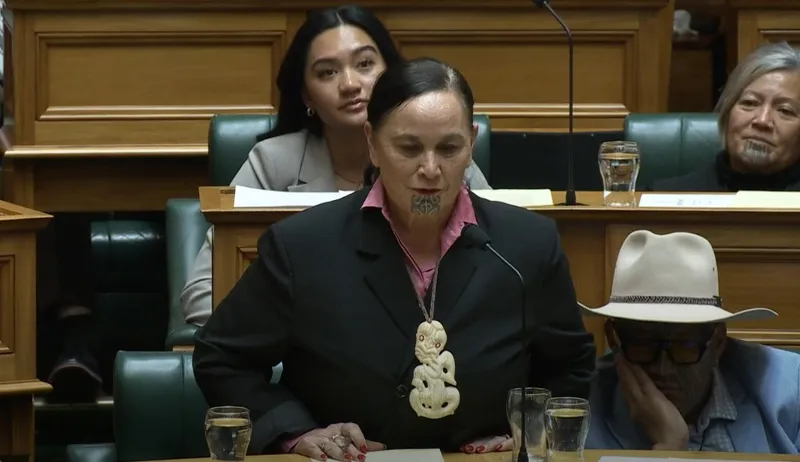
Brownlee didn’t react to the second use of the word “cunt” under his watch, but the repeated use of “spineless” sent him into a tizzy. He grasped desperately for his pearls like a Victorian lady about to faint onto a chaise longue after spotting some uncovered ankles. “I personally found it deeply offensive,” he said. “It was completely unacceptable” and “a gratuitous insult”. Brownlee was on a moral crusade to right all the wrongs of society, starting with enforcing slightly more polite wording in the House of Representatives. “If we don’t change behaviour in here, nothing will change outside.”
After about half an hour of arguing in circles, Brownlee finally put a stop to it and turned to the questions of the day. Winston Peters kicked things off by complaining, for the umpteenth time this term, about the use of the word “Aotearoa” on the order paper. “Who gave anybody the mandate to change this country’s name?” he grumbled. And, for the umpteenth time this term, Brownlee told him that Aotearoa was a perfectly acceptable word. Everything was back to normal. Parliament was back on track.

Joel MacManus
Joel MacManus is a senior writer for The Spinoff. He previously worked at RNZ and Stuff, and began his career at Critic Te Ārohi. His writing explores the political, economic and cultural systems that underpin modern New Zealand. He won the 2025 Voyager Media Award for Best Columnist, Opinion or Critique.


