Echo Chamber: Translation troubles in Te Wiki o te Reo Māori

Gerry Brownlee struggling with parliament’s translation earpieces.
‘Come on, you know this one,’ the opposition jeered, as prime minister Christopher Luxon struggled with a common te reo question.
Wednesday’s question time kicked off, as it so often does, with a question about the war in Gaza. Labour leader Chris Hipkins wanted to know whether the government would vote to recognise a Palestinian state at the United Nations next week, and if so, why did the decision need to be such a big secret? Prime minister Christopher Luxon wouldn’t budge, saying the Middle East was “dynamic” and they needed to keep an open mind (who knows, maybe this centuries-old religious conflict will resolve itself in the next week or so). Hipkins followed up by asking if the government would acknowledge the unfolding genocide in the wake of a new UN-commissioned report, which found “direct evidence of genocidal intent” by Israel. Luxon dead-batted it, saying that was a job for the International Court of Justice and the International Criminal Court.
We were just two questions into a potentially interesting line of questioning, but Hipkins abandoned it entirely and pivoted to his favourite topic: job losses in the construction sector. Hipkins and Luxon have danced this dance so many times that it has become dull. There’s no passion in their eyes. They’re like an old married couple, going through the motions, trying to stay together for the kids (in this metaphor, I guess the kids are David Seymour and Chlöe Swarbrick?). Hipkins points out some bad stats (19,000 fewer people working in construction than in 2023) and asks why that is. Luxon says it’s because Labour ran up inflation. Hipkins doesn’t even bother arguing that point; he just pulls up more bad stats, and they repeat the process over and over again.
NZ First leader Winston Peters got mad that no one was paying attention to him and jumped in with a question about Hipkins’ questions: “Can I ask the prime minister: does he think that the future of the Palestinian state is worth only two superficial supplementary questions?” The foreign minister was looking forward to refusing to answer those questions and was upset to be denied the satisfaction. Since Peters was so keen to answer, Hipkins sought leave from the house to put the questions to him, but National and Act MPs opposed it.
Te teo troubles
It’s Te Wiki o te Reo Māori, so MPs from the Greens and Te Pati Māori are making an effort to ask their questions in te reo. This is causing a bit of a headache for some of the more monolingual ministers (ie most of them).
Te Pāti Māori co-leader Debbie Ngarewa-Packer started with the traditional question about whether Luxon stood by all his government’s statements and actions, “E tautoko ana ia i ngā kōrero me ngā mahi katoa a tōna Kāwanatanga?” This is a standard question you hear even during the 51 English Language Weeks; MPs often ask their first question in te reo before switching to English for the rest.
There was a long pause as Luxon fumbled with his translation earpiece. “Sorry, it’s all a bit confusing,” he said. “Come on, you know this one,” someone heckled.
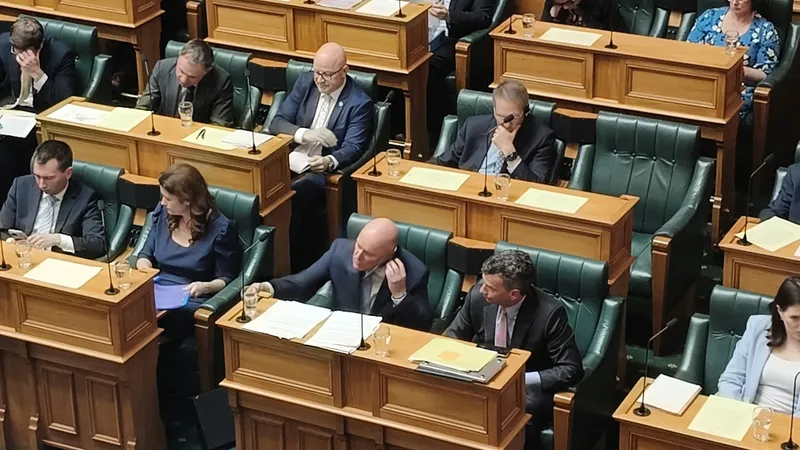
The translation issues continued as Greens co-leader Marama Davidson asked about cuts to Whakaata Māori and Matariki events. Luxon missed part of her question, and Brownlee asked the translator to repeat it, which led to what felt like a minute of silence while everyone watched the prime minister hunch over his earpiece. When she asked about the Regulatory Standards Bill/Te Pire Paerewa Waeture, the earpieces stopped working entirely. Brownlee threw his hands in the air. “I can’t hear anything. What’s going on? Can someone explain?”
Some actual questions
For the past few weeks, amid all the usual rowdy hubbub of question time, Barbara Edmonds has been quietly plugging away, cross-examining Nicola Willis about the unfolding saga of Adrian Orr and Neil Quigley leaving the Reserve Bank; what the minister knew and when she knew it. It hasn’t produced any highlight moments – Edmonds doesn’t have a lot of flair in the house, and Willis is a strong enough performer that she doesn’t show any outward signs of weakness, though she does seem to be getting more and more frustrated with the whole thing. It’s too soon to say if the scandal will blow up in the way Edmonds hopes, but it’s nice to see an MP actually try to get salient answers out of a minister.
One lie doth not a liar make
For viewers brain-poisoned enough to care about the consistency of speakers’ rulings, Brownlee’s term has been a hard one to follow. He acted like the sky was falling when MPs performed a haka and when Chlöe Swarbrick asked government MPs to find a spine, but allowed the word “cunt” (twice!) and let Winston Peters claim Debbie Ngarewa-Packer wasn’t a “real” Māori. Usually, it’s the opposition who claims the speaker is being unfairly harsh and/or lenient, but that’s not always the case.
As National’s justice minister Paul Goldsmith answered a patsy question about crime statistics, Chris Hipkins took umbrage with his categorisation of a Labour government policy. “That’s a big fat lie,” he said from his chair. Nicola Willis picked up on that and tattled on him to the speaker, saying it was a “clear breach of the standing orders”.
Brownlee couldn’t be bothered dealing with it today – he said it was against the rules to call someone a liar, but that is “a different matter to saying that something is a lie”. How exactly one might lie without being a liar is left up to the reader’s interpretation.
Joel MacManus
Joel MacManus is a senior writer for The Spinoff. He previously worked at RNZ and Stuff, and began his career at Critic Te Ārohi. His writing explores the political, economic and cultural systems that underpin modern New Zealand. He won the 2025 Voyager Media Award for Best Columnist, Opinion or Critique.


