


The Golden Mile, the housing crisis, and the problem with progressive cities.
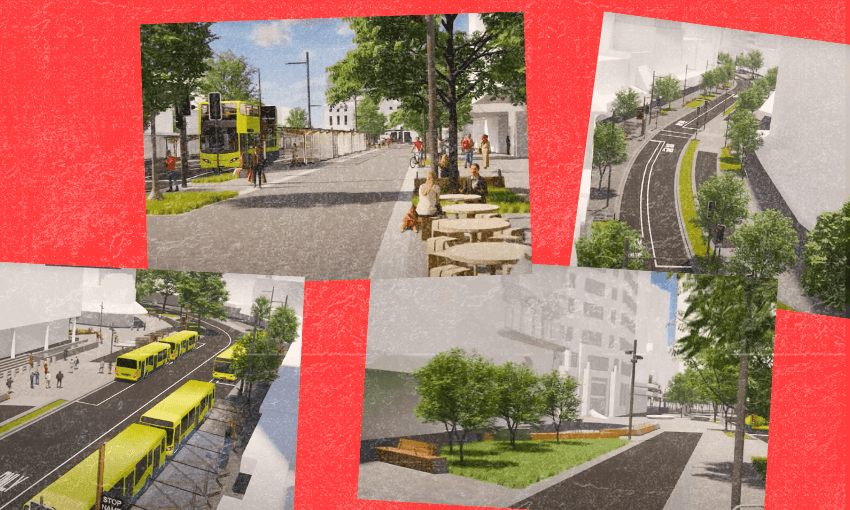
The outcome of last Thursday’s Wellington City Council meeting was inevitable. The council voted overwhelmingly to cancel the Golden Mile project, the $215m upgrade of Courtenay Place, Manners St, Willis St and Lambton Quay that had been hanging around in various forms since 2016.
After more than a decade of talking about it, Wellington killed a project that the city desperately needed because it was taking too long, cost too much, and had become too politically controversial. Council officers were sent away to come up with a new, cheaper plan with a budget of around $40m, though their designs aren’t due back until June 2027.
The Golden Mile failed for the same reason Wellington has the worst housing stock in the country on a value-for-money basis, a rising homelessness problem despite the highest GDP per capita in the country, an infrastructure shortage and a laundry list of other projects that never got off the ground. The same issue applies to San Francisco, Vancouver, Seattle and many high income, progressive cities: the left can’t build.
In urban planning this is known as the “progressive paradox”. The voters who most profess to value affordable housing and accessible services seem least able to form governments to deliver them. Throughout the latter half of the 20th century, left-wing politics, particularly in the Anglosphere, put a significant focus on policies which would prevent businesses and governments from building things that would harm the environment or neighbourhood character. In New Zealand, that took the form of the Resource Management Act, Environment Court, judicial reviews, and the extensive consultation requirements in the Local Government Act.
Wellington has a disproportionately large number of community activists, lawyers and public servants who know how to play the system. The problem is that the legal tools you use to stop a motorway through a wetland are the same ones you use to stop a cycleway or a housing development. The system was designed to block bad projects. It turns out it’s quite good at blocking good ones too.
To understand where the Golden Mile went wrong, you need to understand the Basin Flyover. In 2001, Waka Kotahi NZTA formally proposed building an elevated highway around the Basin Reserve. The locals in Mt Victoria were not happy. The Save the Basin group protested, lobbied, and took the project to court. In 2015, the High Court agreed with them and shut it down.
The Basin flyover prompted a rethink from Waka Kotahi NZTA. The solution was Let’s Get Wellington Moving (LGWM). The city council, regional council, and NZTA combined every vaguely transport-related project in Wellington into mega-projects run by an independent entity with a multi-decade timeline.

LGWM was an attempt to counter these oppositional forces with sheer scale. The plan was to over-consult, over-design, over-plan, try to get everything perfect so that nothing could stand in its way. Instead, LGWM turned itself into a larger target. People grew impatient with the lack of visible progress and outraged at the growing costs and its name became sadly ironic.
When the National-led government shut down LGWM in 2024, Wellington City Council took the Golden Mile project in-house. In classic LGWM fashion, the design was massively overdone. But it made sense for the council to stick to the plan because NZTA remained committed to paying 51% of the costs, which meant it was still a decent deal for the council – at least initially.
The Golden Mile was never really a transport project; it was a placemaking project dressed up as a transport project. The transport aspects were necessary to get the NZTA funding but weren’t particularly good value for money. Moving all the bus bays and shelters and realigning the curbs would have made the buses a bit more efficient, but it’s a big price tag to save a few seconds.
Throughout the many reviews and business cases, the Golden Mile’s calculated benefit-to-cost ratio (BCR) ranged from 5.8 to 1.8. The BCR attempts to calculate the economic and social impacts of government projects. It’s the public service equivalent of a value investor looking for underpriced companies or an effective altruist looking for charitable causes where their money will improve the most lives.
Ahead of Thursday’s meeting, Green councillor Geordie Rogers cast doubt upon the figures Little’s review had produced. “This review set out to kill investment in our public spaces, and it’s tried to achieve that by fudging the numbers,” Rogers alleged. It’s a serious accusation that is difficult to prove. The alternative explanation is simply that the BCR is a crude and imperfect number.
The fact that BCRs are so hard to calculate means there is always a level of uncertainty, so someone who cares about impact per dollar would focus on projects with low total costs and high estimated BCRs; small consequences if you get it wrong, big rewards if you are right. It’s what investors call a “margin of safety”.
One of the main appeals of urbanist projects like pedestrianised streets and bike lanes is that they can offer fantastically high BCRs. You don’t have to build any mega-structures or lay kilometres of concrete. It can often be as simple as repainting a road and adding some street furniture; cheap but potentially game-changing.
Making the Golden Mile a mega-project took that opportunity away. Pedestrian-friendly renewals don’t need the same tactical approach as new highways or tunnels. Going big didn’t work, at least not for the Golden Mile. So the obvious alternative is to go small. A roving team of council staff whose job is to identify street corners where low-cost interventions would have a significant improvement could make a bigger difference by chipping away at the city piece-by-piece rather than putting all their eggs into one big idea to save the centre city.
Solving Wellington’s building problem will take a combination of legal reform and tactical pivots. Some of this is already happening at the central government level with the overhaul of the Resource Management Act, the new fast-track approvals system and upcoming local government reforms. At a local level, though, Wellington politicians and public servants who want to get things built need to get better at playing the game and designing proposals that keep risk low and reward high – both financially and politically.
The council officers who have been tasked with redesigning the Golden Mile have been given a much smaller budget and will focus their efforts on high-impact placemaking changes rather than being distracted by transport realignments. That should, in theory, help them to produce a design with a higher BCR and lower political risks. However, the fact that they’ve been given full year just to produce some drawings is a red flag. Can they resist the institutional temptation to fill the space they’ve been given, or will we end up with yet another overdesigned, unworkable project?