Witi Ihimaera’s play Woman Far Walking strides proudly into 2025

Witi Ihimaera and Miriama McDowell (Photo: Abigail Dougherty)
This year marks the 25th anniversary of Woman Far Walking, and the premiere of a new bilingual version. Sam Brooks talks to the playwright Witi Ihimaera and actor Miriama McDowell ahead of the show’s debut about the process of evolving the work, and what the politics of the show mean 25 years on.
Witi Ihimaera’s play Woman Far Walking has a barnstormer of an opener. A kuia comes onstage, “gathers the audience into her gaze”, and speaks the following:
“I am 160 years old. I was born on 6 February, 1840. I am an aberration. A freak. People make the sign of the cross when they see me because I am against nature, an affront to God; they think Dracula must have bit me on the neck and made me into one of the living dead. Well if he did, he was the one who died.”
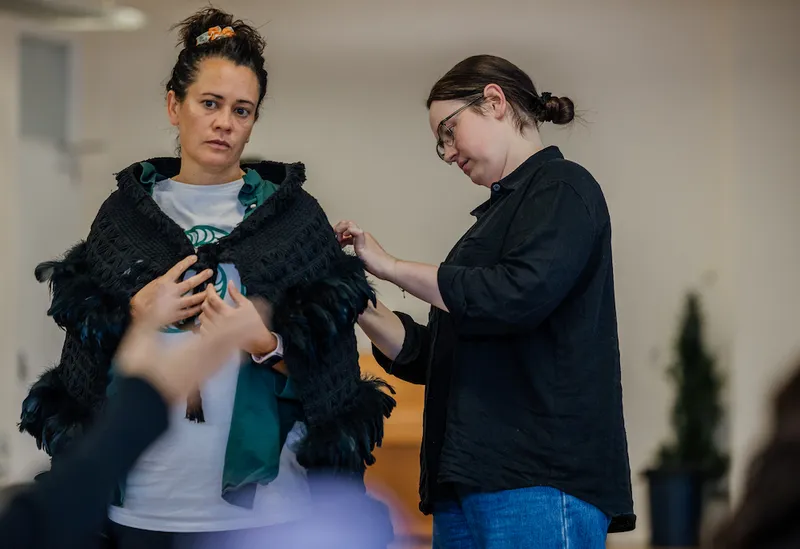
The character is Tiri, short for Te Tiriti o Waitangi Mahana. When the play premiered as part of the New Zealand Festival in 2000, Rachel House spoke those words. Twenty five years later, Miriama McDowell (Ngāti Hine, Ngāpuhi) will say those same words as she inhabits the role of Tiri, who is now 185. Throughout the play, she’s prompted (or taunted) by her descendant, Tilly (Nī Dekkers-Reihana (Ngāpuhi, Te Rarawa, Ngāti Porou)), as Tiri experiences events in New Zealand history, including the Ngatapa killings, the 1918 flu epidemic and the 1981 Springbok tour.
Tiri’s age, however, isn’t the only change to Ihimaera’s play. The most noticeable change is that the script, which was originally written in English, has been adapted to move between English and te reo by director Katie Wolfe (Ngāti Mutunga, Ngāti Tama) and Maioha Allen (Ngāti Apakura, Waikato Maniapoto). The core of the play, however, remains – the story of a woman who has seen all of New Zealand’s history, and has some reckonings on what’s happened, some open wounds to air out, and a captive audience to air them out to. It feels even more politically charged now than it does then.
I talked to Ihimaera (Te Whānau a Kai and Ngāti Porou) and McDowell over a cup of tea on their first day of rehearsal, as the play was still finding its shape. Ihimaera is warm, gregarious and gentlemanly, many things that Tiri isn’t. He’s also delightfully evasive, in the way that people who have been interviewed more than any human should ever have to be often are, and puts questions to McDowell to answer as often as he answers ones put to him. She happily obliges. (For the curious, his tea order: little bit of milk, with one sugar.)
As with many plays, the instigator of this work was the playwright’s mother. They were watching TV back in the 70s, watching a woman on her hundredth birthday be presented with a birthday telegram from the queen. His mother turned to him and said:
“If I happen to be one hundred, and if the queen sends me a telegram, I would spit on it.”
The play comes from that comment.
Ihimaera wrote the first version of the new script back in January, and waited until the entire creative team could have a look and put their voices in. He admits that it’s an unusual process for most fiction writers, but it was one that he was thrilled by. In his book writing, he has the control, and he can force himself to get to wherever the work needs to be. In a play, that process isn’t the same. “Knowing that everybody was going to have a say, we had to make sure that the kaupapa was there, that the play remained political, and it remained inclusive of whoever would come to see it,” he says. “And also, for the first time, this play would actually be bilingual.”
When the show was announced in 2024, it was going to be performed twice a night – once in English, and once in te reo – but when it premieres this week, it will instead be performed once a night, moving between both languages fluidly. This decision was one of many that came out of wānanga throughout the year to develop the script, specifically to breathe life into the reo of the script. “You lean into a rehearsal period knowing that you’ll know some answers, but won’t know all,” explains McDowell. “But in the wānanga process, there’s a little more breath and time. You’re allowed to ask, and you’re allowed to discover as you go. It’s been a beautiful journey of discovery.”
As a result, “what the play would be, or would become, has completely changed from the start of that process.”
The bilingual element of the play might be new, but its staunch politics are not. Language is both a weapon and a shield in Woman Far Walking, and resistance is a necessary action not undertaken lightly. In 2025, we sit in the wake of the divisive Treaty Principles Bill, and the controversial removal of te reo from many children’s books in the education sector. Ihimaera, moving just a few steps closer to his protagonist, minces few words here.
“We’re now in that space where David Seymour still attempts to create a viewpoint of Māori as being a bleached culture. That we should be without the structures of meaning that we’ve always had,” he says. “And then there’s Erica Stanford, with the way in which she’s trying to adjust the education department so that there will be less Māori.”
The director, Wolfe, also doesn’t mince words when she discusses the play over email. “Can I be so bold to say that one of the shifts in Māori storytelling has been the expectation to be taken into a lovely Māori world, where we celebrate the Māori of old, the cheeky nannies and magical tamariki, a misty eyed look to the past, where sadness and humour take the edges off what is a devastating and complex relationship our nation is still reckoning with?”, she says. “When Witi wrote Woman Far Walking, it was a furious play, brimming with rage and violence, and then a very generous amount of hope.
“In our present political climate, we are leaning into these qualities, the rage, the violence, the hope, and we do that with an unprecedented confidence to perform in both languages of this nation.”
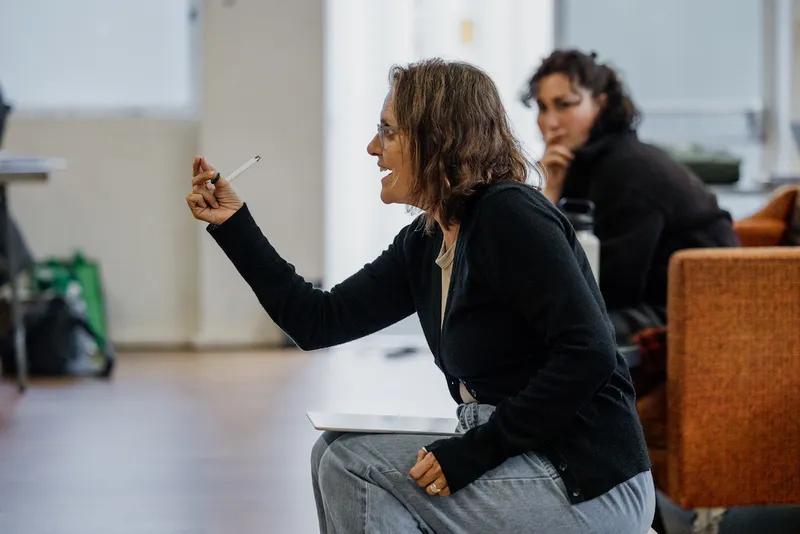
The nature of the play might be challenging to much of Auckland Theatre Company’s audience, which, like many of our country’s mainstage theatre companies, serves an older, more conservative, demographic. Direct address is not new to the audiences of the company, but the impassioned anger that Tiri turns on the audience – both Pākehā and Māori – might be.
“On the marae, direct address is something which you just have to get used to. It’s not only Pākehā who get their heads chopped off on the marae, it’s everybody,” he jokes. “That’s what happens. A traditional audience might not be accustomed to this, but this is a Māori play, produced and directed in a Māori way, with te reo.”
For her part, McDowell believes that Aotearoa is still scared of te reo Māōri. “They can pronounce French words perfectly, but there’s still this inherent racism and inherent fear towards our language,” she says. She also believes that as a Māori actor, to speak te reo on a stage is activism. “And to speak only te reo to people who understand that reo, that in itself, is activism,” she says. “We’ve had so many discussions about what it feels like to speak your reo, to let it fly, but also sometimes it doesn’t land – and how painful that is as an actor.”
“In the same way that, as when you deliver Shakespeare, you know that not everything is landing.”
The question with this show remains: if the reo goes over the head of the audiences, as it might well do with the Auckland Theatre Company (and indeed, the audiences of most theatre companies in the country), isn’t the message going to go over their heads as well?
It’s a question that the team has asked themselves in those wananga held throughout the year. “Where is the place for this play within this ATC audience? How does language play a part in welcoming or pushing away?” asks McDowell. “That’s a beautiful thing about what this play is about. Are you coming with us? Or are you gonna close your ears and close your eyes?”
For Ihimaera, the solution is an audience that is neither purely Pākehā nor purely Māori. “You need a Māori in the audience to show the Pākehā audience,” he says. “‘This is how you’re supposed to act. This is supposed to be where you really cry, this is where you really need to understand the question.’”
It’s fitting that, in this play of all plays, the solution is bicultural. Language and culture as a bridge between audiences, rather than a wall to divide them. Tiri stands on the bridge, tapping her cane.
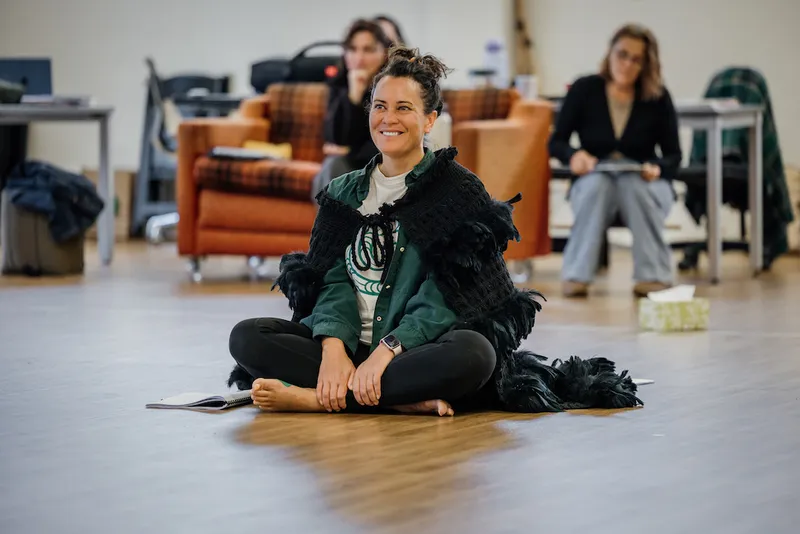
Towards the end of the interview, Ihimaera throws McDowell another question. “Do you think that she finds her peace?”
McDowell considers the question, one that will undoubtedly roll and roil in her brain throughout the rehearsal process. “When I hear you talk about the play, and Tiri just becoming older and older as Aotearoa gets older and older, I think that no, she never finds peace.”
For his part, Ihimaera sees Tiri continuing to walk in the future, and even overseas. Although the show has only been overseas once – in 2002 to Manchester for the Commonwealth Games – he would particularly love the work to go to Palestine. “They would recognise this, this woman is a survivor, she has a place in the world, she’s got a strong place. And maybe one of these days, she’ll be talking in Arabic.
“Tiri’s just going to get older and older. The way I think about it is that she’s going to keep on walking for as long as New Zealand’s history is unresolved.”
In 2025, however, she’s 185. And she feels like she’s just getting started.
Woman Far Walking runs at the ASB Waterfront Theatre from November 4 – 23.

Sam Brooks
Sam Brooks is a playwright and journalist who currently freelances and writes his own arts and culture newsletter Dramatic Pause.


