


Sam Brooks reviews The Dry House, making its New Zealand premiere at Basement Theatre.
Melodramas about alcoholism are as plentiful as modern horror films about trauma. You can track a solid, unbroken, line of these works from today right back through the entirety of the 20th century, and likely beyond (my knowledge gets spotty there). The characters, the conflicts, even the imagery is familiar. When a character onstage, and even onscreen, reaches for a whiskey bottle, we know where the play is going. It takes inventiveness, a fresh perspective, and frankly some audacity to find something new in this material, to actually sail into uncharted territory.
Eugene O’Hare’s The Dry House, which originally premiered in London in 2023 and makes its New Zealand premiere at Basement Theatre this week, finds itself consistently on familiar ground. The premise feels fresh, however. In the Irish border town of Newry, Chrissy (Alison Bruce) has promised her sister Claire (Beatriz Romily) that she’ll go to the dry house – broadly familiar to us as a sort of rehab – once she’s finished her customary morning cans of lager. The spectre of Chrissy’s lost daughter Heather (Zoe Crane) hangs over the both of them.
The stakes and the conflict are familiar. One character wants to drink, the other character wants them not to. Either Chrissy will triumph over her alcoholism or she won’t. A playwright can find depth, even brilliance, in the familiar, but O’Hare seems to be fighting against that at all turns. The beauty of melodramas are that they go big to find truths that are even bigger, and more resonant. They’re larger, and more real, than life, even when the actual story and character beats might be ridiculous.
While the narrative of O’Hare’s drama is unashamedly melodramatic, his actual writing tends toward the register of realism – think the likes of Jim Sheridan or Ken Loach. There’s an intentional lack of musicality and elevation to it, but these characters don’t banter in the way that characters banter, they talk in the way that people do (at least, until the melodrama forces them to monologue). It leads to a disconnected experience, like hearing cats bark or dogs meow. This becomes more and more clear as the play marches toward its ending, and it has to ascend into capital-d Drama to resolve certain character arcs and plot threads.
Unfortunately, a play that is at odds with itself doesn’t lend itself to a cohesive production.
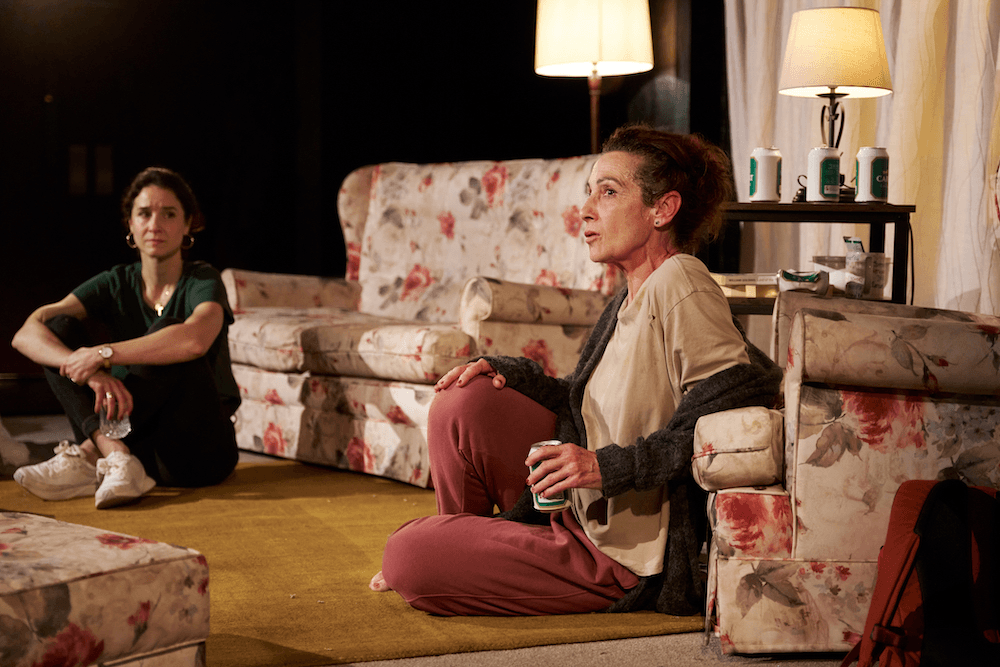
Isla Macleod’s direction leans into the intimacy of the play, to the show’s detriment. The show is simply blocked, with Chrissy spending much of the duration in her armchair, and Claire orbiting her. Were it not for the glowing front light, you can imagine being a fly on the wall of this particular lounge. It’s an intimacy that is also a by-product of working in Basement Theatre, where it theoretically makes sense to trust that the space’s size will draw the audience into the narrative.
It also makes sense here, then, to lean out of melodrama; big drama can feel overwhelming when it’s two metres from your face as opposed to 20. The Dry House demands a certain bigness across the board to feel authentic, but when the entire production is turning itself inward, so much so that the cast often feel like they’re playing for the stage rather than the entire audience space, it’s never going to achieve that authenticity.
Unfortunately, intimacy also trains an audience’s eye to pay attention to details, and the details of this particular production are off. The space, a small lounge, is extremely clean and lived-in, especially compared to Chrissy’s circumstances, and Claire’s reactions. Even the piles of clothes downstage feel like choreographed mess rather than the organised chaos of the truly disarrayed. A repeated needle-drop of ‘Dreams’ by The Cranberries, a band famously from Limerick and more famously big in the 90s, feels out of both place and time in modern-day Newry. Like much of O’Hare’s play, it indicates towards familiarity, rather than nailing the play anywhere or anytime specifically.
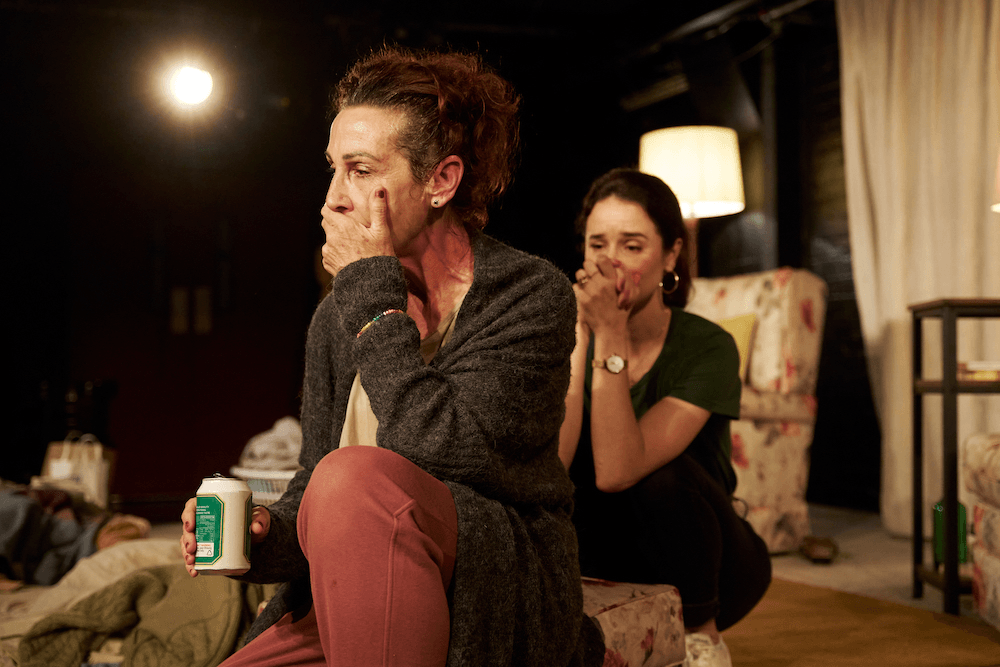
It rests, then, with the cast to carry the show. The only reason why Alison Bruce isn’t a revelation in this role is that she’s always tremendous. Even in work that isn’t up to her standard – which is frankly far too much of it – she’s always an absolute treat for an audience. Her Chrissy is no exception; she finds all of the music in the accent and despite being confined to an armchair for much of the show, she completely embodies the physicality of a big personality trying to drink herself smaller. Bruce’s performance is proof that a character can be completely lived in, aurally and physically, without vocal pyrotechnics or ostentatious movement.
Bruce also completely gets that someone who has been an alcoholic for as long as Chrissy has, also inevitably has a lot of charm, however much dimmed, and an armory full of tactics to get what she wants. There’s a philosophy that a playwright comes up with 70% of a character, and the actor fills in the other 30%. Here, that feels reversed; Bruce’s Chrissy is so much richer than O’Hare’s.
Beatriz Romily and Zoe Crane have trickier jobs. Part of this is the nature of the writing; Claire is the sisterly equivalent of the nagging wife trope, albeit with her own terrible secret, while Heather is a sketch of a character rather than fully fledged in her own right. While both actors have lovely moments, largely within each of their character’s big monologues, they feel hemmed in by the musicality of the Newry accent and, frankly, the lack of musicality in O’Hare’s language.
A play is a blueprint, it’s not a finished product. It requires a production to finish it. A shoddy blueprint makes for a shoddy house. O’Hare’s play has its strengths, however buried beneath mixed intentions on what his premise needs as opposed to what it wants, and this production has a tremendous performance at its centre to recommend it. No house can succeed over its blueprint, and unfortunately, no production can fix a play.
The Dry House plays at Basement Theatre until November 15.