Review: Mary is a slick spectacle that wants to be messy

Olivia Tennet as Mary Shelley (left) and Timmie Cameron as Claire Clairmont in ATC’s Mary: The Birth of Frankenstein (Photo: Andi Crown)
Auckland Theatre Company’s production of Mary: The Birth of Frankenstein is an entertaining ride through a wild night, writes Sam Brooks.
One night in 19th century Geneva, the now infamous Lord Byron hosted author Mary Shelley, her husband Percy Shelley, her stepsister Claire Clairmont and doctor-slash-drug-dealer John Poldiori for a night of debauchery. In common lore, this weekend was the genesis of Frankenstein, and the birth of the horror genre in Western literature (more schooled minds than mine can confirm or deny).
In Auckland Theatre Company’s Mary: The Birth of Frankenstein, playwright Jess Sayer takes this common lore and runs a marathon with it. In turns parlour comedy and visceral horror, it plays out what horrific things could have happened that night – and what these people might have said and done to each other. Unsurprisingly, whatever might have put the seed of Frankenstein in Shelley’s mind is not especially pleasant nor particularly humane.
Sayer sets the scene mercifully quickly – if we don’t know the dramatis personae by reputation, then we get the lay of the land within a few minutes – and instead gets into interrogating artistic ego, how it relates to gender, and what certain people are allowed to say and do in particular situations. It’s less an outright comedy and more a drama with punchlines; no character is pushed to the edges for the sake of comic relief, and she gives us the pleasure of watching genuinely intelligent and funny people cash in on their intelligence and humour.
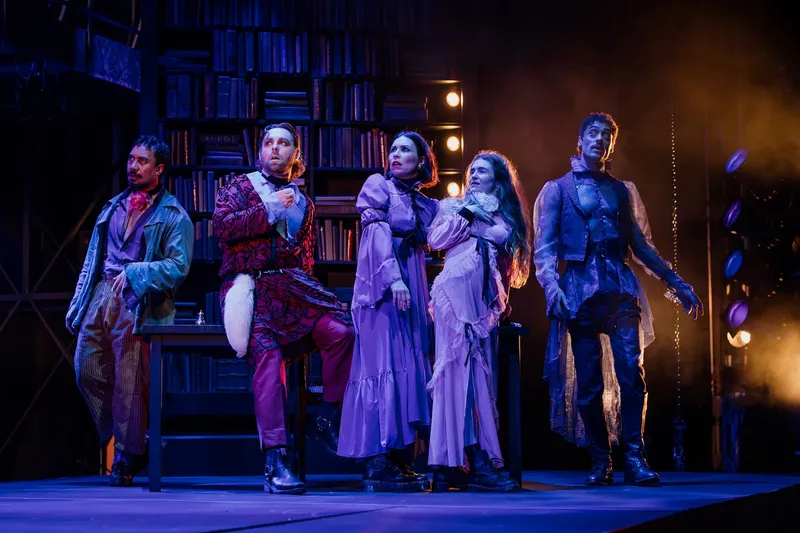
It’s a treat to watch characters play to the height of their ability, and while there’s definitely a hierarchy within Mary’s ensemble of blue-link Wikipedia names, Sayer subverts power dynamics more than she adheres to them.
Oliver Driver (Amadeus, Jesus Christ Superstar, Mr Burns) serves as director and co-creator, and he gives the play the kind of slickness and spectacle that you expect from his long list of credits. Driver’s theatre isn’t television on screen; it is big, visceral and, crucially, actually in the same physical space as the audience. There’s a genuine thrill in seeing a cast cross the floor of a mansion that might actually be the size of a mansion, and get the sense of the sickening grandeur that these characters – or at least a few of them – live within. It’s the kind of theatre that is extremely easy to watch, but hard to achieve, especially while managing tonal shifts between comedy and horror.
The ensemble comes together well, delivering Sayer’s rhythmically overlapping dialogue with symphonic specificity. Olivia Tennet and Timmie Cameron are especially brilliant, with the former having to play the comparatively straight-laced Mary while the latter plays the more mercurial Claire. As the play marches into the second act, both pull out layers upon layers from their characters, and it’s a particular treat to hear them whip dialogue back and forth.
Emily Adams, as the largely mute and clearly ageing maid Marta is a constant, physical, reminder of a darker evening to fall upon them all. (It’s initially jarring that everybody’s accents exist in no man’s land, but it is a relief to not have to listen to “authentic” accents, whatever those might be, for the duration.)
There is a tension between the play that Mary wants to be, and the production. There is a grit, particularly to the performances from the female actors, that hints at something deeper, and more interesting at play. The word “monster” is a recurring motif throughout, and it’s in the performances of both Tennet and Cameron that we get a sense that the capacity to be a monster is in all humanity, regardless of gender, but society forces us to mask it.
It is less present in the performances from the male cast, and that feels at the core of Sayer’s work; a dick is a dick, an asshole is an asshole, but to really dig into what makes a human monstrous, you have to get beneath the surface. All of that grit, however, occasionally gets lost with the slickness of the production.
Like the character, deep down Mary the play wants to be messy, sexy and dangerous. Those things are hard to achieve in theatre of any scale, but particularly a scale that is also aiming to achieve spectacle; there are certain things that simply can’t be done messily, let alone dangerously (sexy is subjective, of course).
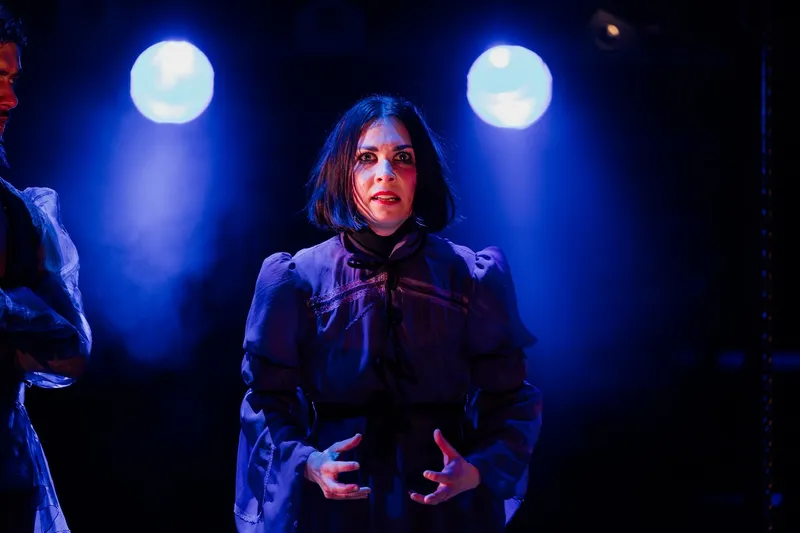
The entire production, broadly gothic in inspiration, designed by John Verryt on set, Jo Kilgour on lighting and Sarah Voon on costume, doesn’t have a speck of dirt on it. It feels like the stage has been set for an expensive show, because it absolutely has been. So while it makes for a smooth ride, albeit with telegraphed bumps, and while it’s entertaining, I feel like Mary wants to make me uncomfortable, to maybe put a little steel nail on my seat.
Both production and play are aiming at a lot of targets, and if it misses, that’s hardly for lack of trying. Sayer’s script doesn’t just blend genre, but manages to make what could easily be a dusty biopic into something electric. The genre, horror, is notoriously difficult to do onstage, and the show manages more than a few jump scares. Additionally, to entertain, while providing spectacle and slickness, is a tall order. When the dust settled at the end of the show, I wanted a little bit of blood drawn; some sense of what had been lost, what it actually might cost to birth a monster. It’s there, in moments, like a flash of lightning, but you have to be quick to catch it.
Mary: The Birth of Frankenstein runs until September 7 at the ASB Waterfront Theatre.

Sam Brooks
Sam Brooks is a playwright and journalist who currently freelances and writes his own arts and culture newsletter Dramatic Pause.


