Good news: It’s kākāpō fuck season

An amorous kākāpō (Image: Tina Tiller)
The world is going to hell in a handbasket but at least the kākāpō are going hog wild.
It’s been a crappy summer. In Wellington’s case, literally. Right now, its citizens can’t go swimming without emerging from the waves glistening with turds. Elsewhere, there have been storms, landslides and floods. Somehow, we’ve all aged 10 years since the Waitangi dildo strike. Overseas, masked federal agents are abducting normal people from the streets and Venezuelan presidents from their mansions, both in contravention of quite a few rules and norms. People are still being mowed down in Iran and Gaza and as it turns out, many of the world’s most powerful men have quite the history of palling around with a notorious paedophile.
It’s enough to make you want to check into a mountainside monastery and live out the rest of your days raking sand. But thankfully there’s still one thing worth living for. Look up. What’s that you see? That’s right, the rimu trees are in mast, producing a bountiful harvest of small, fleshy, red and above all nutritious berries. And you know what that means: it’s kākāpō fuck season.
“So what?” the ignorant or peabrained might reply. “Birds have sex all the time.” Let me explain it to you. Unlike some animals that have evolved to do things like survive, kākāpō have opted instead to become a screeching, smelly, groundbound predator magnet with an impossibly convoluted approach to breeding. They reserve their boning for when rimu are producing berries and that only happens every two to four years. This year could be one of the best harvests in decades and it couldn’t come at a better time. The breeding population of female kākāpō is at 83, the largest since conservation efforts began 30 years ago, and the big green parrots are raring to go.
As the rest of us have been curling up into a cocoon of despair, male kākāpō have been standing in a forest yelling until someone comes along to have sex with them. Their booming mating calls rang out over three small southern islands all January. The resulting eggs have provided some of the only deposits of hope in an expanse of sewagey seas, disaster and democratic decline.
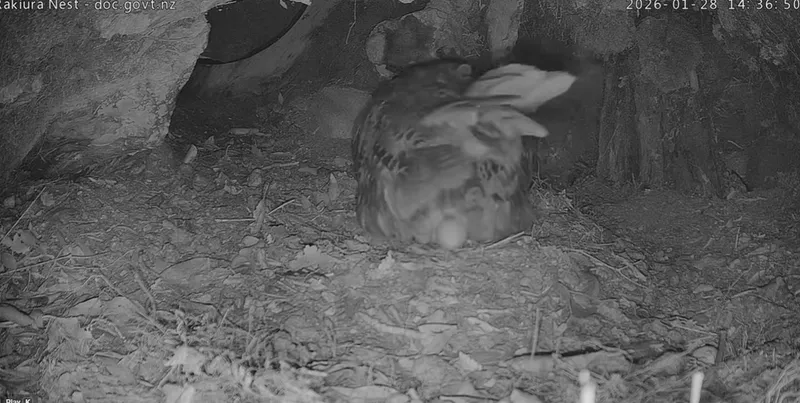
The world has grasped those deposits with both hands. “World’s fattest parrots set for mating bonanza”, reads The Washington Post. “Berry nice to meet you”, says The Guardian. “Bumper fruit crop could lead to huge mating season.” Public interest is so great, the Department of Conservation (DOC) has set up a 24/7 live stream of the nest of one kākāpō, Rakiura, on Whenua Hou/Codfish Island. Environmental journalist Ellen Rykers explains why kākāpō shagging season delivers such a much-needed dopamine boost even outside the parrot community. “In an era where it feels like everything is going to shit, there is something pure and joyous about a bunch of parrots having a feast, getting it on, and making cute babies,” she says.
But it’s not just any parrots. Kākāpō are almost perfectly calibrated to go extinct. They very nearly did, with the population dropping to just 51 in the mid-90s. This breeding season is a big leap forward on a long comeback trail. The Department of Conservation says 170 eggs have been laid so far, with the first chicks expected to hatch soon, though not all eggs will be fertilised and not all chicks will make it to fledgling. Doc says hope for the future underpins a lot of the hard work and dedication it’s taken to get to this point. Rykers feels the same way. “We love an underbird story – a species overcoming the odds to survive. It feels like right now we all need a laugh, and something to believe in. Why not a future where we have more big, beautiful, booming kākāpō bumbling through the bush?” she says.
Chelsea McGaw, Forest and Bird’s regional conservation manager for Southland, says the last few years have been pretty difficult in the conservation world. Even the wins, like a recent decision to turn down a seabed mining operation in Taranaki, have been more about arresting decline than building a greener future. In that light, kākāpō fuck season is delivering something increasingly rare: a cause for hope that’s building to something better. “Those kinds of success stories, they’re the ones that make you not want to go home and cry,” McGaw says.
We all need something to stop us going home to cry. So as you survey the sea off Wellington’s south coast and contemplate the rare forms of giardia you could get by taking a dip or doomscroll a news notification about Donald Trump randomly bombing Madagascar, just remember, the rimu are in mast. The kākāpō have boned to their hearts content. Somewhere a host of eggs are incubating. Out of this joy-starved summer, an army of fat parrots will emerge.

Hayden Donnell
Hayden Donnell is a senior writer for The Spinoff. He previously worked at RNZ, TVNZ and the New Zealand Herald, alongside other media companies that have since closed down or been renamed. His primary passions are local politics and the Big Fresh animatronic fruit and veggies.


