
It couldn’t find a surrogate bird big enough to incubate moa chicks, so the company trying to resurrect the extinct species has developed futuristic-looking artificial eggs to do the job. And they work – at least for chickens.
Which came first, the chicken or the egg? When it comes to trying to resurrect an extinct bird, it turns out it’s the egg.
Texas-based biotech firm Colossal Biosciences today announced it has created an artificial egg that can grow a bird from shortly after fertilisation through to chick. It’s the first step, they say, in bringing moa back from extinction, but could also have benefits for conservation and biotechnology research.
In mid-2025, the company announced its plan to de-extinct the South Island giant moa. The project, backed financially and fervently by filmmaker Peter Jackson, will analyse DNA from moa bones and use information about what gives birds their “moa-ness” to genetically engineer a living moa-related species.
One of the many, ahem, colossal challenges of that work is to find an animal that could then grow and birth the bird. Unlike other de-extinctions, where there’s a clear living surrogate (like the grey wolf for the direwolf), there’s no bird big enough to birth a moa.
Moa eggs have roughly 80 times the volume of a chicken egg and eight times that of an emu’s. The company had previously talked about using an emu but now say even they aren’t big enough. Instead the plan is to grow moa in a version of these newly developed artificial eggs.
It’s pretty wild stuff. The team basically needed to create an entire biological system outside a living body that could nourish, sustain and protect this growing chick.
In a press release, Colossal Biosciences CEO and co-founder Ben Lamm said that bringing back a species like the South Island giant moa “requires building an entirely new incubation system where no surrogate exists and scales in ways that ordinary biology simply doesn’t”.
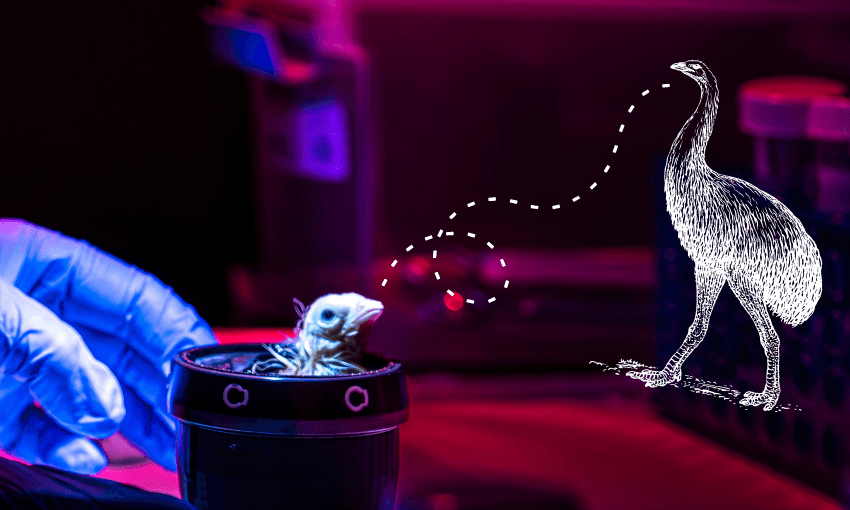
The system Colossal created looks something like a futuristic Fabergé egg. The egg cup, so to speak, has a lattice shell with a silicone membrane. The membrane is what lets oxygen through to the egg, while keeping everything moist. A press video shows workers plucking freshly laid eggs straight from the chicken coop and gently cracking them into the artificial shells to continue incubating.
Using the system, Colossal birthed 26 leghorn chicken chicks, but would not say how many embryos they started with. The chicks are now living at the Colossal ranch and researchers are monitoring their health, longevity and ability to have chicks of their own, said Andrew Pask, Colossal’s Melbourne-based chief biology officer, in an email to The Spinoff.
So is this a breakthrough? Nic Rawlence, director of the ancient ecology lab at the University of Otago, pointed out that the technology Colossal created only solves part of the surrogate problem. “Colossal’s artificial egg is effectively the eggshell and diffusible membrane allowing oxygen to pass through to the developing bird embryo. It still requires an embryo and yolk to be carefully added to the artificial egg. Given the large size differences between chicken eggs and emu and moa, there won’t be enough yolk in living birds’ eggs for the development of a giant ‘moa’ chick,” he said.
Pask said in his email that they still had to supplement the growing chick with calcium that would normally come from the shell.

Scientists have previously been able to grow white leghorn chicken and quail chicks in so-called shell-less cultures – where the embryo, yolk and albumen (egg white) are incubated outside a biological shell. But those sci-fi shells were made of materials that either made it hard to see the growing chick, or were extremely delicate. Some even needed strange, tilt-a-whirl-meets-Glad-Wrap contraptions where the egg was spun around for the first three days of its life. Most could only grow the chick after those three days and almost all of them required the developing embryo to be blasted with pure oxygen, which, according to Colossal, could damage the embryo’s DNA.
Colossal’s system is different in that they were able to transfer the egg’s contents much earlier, around 24 to 48 hours after laying, according to Pask’s email. What’s more, the membrane means that the embryo can survive without additional oxygen.
Pask told The Spinoff that their goal was to make a system that is as close to the egg as possible. “We spent a long time perfecting the design and functionality. Now we have excellent survivability of eggs but most importantly, we have a system which more closely mimics the natural egg, leading to healthier birds.”

Besides the obvious cool factor of bringing back an extinct species, Colossal says the technology it develops can help conserve critically endangered species. For example, surrogate eggs could help breed endangered birds using banks of genetic material.
Rawlence noted, however, that you’d still need to genetically engineer chickens or other birds to create the yolk and white that would sustain the growing bird. “You’re going to have to create these transgenic chickens, let them mate, lay eggs and then, just like in the video, you’re going to have to find those eggs and carefully transfer them to this new system,” he told The Spinoff.
What’s more, chicken embryos are often used in biomedical research, for example to understand how blood vessels form, develop cancer therapies and test drug delivery systems. This new egg system allows access to the egg as it develops, so could make this research easier.
Biomedical or conservation use-cases – rather than de-extincting moa – are the real breakthroughs, said Amanda Black (Tūhoe, Whakatōhea, Te Whānau a Āpanui), director of Bioprotection Aotearoa at Lincoln University. “Clearly Colossal Bioscience is making strides in technological breakthroughs, which is always fascinating to read, it’s just unfortunate that it seems to want to continue cosplaying conservationists. It would be great if the technology breakthroughs were communicated without needing a fantastical story to launch it,” she said in a statement.
There are also speculative concerns, from Rawlence and others, that this new technology will be held privately by Colossal, and the conservation or research gains the company boasts will only come to fruition for those willing to pay for it.
According to the scientists The Spinoff spoke to, there’s little appetite for de-extincting moa in Aotearoa. Reasons range from iwi opposition and going against sacred values of whakapapa, to welfare concerns, to simply not needing these birds from an ecological point of view.