Prediction: New Zealand will eventually be one big Chemist Warehouse

Chemist Warehouse growth over time. Image: Alex Casey
Alex Casey charts the rapid growth of the big yellow discount pharmacy across Aotearoa and finds independent pharmacies struggling in its shadow.
There are two Chemist Warehouses in Auckland’s CBD that are just 240 metres apart – that’s shorter than the Skytower if you plucked it out of the ground and laid it down sideways. It’s so short that the average person could walk from one to the other before they’ve made it to the end of the radio edit of ‘Welcome to the Black Parade’. If this was 2009, Usain Bolt could sprint between them to buy some Musashi, or whatever else athletes need, in about 20 seconds.
In a year where restaurants are shuttering, department stores are closing their doors, and the economy has gone to shit, the Chemist Warehouse empire only seems to be getting stronger. Auckland is now home to 35 Chemist Warehouse branches, seven of which have opened just this year. The discount chain has silently slithered inside the skins of beloved fallen icons Geoff’s Emporium and Smith and Caughey’s, reanimating their corpses in garish colours and hypnotic Dan Carter videos like a parasitic zombie snail.
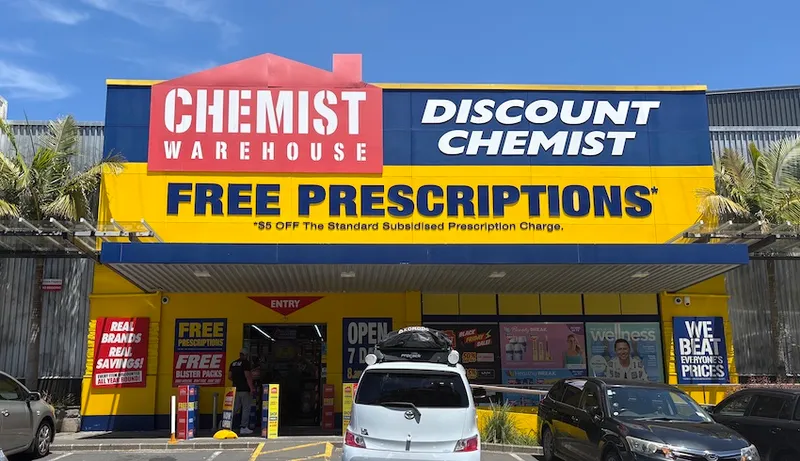
The same aggressive expansion is happening right across the country. Canterbury has welcomed four new Chemist Warehouses this year alone, including one plopped unapologetically next to the iconic Drexel’s breakfast diner in Riccarton, and the imminent opening of an extremely fugly store in the central city. “It’s offensively yellow,” one Redditor said. “Giving me big minion vibes.” Elsewhere, New Plymouth was blessed with a second Chemist Warehouse just last week, and Palmerston North looks to be up next.
It’s a lot in just eight short years. The Australian pharmaceutical behemoth first arrived on our shores in November 2017, with a store in Auckland’s St Lukes boasting discounted beauty products, perfume, supplements, vitamins, and cheap (or even free) prescriptions. Despite its bewildering, lobotomy-like effect on consumers, the yellow megastores quickly started to spread across Auckland and then the wider North Island, eventually jumping the Cook Strait in 2020. There are now 68 Chemist Warehouses across Aotearoa, with more on the way.

The Chemist Warehouses in closest proximity to each other are the aforementioned Auckland CBD pair (240 metres apart), followed by the Westfield Newmarket and former Smith and Caughey’s site (500 metres apart) and a dynamic duo in Botany (550 metres apart). There’s a confusing couple in Westgate, with one in Westgate Mall and one in Westgate Lifestyle Centre, that are just 900 metres apart. In Christchurch there are two Chemist Warehouses just five minutes apart in Riccarton, and in Tauranga you can hit three stores in just 22 minutes.
Keep digging into the data, and the future starts to look pretty bonkers. The growth from just one Chemist Warehouse store to 68 Chemist Warehouse stores is an increase of 6700% over just eight years. Some highly credible independent modelling done by The Spinoff’s data division (our very generous finance manager Cecile between “paying the bills” and “keeping us from liquidation”) suggests that the current trajectory would see 4624 Chemist Warehouses by 2033. Keep the same projection going, and there would be 314,432 stores across Aotearoa by 2041, and 21,381,376 by 2049.
(The Spinoff would also like to add that this is just a joke, and that we did approach Chemist Warehouse about its expansion plans but did not get a response.)

Even if its plans for growth don’t prove as dramatic as my foolproof projections (the most common figure in recent reporting is that the Chemist Warehouse is aiming for a total of 70 stores in New Zealand, which looks right around the corner), there’s still a lot of unanswered questions about the takeover. Does our population actually need this many Chemist Warehouses? How much discounted Nicki Minaj Pink Friday Body Mist can a small island nation possibly consume? And what is this all doing to our locally owned chemists?
John Saywell is the chief retail scientist for the Independent Pharmacy Group, a collective of 80 owner-operated pharmacies located everywhere from Kaitaia to Central Otago, and has been monitoring the impact of discount chains like Chemist Warehouse on independent pharmacies in recent years. “We’ve seen it wash through the whole industry,” he says. “The immediate impact of a big discounter is that they take some market share off everyone else, and then the owner operators worry that they have to drop their prices to try and compete.”
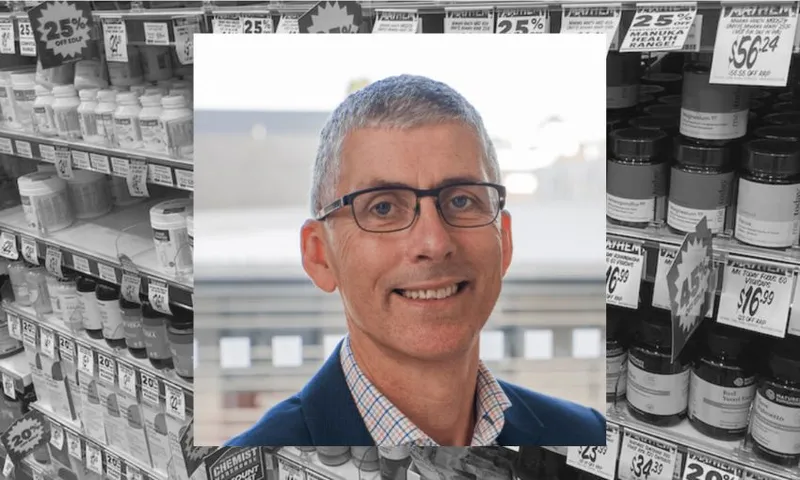
In just the past five years, around 150 owner-operated pharmacies have closed down across Aotearoa. “There were already too many pharmacies in New Zealand, but the addition of these big new ones was the final blow for many,” he says. It isn’t just about taking the market share, but putting pressure on an already stretched workforce. “They’ve also taken hundreds of qualified pharmacy staff when there was already a shortage which, for some owners, was the other nail in the coffin when they were already struggling to stay open.”
Saywell says independent chemists can thrive in the shadow of Chemist Warehouse by continuing to offer high quality, localised, in-store service. “We can’t compete on price, because we don’t have the economy of scale and we don’t have the business model that the big corporate chains have,” he says. “One key thing we have found to preserve business profitability is through maintaining high levels of in-store service, because good, personalised service is at the opposite end from Chemist Warehouse.”
Bhaidas Bhula, the 77-year-old owner of New North Road pharmacy since 1981, can attest to this. “I am lucky not to have been affected by Chemist Warehouse simply because my customer base is extremely loyal to me,” he says. “They all say that they don’t want to go to the Chemist Warehouse because one: they don’t give good service, apparently, and I give good service. And two: they say they don’t want to support them because the money is going offshore.” He has never set foot in a Chemist Warehouse himself, and doesn’t intend to.

“You’re often waiting for 30 minutes, which forces you to go around the shop and buy things,” Bhula says. He believes it is a marketing ploy. “People don’t realise what’s actually happening to you when you go in there.” Chemist Warehouse also consistently waives the $5 prescription fees. “People think they are saving $5 on their prescription, but then they’re spending $60 extra on stuff they don’t need,” Bhula says.
For a brief time, Bhula could also offer prescriptions without charge when the Labour government scrapped the fees. With the $5 prescription fee reinstated in July last year, the Chemist Warehouse have been able to absorb the additional cost, and smaller chemists are struggling to compete. “In Auckland, I see that most local pharmacies are not charging the $5 fee either, which is crazy,” says Saywell. “That costs the average pharmacy around $100,000 a year, so can be the difference between your business surviving or dying.”
When asked if we even need this many giant Chemist Warehouses, Bhula puts it plainly. “We definitely don’t. They have a total monopoly, and unfortunately the lay person is not realising this.” He worries about what the future holds for small businesses like his. “I think the outlook is very poor. I think you’ll see the likes of myself closing down because we can no longer compete, and then everyone will turn around and say ‘oh my local Mr Bhula’s closed down? Why did he close down?’ It will be because you didn’t support me.”
Saywell is more optimistic. “Both ends of the market will survive. The discounters will have 30% of the market. There’ll be 30% of people in the middle who are at risk by not figuring out whether they’re going to be big and cheap or small and personalised, and the remaining 30% will be local owner-operators providing personalised service.” And while he remains confident the average consumer can tell the difference between a discount chemist chain and a small local business like Bhula’s, he has some parting wisdom that might help.
“Go where you will get what you need,” he says. “And if you need someone who knows your name, go to your local independent pharmacy.”

Alex Casey
Alex Casey is a senior writer at The Spinoff with over a decade of experience writing about popular culture and social issues in Aotearoa. She lives in Ōtautahi and likes watching reality TV and walking the dog, occasionally at the same time.


