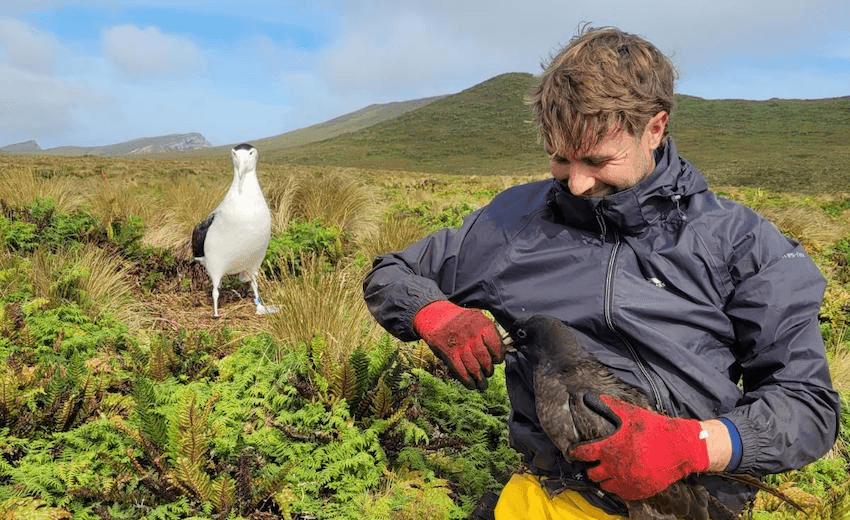

Alex Casey talks to researcher Jamie Darby about swapping an Auckland summer for two months tracking endangered seabirds on the Antipodes Islands.
It was New Year’s Eve, and while many across Aotearoa were likely queasy after too much frivolity, Jamie Darby was green around the gills for a very different reason. He was at the start of a gnarly three-day voyage from Bluff to the remote uninhabited Antipodes Islands, and dealing with three-metre swells at the calmest of times. “Making a cup of coffee, it’s a serious balancing act,” he says. Even the simple act of sleeping required securing a tarpaulin alongside the bed, ensuring one doesn’t “go flying” across the sleeping quarters in choppy waters.
A couple of bumpy nights and a few spilled coffees later, Darby arrived at one of the most remote places on Earth. As a researcher from the school of biological sciences at the University of Auckland, his mission for the next two months was to collaborate with DOC’s Conservation Services Programme to track the endangered Antipodean albatross. In a world first project supported by the University of Auckland Foundation WWF New Zealand, and the university’s school of biological sciences, fine scale GPS units are following their movements at sea, providing insights into their deadly interactions with commercial fishing boats (now the leading cause in their population decline).

But before all of that good work can begin, one must make it ashore at Hut Cove in one piece. “It’s an interesting introduction to the island, because you really are just tripping over the wildlife,” laughs Darby. “If you’re unlucky, you might have an elephant seal or two on the rock platforms where you land, and then you have to stealthily get through a big pile of penguins and fur seals.” Still battling sea legs, the small crew then had to winch two months and several hundred kilograms worth of research equipment, food and personal gear up to the hut.
The island is officially uninhabited by people apart from visiting research groups, but Darby says “the mark of humans” remains. Their small hut sits next to a castaway depot, which has provided a refuge throughout history for those marooned on the island – when they could find it. In 1893, 11 crew members from the shipwrecked Spirit of the Dawn lived for 87 days chowing on raw mutton bird and mussels, while the well-supplied castaway depot sat untouched on the other side of the island. In 1908, crew members of the President Felix Faure survived for 60 days at the castaway depot before being rescued.

When it comes to humans navigating the notoriously inhospitable island, the challenges don’t stop there. DOC researchers have been monitoring the albatross study area for decades now, yet it remains an extremely narrow and steep journey up to the colony. “Calling it a path is quite generous, but when the path runs out, you just have to make your way across quite deep tussocks and fern tufts and things like that,” Darby says. “You end up falling over a lot – I actually rolled an ankle in the first few days here just getting used to the place.”
Once at the colony, Darby and his co-researcher split the area in half and got to work recording which albatrosses were around, identifying them by their coloured and numbered bands. “Even for such a large bird, they’re quite good at hiding,” he says. “They are also full of character and very interactive.” He remembers spotting a chick furiously flapping its wings and trying to take off from a high point. “As they take off they will make this little sound – ‘weeeee’ – which I wasn’t ready for. It’s very, very, hard not to hear that as them having this little bit of exhilaration.”

It is also the time of year that new albatross pairs start to form, and birds may even make a nest for an egg. “That leads to an awful lot of very cosy interactions, which is really beautiful to look at,” says Darby. “We have one male that we knew had been alone for the last decade, and suddenly a female has appeared and they’re courting, and it looks like they’re going to have a nest.” It might sound a bit like Love Island, but every pairing is extremely crucial – it takes the Antipodean albatross 10 years to start breeding at all, and then they lay just one egg a year.
With the female population impacted far worse by commercial fishing vessels than the males, Darby says they have been prioritising tracking females with GPS technology to better understand why that is. “We just need better information on what they’re doing because they’re just too mobile and too remote to get any direct observation on what they’re up to,” he says. They recently got a track back from one bird that had flown 1000km out into the Pacific, and back again, in under a week. “You look at this data, and you just get blown away every single time.”

After a hard day’s grind at the colony, Darby returns to the hut to catch up with the other DOC researchers currently working on the island. Data is uploaded, card games are played, and dinner is eaten – “we had a lovely gnocchi and butternut squash and feta dish that the penguin team cooked the other day.” There’s a diesel stove to keep things toasty when the bitterly southerlies roll through from Antarctica, and even a little library shelf of books left in the hut by previous visitors, which includes guides to flora and fauna and a surprising number of thrillers.
While many of us may dream of voyaging to a remote island and being left out of reach with a tatty old thriller, modern communication has caught up with the Antipodes. “I do lament, a tiny bit, about having the internet out here on this trip,” laughs Darby, “because it is very nice to be contactable, but it also means that people still want things from you.” He keeps his phone use to a minimum, and doesn’t try to keep up with the daily news. “It feels like time is flying by, because everything we’re doing is directly in front of us, so you can’t ever think too hard about the outside world.”

Nonetheless, the impact of the outside world still looms over the entire tracking project, which is all about the harmful interactions between the Antipodean albatross and commercial fishing vessels. For example, baited hooks on a long line will attract albatross as they are being set in the water, only to hook and drag them down, drowning them. The warp lines used to stabilise the nets off fishing trawlers are imperceptible to the albatross travelling at 100 km/h, causing “catastrophic” damage when struck. Other times, they get trapped in the giant haul net itself.
It’s better understanding these preventable, human-made problems – and possibly bringing about solutions – that keeps researchers like Darby swapping their Aotearoa summers for the subantarctic. The Antipodean albatross population has already dropped by two thirds in the last 15 years, with fisheries recently found to cause 350% more deaths than previously reported. “If you consider that it takes them so long to even get to maturity to start breeding, that rate of decline is why they’re feared as one of the species that’s most at risk of extinction the next one or two decades,” says Darby.
“We just want to try and give them the best chance.”