Is New Zealand’s nang use sizing up?

Not just a gas: there’s renewed concern about nitrous oxide abuse in New Zealand. (Design: Tina Tiller. Images: wonderwhip.co.nz, ezywhip.co.nz)
Nitrous oxide canisters have grown – and so have concerns about their recreational use.
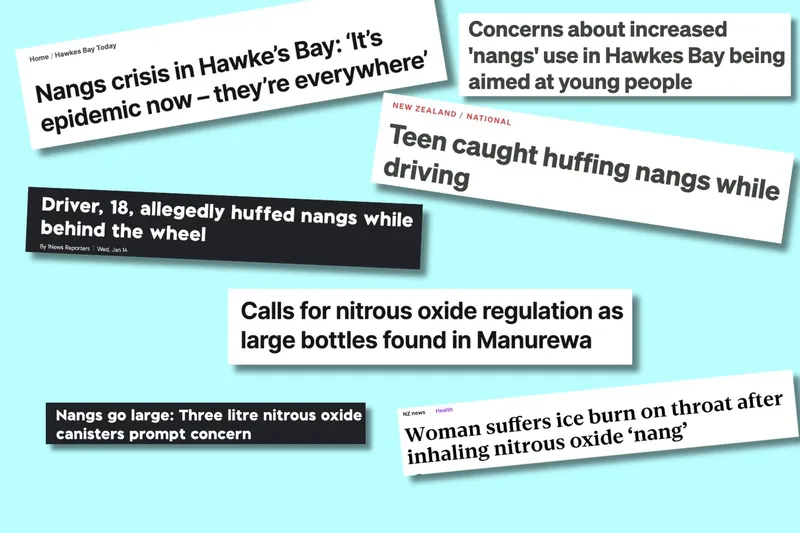
Nangs are back in the headlines, because of fresh concerns that recreational use – and abuse – by young people may be increasing. The canisters, originally designed for use in whipped cream dispensers, contain nitrous oxide, or nos. Bay of Plenty police reported finding people inhaling the substance while behind the wheel. Members of the Hawke’s Bay community are concerned too, recently holding a hui with Health NZ, councils, police and youth representatives about the noticeable rise in discarded canisters, described as an “epidemic” by those who dispose of them.
“Informal reporting from our Hawke’s Bay emergency department suggests at least two cases of nerve injury from chronic nitrous oxide use have been seen over the last three months,” says Health NZ’s medical officer of health Dr Nicholas Jones. “Where concerns are raised about sale or supply, we will help ensure those concerns are appropriately escalated to the regulator.”
Hmm, that does sound concerning.
“It’s totally reasonable for a community to be concerned, particularly if there is a massive uptick in actual consumption with no adequate uptake in education,” says University of Otago drug use researcher Jai Whelan.
However, he’s not a fan of the term epidemic (unless something’s an actual disease) and cautions it could lead to fear or shame. “I don’t want there to be greater stigmatisation and therefore reduction in help seeking for people that have an actual issue or feel like they have a dependence on nitrous.”
So, what’s new?
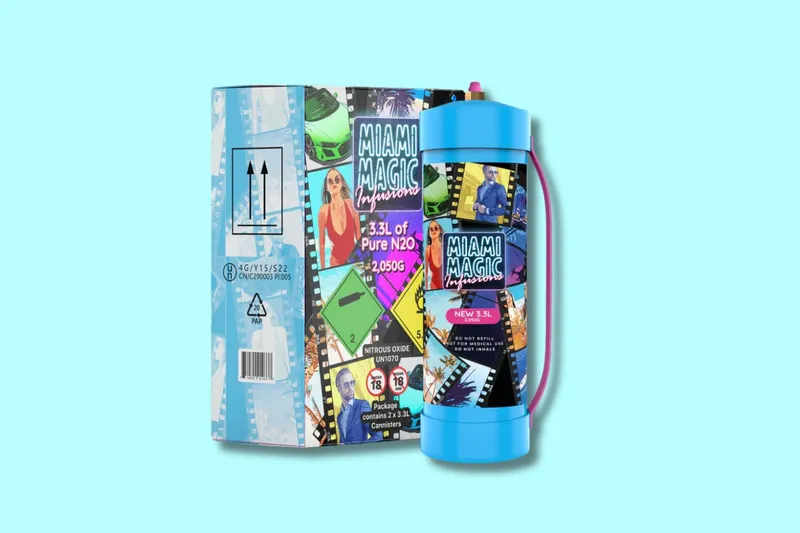
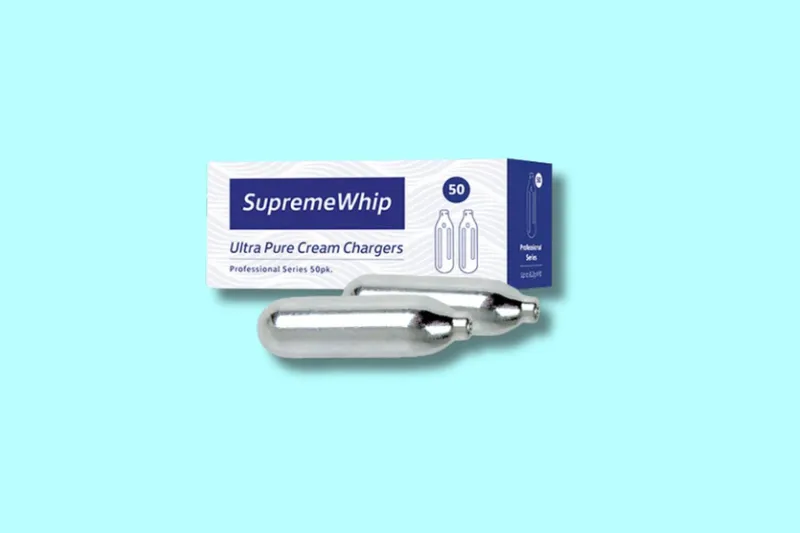
Keep an eye on the gutters and you’ll find some of these nos products are now bigger and brighter than ever. Covered with colourful motifs and lettering, the new generation of jumbo-sized nitrous oxide tanks are far, far bigger than the little steel canisters you’re probably more familiar with. The Miami Magic Infusions model sold by one local supplier is 2050g in size, compared to a classic 8.2g steel canister.
Both are (ostensibly) designed to be used in tandem with whipped cream dispensers in commercial cooking, but Whelan is sceptical of the big, bright canisters. “I’m extremely dubious of anyone who genuinely thinks that those huge tanks are being used for catering. No one’s buying Miami Magic for the cream bun filling.”
They’re “very accessible” according to Whelan, available both online and in local shops.
How bad is nos anyway?
Measuring the harm of any substance is complex and can vary according to methodology. A 2023 University of Otago study ranking drug harm in New Zealand put nitrous oxide at the lowest end of the spectrum, with a score of 3 out of 100, compared to 32 for cannabis and 88 for alcohol, which was the most harmful drug. A Massey University Substance Outcome Harm Index published in 2025 measured individual risk and excluded societal harm, ranking nitrous oxide at 3 on a scale of 10, above MDMA, cocaine and LSD. Of regular users surveyed in one global study, 3% reported permanent sensory symptoms.
Health NZ says that recreational inhalation of nitrous oxide gas can pose “significant” health risks, particularly if use occurs over a long period of time. “These risks can be short-term, acute harm in the form of frost burns to the mouth and throat, or injury due to loss of consciousness, through to long-term chronic harms including permanent brain damage from hypoxia (lack of oxygen), or nerve damage, which can cause ongoing numbness or tingling in the hands and feet, weakness, difficulty walking, or problems with balance and coordination,” says Jones. “Nerve damage can be permanent.”
Whelan says that while nerve damage, or other significant issues, can and does happen, it’s typically from long-term or very high-dose use. “Nerve damage can indeed be permanent, which is why it is also important to be wary of early signs of issues [like] ongoing B12 inactivation.”
A 2024 study into nitrous oxide myelopathy (spinal cord compression) by Auckland City Hospital neurology chief resident Shilpan Patel found that the drug caused vitamin B12 inactivation (making the vitamin useless to the body), sparking neurological damage. One of the patients in Patel’s study reported their peak usage involved 200 canisters in a single session.
Other extreme cases of nitrous oxide abuse have included one person inhaling two litres a day and ending up in hospital, and another needing a wheelchair.
Yikes. So can it be safely used?
“Although nothing is absolute, it is reasonable to suggest that infrequent and low-dose use has a much lower likelihood of causing harm,” Whelan says.
While no drug is completely safe, the New Zealand Drug Foundation reports that the gas has been used recreationally since the 1700s, and consensus among drug experts is that “using nitrous oxide is a lot less dangerous than using many other drugs,” including alcohol.
Whelan agrees. “Nitrous oxide is not very harmful. And if it was very harmful, we probably wouldn’t pop it into our hospitals, or give it to pregnant mothers in labour.” Nitrous oxide is commonly used for anaesthesia in hospitals – including during childbirth – in the form of Entonox, a 50:50 combination of nitrous oxide and oxygen, which ensures the brain isn’t deprived of oxygen.
Those cream chargers and canisters on the other hand are 98% nitrous oxide, so “relatively pure”, says Whelan. “Not breathing oxygen does destroy brain cells… but not in seconds.” However there’s a genuine risk of hypoxia, a condition where there’s low levels of oxygen in your body tissue. “It’s important to breathe normally after inhaling (you don’t need to force re-breathe the balloon – get some oxygen in your lungs), and it’s a good idea to space out doses in a session.” Symptoms of hypoxia range from confusion and headaches to blue skin and heart rate changes. In some cases it can be life threatening.
Whelan says he hears some inaccurate talk of side effects. “There seems to also be a lot of discussion and misinformation about the direct effect of nitrous oxide, that it’s somehow inherently neurotoxic to inhale. It doesn’t appear to be the case, or to my knowledge, there’s no kind of evidence of that,” he says. “I think it’s interesting that people think it kills brain cells. I don’t really know where that comes from.”
Research on the effects of combining recreational nitrous oxide with other substances is slim. “The general advice is to be mindful… particularly with other dissociatives like ketamine,” Whelan says.
And is it illegal?
It depends. If you’re buying it to whip cream, go for it. However, “it is illegal to sell, supply or possess nitrous oxide for recreational use,” Medsafe advises. If it’s sold for recreational inhalation then the Psychoactive Substances Act 2013 applies. Suppliers run the risk of a $500,000 fine or two years in prison, while users could be fined up to $500.
Haven’t we cracked (lol) down on these before?
Yep. Nitrous oxide was previously regulated by the Medicines Act 1982 until the government crackdown in 2024, which saw the penalties increased and moved under the Psychoactive Substances Act. It followed a rise in “nangs-related injuries”, which saw 25 ACC claims in 2024, compared to 10 the year prior, and six patients referred to Auckland Hospital’s neurology department with “severe spinal injury” in 2023 due to nos abuse, up from zero in 2022.
So, who’s using it?
It’s not just young people, says Whelan. “I think everyone’s using it.” However data on nitrous oxide use in Aotearoa is “quite poor”. In the 2025 New Zealand Drug Test Survey, run by Massey University and Whāriki Research Centre, 50% of respondents reported having used nitrous oxide during their lifetime with 11% having done so in the past six months. Of the nearly 5,000 people sampled, 63% reported having experienced no harm from any drugs used in the previous six months. Back in 2003, a study of Auckland University students showed 57% knew about nos and 12% had taken it recreationally.
A 2015 UK study found it was the second most popular recreational drug (after cannabis) and use was “generally moderate”.
How else can harm be minimised?
Drug information resource The Level advises it’s safer to sit down to avoid accidents like falls, users should discharge the nos into a balloon to prevent freeze burns from the cold compressed gas, and it’s best to stick to small canisters for more controlled doses. That’s advice echoed by Whelan, who says education helps reduce harm. “Knowing that you need to take a break is one really simple piece of information that people should have,” he says.
Speaking of restrictions…
Yeah, those are back in the headlines too, with calls for politicians to revisit the law around selling nitrous oxide and consider a ban around dairies and vape stores.
But, a hardcore crackdown could lead to stigmatisation, according to Whelan. “There is potential that people will move to other substances that might be more harmful.” It could also create a black market for nos, putting users at further risk, he says. Whelan thinks legalisation and regulation would reduce harm by creating a controlled market with safer products. For example, canisters that contained half nitrous and half oxygen would be “a complete game changer”.
The NZ Drug Foundation supports the regulation over prohibition of “all lower-harm substances” like nitrous oxide.
Other suggestions to limit harm include setting a cap for canister sizes and introducing plain packaging rules, and centralising the sale of recreational nitrous oxide to licensed suppliers.
Emma Gleason
Emma Gleason is a staff writer at The Spinoff and an award-winning fashion journalist. But it’s not just clothes that interest her, you’ll find her exploring tasty cheese, influenza outbreaks and more important things right here. She has experience with some of the country’s leading media outlets as well as the toaster in our kitchen.


