From Great Walk to great woe – the rise and fall of a Ruapehu shortcut

Alex Salmon and Mount Ruapehu (Photo of Ruapehu taken by Geoff McKay and sourced from Wikipedia)
They call it the Ditch Track, spat out as a warning for trampers to avoid it. But before neglect and decay set in, it was Salmon’s Track – a straight-shot lifeline across the tussock, built by one man with a mattock, grit and a vision. It’s time to give it back its real name.
Down in the sparse Whakapapaiti, on Ruapehu’s northwestern flanks, there’s a sign hidden in the bush. Its retro font, once bold white on forest green, has been softened by many decades of harsh alpine weather. Lichen creeps in at the corners, like an old secret being incrementally erased. It reads: Chateau This Way.
Most trampers don’t notice it; the bush here swallows both sound and sight. But for those who do, the sign is a relic – a hardworking, weathered survivor from another era.
The marker is one of the last surviving whispers of Alex Salmon, former park ranger, a man forged from timber and frost. Fiercely strong, Salmon learned the ways of the bush in Taranaki and came to the central plateau in the 1920s, not for glory or romance, but for a carpenter’s wage. Salmon worked on one of the most audacious projects the region had ever seen: the grand Chateau Tongariro.
When the job was done, he didn’t leave. Hopelessly in love with Ruapehu, Salmon first took charge of guiding and skiing at the Chateau, then later became Tongariro’s first paid park ranger.
In 1949 he built a hut in the lower Whakapapaiti Valley, with safety in mind (in 1931 a group of 14 people had lost their way descending from the summit and ended up stranded in the valley). The hut, named Alex Bivvy and popular with trampers, was also a base for further track construction and maintenance. Salmon bought the materials himself and carried them in, accompanied by a pack horse and his faithful dog Star.
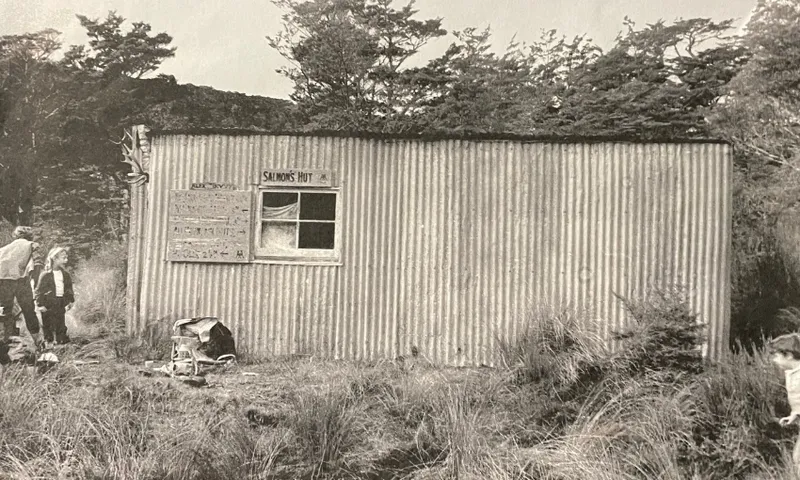
He refused payment for either the materials or the hut. Over time the bivvy deteriorated, and the new Whakapapaiti Hut, built in 1965, proved more popular. Alex Bivvy was dismantled in 1980 – except for its last standing sign: Chateau This Way.
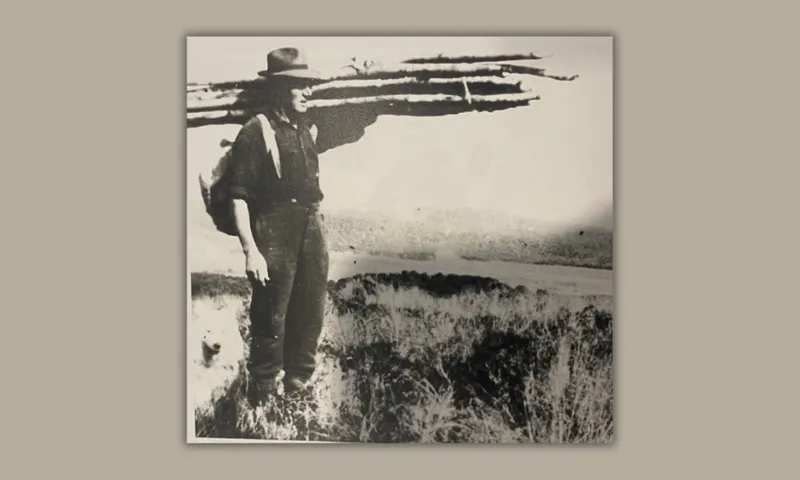
A confirmed bachelor, Salmon’s main love interest was the mountains and he spent all his own time working on improving the national park. He lived by himself in a Ministry of Works cottage with no insulation, an open fireplace, and a coal stove in the kitchen. It was rustic, but Salmon considered it palatial.
He cut a distinctive figure around the mountains, always clad in a fedora style hat (he owned two: a weathered one for work, and a “good” one for going into town), a checked shirt, old tweed jacket, woollen trousers and boots. Rainy days were not wasted – these he spent making billies for the huts around the national park, using discarded food cans from the Chateau. He’d punch holes near the rim and fashion a handle using number eight wire. Thanks to Salmon’s work, every hut had a motley collection of these unique billies in all sizes, and they came in handy on cold, crowded nights.
In Salmon’s day only a few tracks existed around the mountains. One ran from Ohakune up to the old Blyth Hut, another went to Ketetahi Springs. The saddle track gave access from the Chateau over to Waihohonu Hut. But if trampers wanted to get from the Chateau to Mangatepopo Hut, they had a long, time-wasting expedition over the top of Tama Lakes then skirting between Pukekaikiore and Ngāuruhoe.
Salmon thought the track system was limited and unhelpful, and the Mangatepopo route was a bit unsafe, as it went to higher altitudes and exposed trampers to the elements for longer.
A man of self-made solutions, he decided to build a more direct track and set about constructing it in his spare time and at his own cost. Starting at the Chateau, he walked to the top of each ridgeline, looked back to where he’d started and forward in the direction of Mangatepopo Hut, then stuck a pole in the ground. They were around five feet tall and cut from rounds of wood. Eventually he had one pole on the top of each ridge in a beautiful, dead straight line. In total, he placed about 600 poles.
Then he cut the track with a mattock, avoiding any deep gullies and ensuring the easiest grades for tramper travel. He placed planks over small creeks and wired the planks to iron pegs so they wouldn’t be washed away even in flood.
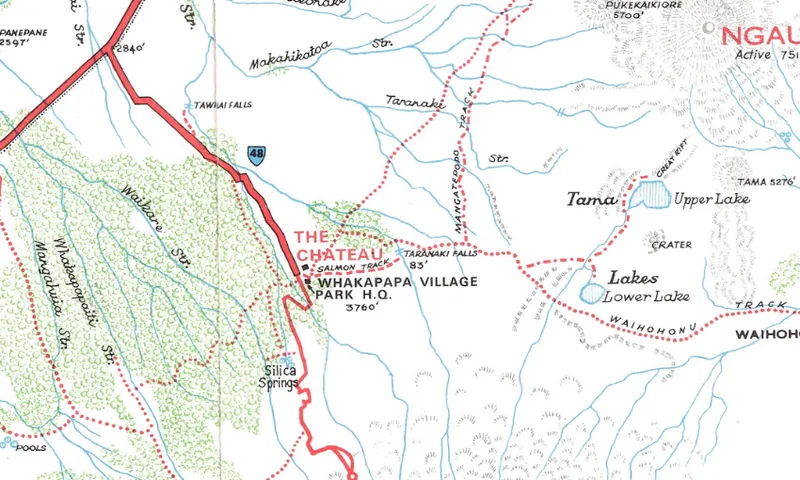
The track was immediately popular and the old saddle route became abandoned. The new route saved 6.5 kilometres and was considered safe even in thick fog or at night.
The park board was advised that the track had been constructed by a staff member at the Chateau and no payment was expected. At their meeting it was noted that Salmon had built the track to induce visitors to use this section of the park more.
A newspaper observed: “Board members were amazed that anyone could be so interested in the park as to shackle himself with such an arduous task.” They tried to pay him, and he declined. The board wrote to Salmon to thank him and inform him it would officially be known as “Salmon’s Track”. And so it was.
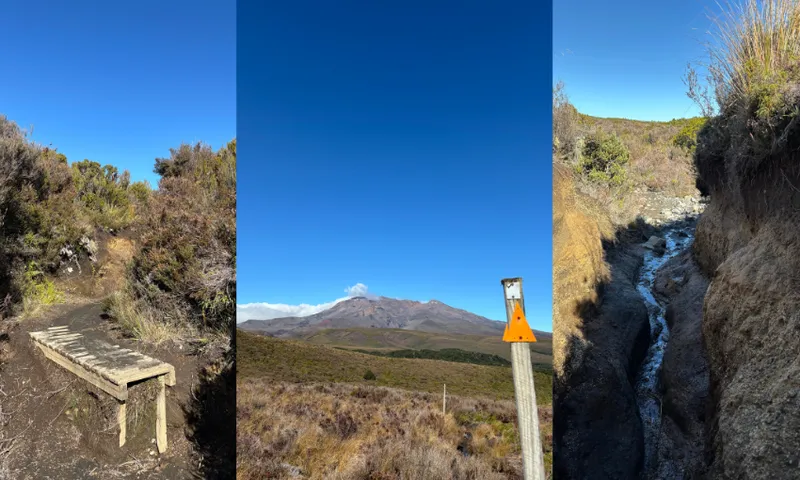
Today the track is part of the Tongariro Northern Circuit – and a deeply unpopular part. Peek into tramping forums and groups, and you’ll see trampers advising others to avoid it at all costs. It’s fallen into disrepair and is known not as Salmon’s Track, but as the Ditch Track. While the Great Walk is one of the most popular and bucket-listed in the country, this section – usually the circuit’s first day – is often skipped.
DOC’s Great Walks need to be of a certain standard, and it’s a well-known fact that this section of track hasn’t been up to scratch in a long time. Yet investment and action from DOC historically hasn’t been forthcoming. In June, volunteers under the Backcountry Trust tackled it, doing some track cutting and repairs to drainage and boardwalks. With organisations like the Backcountry Trust and the West Coast’s Permolat group, New Zealand has seen a rise in volunteers not waiting for the government to offer solutions, but rolling up their sleeves and getting stuck in. Just like Salmon.
New DOC Tongariro operations manager Libby O’Brien said the enthusiasm is there to upgrade it to be of a standard people would expect for a Great Walk, not to mention being in a dual world heritage area. “It’s not a cheap fix though, likely to be over a million bucks to really do it justice,” O’Brien said. “But I’m really keen to see if iwi are supportive of us looking to source the funding not only for our visitors but to make sure this historic track is looked after in a way we simply should, given the special place it’s part of.
“We’re super grateful for the work the Backcountry Trust have done recently and we could be looking at even more involvement from volunteers to help us look after our tracks. We know money is tight, especially for central government organisations, but if we are brave to think outside the box and involve all those who love this place maybe we can see the Mangatepopo Track brought up to a standard we all expect it should be at.
“We owe it to not only the park, to our Treaty partners, but also to those who have come before us who have passionately cared for Tongariro National Park.”
It’s tempting for DOC to simply give up on the track and instead direct trampers to get a shuttle to Mangatepopo and forgo that section entirely. Many do. It’s easier said than done, though; shuttles aren’t regular, and the circuit’s popularity risks declining if we give up on it being a circuit. It is, after all, the Tongariro Northern Circuit, not the Tongariro Northern Almost Circuit.
The Ruapehu region has been plagued with bad news over the past few years, with the liquidation of Ruapehu Alpine Lifts, low snow seasons and closures of the Ruapehu mills, meaning the loss of jobs and crucial economic activity in the region. Morale has been at an all-time low, public attention obsessed with the politics of ski field concessions to the exclusion of all else. Properly fixing the Mangatepopo Track and restoring the circuit’s status to a proper Great Walk is one initiative that could help encourage more visitors and boost the region.
“Everyone who steps foot into Tongariro National Park experiences the mauri of this place in their own special way, and it feels like it’s time to ensure the tracks that allow visitors to experience that are safe and at a standard they should expect,” O’Brien says. “Things have been tough here for a while, so it’s time to do everything we can to support the Ruapehu region to bounce back as much as possible.”
And what of Alex Salmon? Beyond a point, he disappears into the ether of history. Salmon became chief ranger in 1951 and resigned in 1957. After that, there’s nothing on record.
Sadly, the name Salmon’s Track never stuck. It does appear on the occasional map, but today it’s marked on the topo as “Mangatepopo Track”. Let’s stop referring to it as the Ditch Track, though; the name doesn’t do anything to encourage visitors, investment or enthusiasm. It derides the mountains we love so fiercely.
Let’s start calling it Salmon’s Track again, to recognise and celebrate the vision, grit and sweat not only of Alex Salmon but of the volunteers who now walk in his footsteps.
Fellow ranger Ralph Harris reckoned Salmon was “a real toiler” (Salmon famously led the first party to summit Ruapehu, Tongariro and Ngāuruhoe in one day, in 1930). “He was never happier than when doing hard physical labour – he was definitely one of the ‘old school’, a generation that has now disappeared.”
He had a simple philosophy: he loved the national park and wanted everyone to visit it, so he did everything he could to make it accessible, via well-kept huts and clearly marked tracks. That sign, tucked away in the bush at the old Alex Bivvy site, was one of many Alex made, but it’s the only one left now. If you find it, and if you stand there long enough, you might see him, even if only in your imagination: stepping out from between the trees, sawdust on his trousers, a welcoming smile and the mountain in his eyes.

Hazel Phillips
Hazel Phillips is the author of four books: Fire & Ice (2025); Solo: Backcountry adventuring in Aotearoa New Zealand (2022); Wild Westie (2014), a biography of Sir Bob Harvey; and Sell! (2013), a history of the advertising industry.


