Lessons from the ‘neglected’ under-18 dental service in the push to expand care

The scale of unmet dental need is huge, for both children and adults (Image: The Spinoff)
Essential dental treatment is free for kids. Here’s what it would look like to make it free for others.
Every day, at primary and intermediate schools around the country, children go to the dentist. Sometimes that service is delivered in school dental clinics; other times, it’s in a mobile dental van. Lateisha Chant is one of the oral health therapists in that van, working mostly in kura kaupapa Māori around the Wellington region. “I love my job – I’m so fortunate that I get to build good relationships with my community,” she says.
As an oral health therapist, Chant diagnoses teeth and gum problems, but she also provides education about how to care for your mouth, important for kids to know from a young age. “Within the school dental services, we go in and we are able to see the kids quite regularly and having that regular care, we’re able to spot things before they get bigger,” she says.
Along with the kids come their parents – some of whom ask if they can be treated too. But the funding just isn’t there. At recent school holiday clinics, Chant had multiple parents asking for dental care every day. “It’s heartbreaking, because you just want to help them on a human-to-human level,” Chant says. “I do everything I can to help the tamariki but if they’re over 18, it’s like – I’ll give them toothpaste samples.”
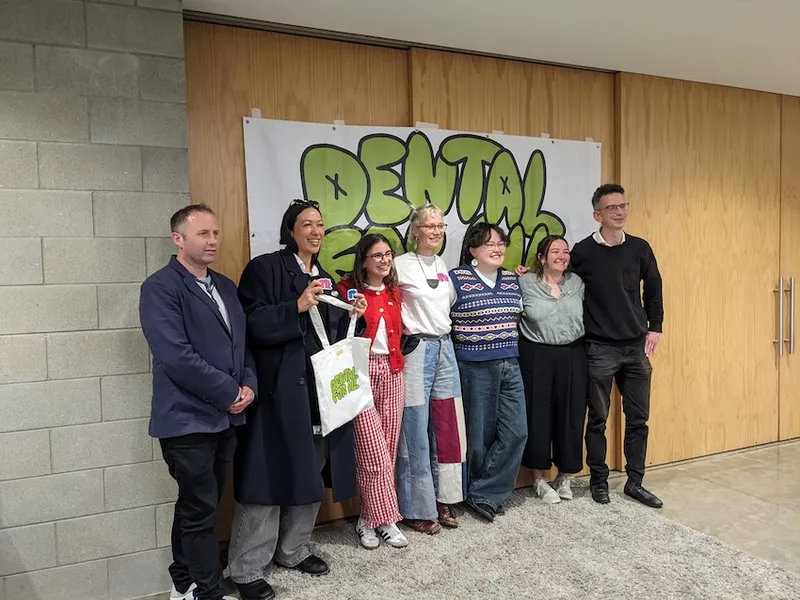
Chant is a supporter of Dental for All, a campaign advocating to make going to the dentist free for everyone in New Zealand. Her experience working with kids, who can get free dental care, shows some of the ways expensive dental care is failing to provide for everyone, and why the system is in need of reform.
Once kids are in high school, then their free dental care is provided by private practitioners who have signed up to a contract with the government, which isn’t all dentists. This contract hasn’t been updated for 20 years, says David Excell, president of the New Zealand Dental Association, and it’s not financially lucrative. “Many dentists only provide care on the contract out of goodwill.” A review is currently under way to examine the terms, which will be completed in 2026. Dentists seeing teenagers from year nine onwards often find issues requiring more expensive, complex, time-consuming treatment – because those children had issues which weren’t addressed earlier.
Currently, Excell says, the dental service “is way behind” on seeing under-18s, with only about 70% getting the full care they are entitled to. Dental therapists like Chant are in demand but the workforce is small, and training is only available at Otago University and Auckland University of Technology.
It’s similar for dentists. “We still produce just 60 dentists a year, and that number hasn’t changed since 1985. Since then, our population has grown by two million,” Excell says. Currently, about a third of dentists are trained overseas, but the number of dentists migrating to New Zealand is increasing. “We’re starting to rely on the workforce trained overseas – in a few years just 50% of dentists could be trained in New Zealand,” Excell says. The NZDA has called for an increase in the dental workforce to 90 funded seats in the dental school at the University of Otago each year.
In some areas, the issue is access. Dental for All recently ran a roadshow through the country, featuring free dental days and chances for people to share their experiences in the dental system. The group found that in some areas, like the East Coast, mobile dental clinics hadn’t visited schools for years. “Making dental truly public – building an integrated child, adolescent and adult community dental service – would improve planning and accountability for the under-18s service, and mean the government has to square up to the fact that oral health is part of general health, and needs urgent attention,” says Hana Pilkinton-Ching, a Dental for All campaigner.
Chant worked in Te Tai Tokerau before moving to the Wellington region. “It’s really hard to staff – it’s a big region, with high needs.” Some new graduates are recruited through the voluntary bonding scheme, a Te Whatu Ora initiative where health professionals are paid extra money to work in areas where there aren’t enough of them. The money can be used to directly offset student loans. She’s hopeful about more Māori health professionals coming through dental training. “A lot of them are actually returning to where they were born and raised, wanting to give back to the community,” she says.
What about adult dental care?
If the under-18 subsidised dental service isn’t meeting requirements, then the over-18, unfunded one leaves even more people behind. The Ministry of Social Development increased the “special needs” grant for dental care from $300 to $1,000 in 2022, but many people don’t qualify – for example, if you have other savings you could use instead. Multiple fillings, extractions or root canals can cost much more than $1,000, especially because those most in need tend to only see the dentist when they’re in severe pain.
The NZDA provides full oral care in association with ARCH, the Aotearoa Charity Hospital. Ten $10,000 grants for low-income adults who couldn’t access care any other way are available in the 2025 round of funding. With the dentists providing care not charging for their time, this has provided more than $430,000 of dental treatment for 300 people throughout the country. Many of those receiving treatment were identified through city missions or other charities working with the homeless.
Instead of the limited treatment options covered by the $1,000 MSD grants, dentists were able to do extractions, provide dentures and restore people’s mouths to full function. “It’s just life-changing,” Excell says. For the people accessing a full course of treatment, this funding is amazing, but it doesn’t address the number of people who are not receiving treatment. Some of the stories of unmet need are told in a Dental For All report from earlier this year, which includes people going into debt to pay for root canals, having to prove they have no savings to access the MSD dental grant and cancelling other health appointments to prioritise dental care.
The NZDA is advocating for full dental care to be extended at least up to age 25. “When people leave home, go into the workforce, go flatting, we lose them,” Excell says. “A small filling caught at a yearly checkup won’t turn into a root canal, an extraction, or a debilitating infection which lands you in ICU.” While the cost would be high, preventative healthcare saves money, Excell says – both on treatment and other costs like sick days, poorer nutrition if people can’t eat normally and lost quality of life from pain and discomfort.
Oral health is an intrinsic part of all other healthcare: what happens in the mouth, of course, affects the rest of the body. Excell thinks New Zealand’s exclusion of oral health from its otherwise subsidised health system makes dental care seem unimportant. “Dentistry is treated as a nice-to-have,” he says. “If the government doesn’t see dental care as a priority, why would New Zealanders?”
Tule Misa, the president of the Pasifika Dental Association, practises in Christchurch. She sees the impact of inaccessible dental care daily: her patients are “not sleeping, not attending school, not attending work because of the problem that they have with their teeth”, she says. At times, people knock on her door when she’s at home, wanting help with their teeth – but the most she can offer is a prescription for the pain. She has seen members of the Pacific community get loans to pay for dental treatment with consequences down the track. “Then they have to pay for the loan, and the cost can be really high.”
If free dental care was to be more widely offered, either for 18-25s or for everyone, there’s a lot to be learned from the current dental care provided to under-18s in terms of how to make it more accessible. Many of Misa’s patients don’t feel comfortable in a dentist’s office.” It feels scary and unfamiliar,” she says. “Many people won’t access care until they’re in pain.” Timing is also a factor – when she treats children she finds that parents with shift work often can’t make appointments. “There’s a lot of people who, by the time I see them, the only thing I can do is take [their tooth] out.”
“We don’t see many of the under-18s, because they don’t know that it’s free,” says Misa. She would like to see the model used by youth “one-stop shops”, which offer primary healthcare and mental healthcare, for dental care, where the focus is making the environment welcoming and inclusive. She also thinks a dental equivalent of Healthline would make it easier to ask for help. “For a lot of people it’s a very isolating experience going to the dentist, but if you are able to have more people around who you know and it feels familiar and more like from when you’re a kid, it’ll be easier to come in when you need it.”
Making dental accessible for everyone was a policy platform of the Labour Party’s campaign in 2023, and is a pillar of the Greens’ 2025 alternative budget. Expanding dental care up to age 25 and for Community Service Card holders was in New Zealand First’s 2023 policy, but not part of their coalition agreement with National. In other countries, like the UK, dental care is fully integrated into national health programmes. “I just want people to be able to get care whether or not they can afford it. I just can’t wait – I hope I see it in my lifetime,” Misa says.

Shanti Mathias
Shanti is a contributing writer at The Spinoff with a focus on Christchurch and the South Island. Email her at shanti@thespinoff.co.nz


