How tā moko is redefining gender for takatāpui Māori

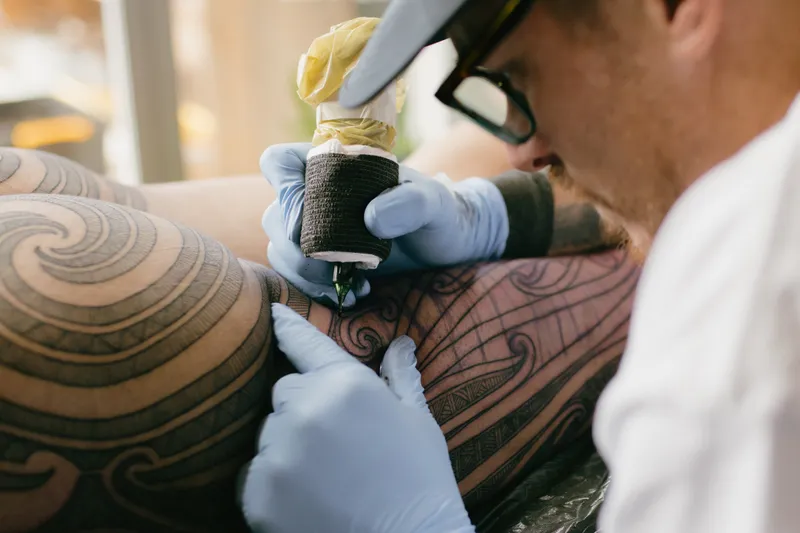
Jordan Walker receives their puhoro from Maia Gibbs. (Photo: Supplied/Ellen Mary-Taylor).
As Western models of gender affirmation fall short, one takatāpui Māori turns to pūhoro and whakapapa – reclaiming identity through tā moko and redefining what it means to be seen.
He pāpā ahau, he kaihanga ahau, he Māori ahau – he takatāpui hoki ahau.
In the history of Aotearoa, two things have long existed: the practice of tā moko, and the existence of takatāpui. As Ngahuia Te Awekotuku writes in Mau Moko: The World of Māori Tattoo, tā moko has always carried the weight of whakapapa, identity and social belonging. Post-colonisation, these indigenous understandings of tā moko were misunderstood by the mainstream, resulting in less Māori wearing tā moko – until the 1980s. It was then that moko started its resurgence, led by Te Tairāwhiti rangatira Derek Lardelli, Mark Kopua and Riki Manuel.
At the same time, indigenous queer identities were reconnected by the resurgence of the kupu “takatāpui” in gay, lesbian and transgender communities. Many scholars have since explored the whakapapa of the kupu and have solidified this mātauranga within educational institutions.
For a long time, there has been little overlap in conversations about being Māori and being takatāpui.
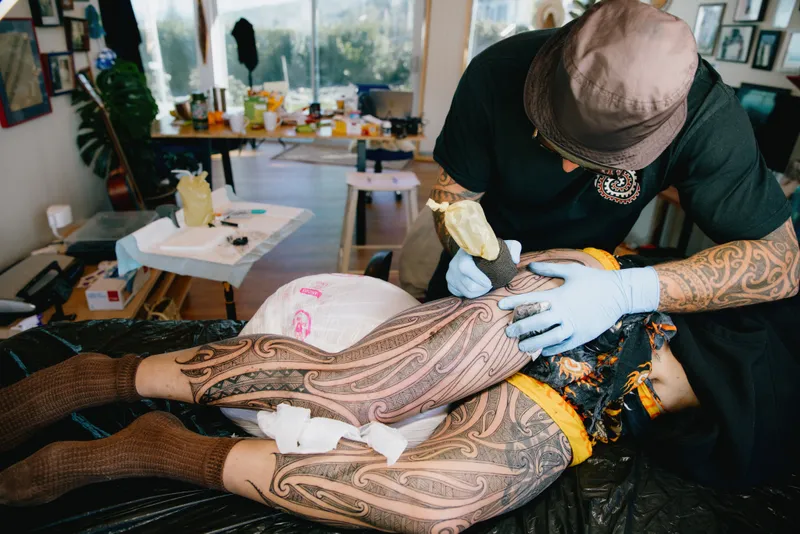
Traditionally, moko kauae is worn by wāhine, and mataora by tāne. Although also perceived as traditionally gendered, the resurgence of pūhoro – the tā moko worn around the buttocks, hips, puku, and legs – being received by wāhine is pushing back against the perception that they were only worn by tāne.
It is often said that receiving moko is a significant moment for a person’s hauora, as it connects the individual to not only their culture but also to their whakapapa. Designs are intertwined with patterns representing whānau members, with moko serving as a permanent representation of whānau on your body.
Affirming identity is deeply intertwined with hauora, which I considered when wondering how I could best affirm my culture, whakapapa and how I express my gender.
In collaboration with Te Tairāwhiti kaitā Maia Gibbs, and photographer and videographer Ellen Mary-Taylor, I documented my journey of receiving a pūhoro, in a short documentary titled TAKAPAPA, directed by Briar Rose. The kupu “takapapa” has been carried by takatāpui rangatira, Lara Taylor-Heta, and weaves together a sense of belonging through whakapapa and takatāpuitanga.
Within LGBTQIA+ communities around the world – especially those in Western societies – there are a number of ways people affirm their identities and gender. The desire for affirmation for transgender people is often brought on by body dysphoria and the anxiety of not “passing” as one’s preferred gender. Many people seek out gender affirming care like hormone therapy, surgery, facial hair removal, voice modification, tucking, packing, or binding.
These methods address how gender is viewed by Western society: inseparable from physical sexual characteristics. But gender and sex are different. They aren’t intertwined, and many gender characteristics are learned traits or stereotypes enforced by Western society.
If a society influences what gender looks like within their communities, what does it look like within te ao Māori? To me, it looks like moko.
During a wānanga at Kirikiriroa Marae in early 2024, when I was a kaimahi for InsideOut Kōaro, I was listening to a thesis presentation by academic Maia Berryman-Kemp about takatāpuitanga and moko, I asked another attendee if they would consider ever getting a mataora. They said yes. Although I said the same, I was apprehensive and began wondering why I was unsure and how to navigate those feelings.
Having the opportunity to wānanga and ask other takatāpui whether they would get moko, inspired me to consider if this was how I could showcase the intersection of my identity: my gender, whakapapa and Māoritanga.
I wasn’t, and still don’t consider myself to be ready to receive a mataora. When I began thinking about tā moko, gender affirmation, processing trauma in the body and endurance, I instead became fixated on pūhoro and the areas it covers. Knowing Gibbs’s work, and my perception of masculinity within the moko practice, I met him to see how I could navigate the journey. Gibbs comes from a staunch line of tāne kaitā and I wondered if he would agree to meet me. What unfolded from there was a beautiful friendship of understanding, providing the safety I needed to receive a pūhoro.
The idea of western affirmation surgeries had always made me uneasy, particularly here in Aotearoa where public health wait lists are long, and affirmation choices are minimal. The thought of being stripped of something from my body felt daunting. I didn’t want to lose that part of me. It didn’t feel gender affirming, but the thought of moko and pūhoro did.
Gibbs created a design for my pūhoro that encompassed my whakapapa, the intertwining of my taha wāhine me taha tāne and my whānau – all bound by a reference to my mum’s papakirango kete.
I am now marked with my takapapa. My story is written on me not only for myself, but for my whānau, my son and my mokopuna mō ake nei. It is a declaration of who I am – that my takapapa is my strength.
I have felt an immense sense of reconnection through receiving my pūhoro. When I look at myself in the mirror, at my body, I see a body which is holding the mana of a person, and that resulted in the most euphoric sense of self for me.
TAKAPAPA will be available to watch here from March 28.

Jordan Walker
Jordan Walker (Ngāi Tūhoe, Ngāti Porou, Ngāti Kahungunu ki Wairoa, Ngāiterangi) is a Te Tairāwhiti-based creative producer, takatāpui, and founder of Maraki Productions, where they work across Aotearoa on kaupapa-driven projects that centre Indigenous values, cultural connection, and equitable access.


