The impact on NZ if the AI bubble bursts

We asked tech consultancy director Ben Reid, minister of finance Nicola Willis and economist Shamubeel Eaqub to peer into the future.
Even AI true believers worry that we’re in a bubble – maybe even a ‘meta bubble’. Duncan Greive asks how New Zealand would survive it popping.
Last week marked three years since OpenAI debuted its ChatGPT product and launched the generative AI arms race into mainstream consciousness. Its impact was immediate – it reached 100m users by January 2023, the fastest platform to ever reach that mark. The milestones have kept coming, with OpenAI now valued at US$500bn, with both Anthropic and Elon Musk’s xAI not far behind, while AI-focused chipmaker Nvidia is the world’s most valuable business, briefly touching US$5 trillion.
The valuations are less a reflection of earnings, than of potential: AI has birthed a fresh crop of shiny new technology seers, each attempting to outdo one another with bold predictions. OpenAI’s Sam Altman is the showman: “AI will do 95% of what marketers use agencies, strategists, and creative professionals for today… at almost no cost”. Nvidia’s Jensen Huang is the guy selling pitchforks in the gold rush: “Everyone is a programmer now. You just have to say something to the computer.” Perplexity’s Dario Amodei is the doomy philosopher king, “My chance that something goes really quite catastrophically wrong on the scale of human civilization might be somewhere between 10 per cent and 25 per cent”. Fun!
It’s the perfect story for our time, dystopian or utopian depending on where you sit, and arriving in an era when trust in tech companies and their founders has cratered amongst much of the population. A recent Edelman survey showed “US respondents are more than twice as likely to say they reject the growing use of AI than they are to embrace it.” But for every doubter there is a true believer in the c-suite, with One NZ CEO Jason Paris typifying boss’s enthusiasm for a technology which promises human-like (or -surpassing) performance from a product which never sleeps or pulls a sickie.
That means there is a manifest opportunity for vast savings to businesses (and theoretically, to consumers), while also clear potential for job losses at an extraordinary scale. There is also a still boiling tension between content creators, from musicians to filmmakers to social media stars to consultants, all of whom have seen their work devoured by AI companies to train their models, almost never with explicit consent.
Too much, too soon?
Then there’s the increasingly loud chatter about an AI bubble. Part of what scares even veteran financiers used to big numbers is how closely tied all these companies are becoming. One recent Anthropic deal typifies the cosy nature of financing in the sector. It involves the company agreeing to spend $30bn with Microsoft, on Azure servers running Nvidia chips, while Microsoft and Nvidia agree to invest “up to” US$5bn and US$10bn respectively in Anthropic. It means any failure can’t help but ripple through the system.
The circular nature of the dealmaking, the vagueness around timelines and sometimes imprecision about just what is being bought and sold have led increasing numbers of observers and investors to wonder about whether this market is getting much too frothy for its own good. Bubble theorists don’t doubt the promise of the technology, but do worry that its adoption cannot possibly keep pace with its costs.
This is because it’s so reliant on hardware, most notably chips, datacentres and power plants, each with their own complexities. Chips are worked very hard, so can be burned through in as little as a couple of years. Datacentres require land acquisitions and complex permitting from often resistant local populations. And so-called hyperscale datacentres are so big they often require their own power plants, which are in even shorter supply than chips.
The scale of this challenge was elegantly, if chillingly, put by investor and writer Paul Kedrosky on a recent episode of Bloomberg’s Odd Lots podcast. He described AI as a “meta-bubble” – that is, a bubble which combined attributes of most previous bubbles: real estate, technology, loose credit and a notional government backstop. That last part relates to the national security arguments which have been made to beating China in the AI arms race. These mean there is a strong belief that if things go wrong, the government will pick up the tab. “It’s like we said, you know what would be great? Let’s create a bubble that takes everything that ever worked and put it all in one,” said Kedrosky.
Even the founders themselves are starting to get the wobbles. Altman said in August “Are we in a phase where investors as a whole are overexcited about AI? My opinion is yes.” Amodei recently described the current situation as “very concerning” at the New York Times’ Dealbook conference. Even Softbank, the Japanese investment conglomerate known for its starry-eyed view of tech’s future, sold its entire US$5bn Nvidia stake in November.
The global consequences of a bust could be enormous. There is a tight loop of investment, loans, chips, compute and cloud infrastructure involving a small handful of very leveraged companies and lenders. Many analysts see the upward curve of spending by businesses and consumers never steepening sufficiently to generate a return on investment. As much as half of all US growth has been driven by the AI boom, and its collapse could see huge failures in public and private markets. The likes of Microsoft, Google and Amazon could withstand it; but OpenAI, Anthropic, xAI and their lenders could collapse, incinerating billions of dollars along the way.
Where does that leave New Zealand?
Late last week the Herald ran a piece under this somewhat alarming headline:
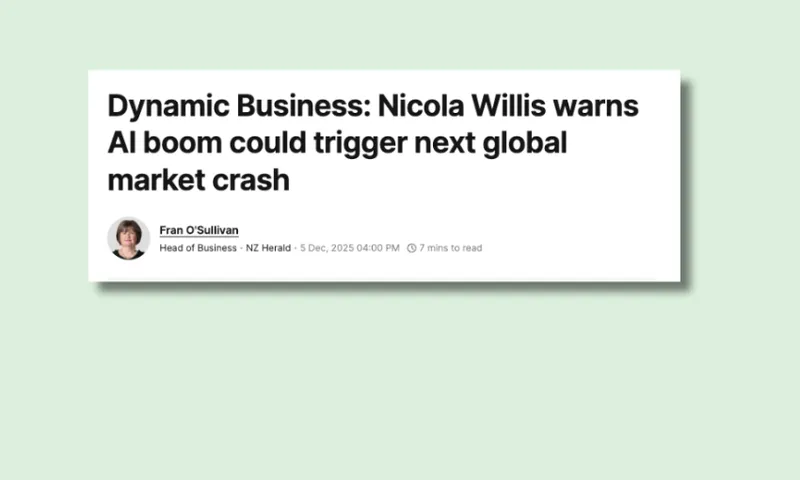
It’s a fairly pointy headline for a piece with no direct quote referring to an AI crash. In fact Willis was cautiously positive toward AI investment when contacted by The Spinoff and asked about any concerns she might have for investments in the sector. “Not all of the tech giants developing AI are going to win so there will be downs as well as ups on global stockmarkets,” she wrote via email.
“However, there are signs that AI is delivering productivity gains. So our job as government is not to try to predict stockmarket trends, but to maximise the potential upside of the new technology while ensuring New Zealand is able to withstand the next economic shock, whether it is in the form of market upheaval, trade disruption or a natural disaster.”
Still, it is essentially a statement of the extremely obvious that as a small trading nation, if there’s a major crash in the most powerful growth sector of US markets, we will be impacted. There will be financial and technological implications for us if the whole thing blows up.
The financial aspect is more charged because New Zealand has endured a long period of economic doldrums, suffering two recessions and a lengthy “vibecession” in recent years. Put simply, we’re not ready for another downturn, as it doesn’t feel like we ever got out of the last one.
That is in part because the AI boom – which estimates suggest has contributed half or more of all US growth this year – has largely passed us by. There are no frontier AI businesses founded here, despite it being ubiquitous in investment decks. The hyperscale data centre boom has swerved New Zealand, potentially due to high and erratic power prices, with Amazon the most high-profile to withdraw. There is a vigorous debate in Australia about a national AI strategy, one which has seen culture and creatives butting heads (and winning) with tech founders. Still, it’s on the global map – OpenAI has opened a Sydney office, whereas here it’s more plaintive exhortations from government and corporates for more businesses to use the technology.
Could we be lucky being late?
Paradoxically, being slow to nowhere on AI might prove to be a very good thing if the bubble pops, according to several analysts. Ben Reid runs the technology consultancy Memia and writes a widely-read AI newsletter on Substack. He told The Spinoff that while he believes AI is a transformative technology with huge potential to help Aotearoa, he also believes investment has likely got ahead of adoption, creating a clear and very large bubble, and that “it’s hard to believe it’s not going to pop any day now.
“That said, New Zealand’s been in a near-recession for much of the last couple of years already and technology is a relatively small part of the overall economy – so I’m not convinced there is much further to contract,” says Reid.
This sentiment is echoed by the economist Shamubeel Eaqub, of the investment managers SImplicity. “On the technology, I expect it to be like the rise of the internet through the dot com era. That is, the massive infrastructure and progress being made through the current period of extraordinary investment will reap huge technological progress in coming decades. It mirrors the kind of investment surge in railways for example.”
Those comparisons are frequently made – and compelling. The railroad boom in the US through the mid-late 19th century saw huge investment along with multiple booms and busts, leaving behind a transformative technology which opened up vast tracts of land to agriculture and helped create cities from bare land. The dotcom bust saw dozens of over-hyped companies fail, but survivors like Google and Amazon became enormously powerful building blocks of the modern internet. In both cases, some investors took heavy losses in the short term but the infrastructure built survived the busts and powered booms to come.
This sentiment is echoed by Milford Asset Management’s Andrew Curtayne, who told Ryan Bridge: “New Zealand’s not really spending the money, but we benefit from it. So if all these AI tools come out… we are able to benefit from that without having to really pay much for it.”
This divide – between the short term financial consequences of a bust, and the long term technological dividends of the investment – comes up consistently. “As a technologist, I think the global AI investment bubble should be a positive thing overall for New Zealand: it will level the playing field for access to capital and talent which have been challenging much of the AI ecosystem here – and provide more opportunity for New Zealand tech companies to compete fairly instead of coming up against VC(venture capital)-funded growth-at-all-costs startups,” says Memia’s Reid.
He too cites the dotcom bust as instructive, giving a ray of hope for a technology which has sometimes felt hostile to many people. “Now as then, timing is everything. Imagine a world next year when “intelligence” is abundantly cheap because there are all these datacentres full of GPUs (graphic processing units) desperate to find uses… what could you do with that?”

Duncan Greive
Duncan Greive is the founder of The Spinoff, along with the agency Daylight and music platform Lume. He also hosts The Fold, a podcast which features interviews and analysis about the media sphere in New Zealand.


