To save the CBD, stop calling it the CBD

A new Heart of the City ad campaign
To succeed in a post-Covid world, city centres need to be more than ‘central business districts’.
If you’ve been out around Auckland lately, you may have noticed billboards and bus stops plastered with the phrase “get from A to CBD”. It’s part of a campaign run by Auckland city centre business association Heart of the City, encouraging people to frequent their businesses by offering free rides in retro taxis from the outer fringes of Auckland into the city centre. A few taxis full of people from Takapuna probably won’t be enough to turn the city around, but anything helps. For now, the city centre is suffering from an economic downturn, covered in construction, and is holding its breath in hope that the City Rail Link will fix everything.
“Get from A to CBD” is a cute tagline for a well-intended campaign, but it’s demonstrative of one of the most annoying things about New Zealand cities: the phrase “CBD”. I write a lot about urbanism and generally try to avoid using “CBD” in favour of other nouns such as central city, inner city, or downtown (although that one feels a bit too American for my liking). Partly that’s because initialisms can be confusing and look clunky on the page. But more importantly, it’s because “central business district” is a bad way of describing a modern city centre.
City centres are places of businesses, but they’re also full of residences, recreational facilities, public gathering spaces, religious and cultural centres, tourism attractions and more. When we think of city centres only as business districts, we forget what gives those areas value: the people. In most English-speaking countries, “central business district” is synonymous with the financial centre; a cold, soulless part of town dominated by glass towers full of bankers and wankers. It’s really only in New Zealand and Australia that “CBD” has come to refer to the entire urban core.
Coming to work or a place of business is one of the reasons people spend time in a city centre, but it’s a far less important reason than it used to be. Since the emergence of Covid-19, city centres across the world have seen a decline in daily commuters and overall economic activity. A PwC report in Canada found declining retail trade and rising commercial vacancy rates in all six of the largest cities. A UK study estimated £3 billion in lost revenue for city centres due to changes caused by Covid-19. In the US, office vacancy rates hit a 30-year high of 18.2% in 2023.
The same trend is clear in New Zealand. In Auckland and Wellington, office vacancy rates spiked in 2020 and have continued to rise. Christchurch has managed to buck the trend thanks to the ongoing rebuild and population increase.
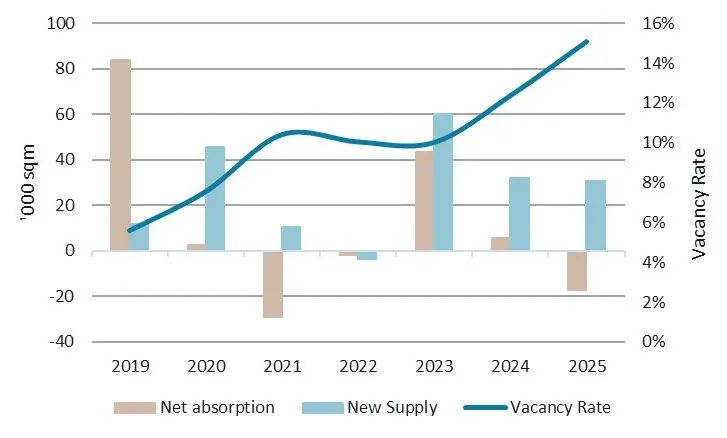
The simple reason for this is that more people are working from home. Even with workplaces enforcing return-to-office policies, many people are working from the office three or four days a week rather than five. On top of changes in work patterns, retail trends have shifted. Online shopping is growing, and that’s reducing the amount of retail sales in city centre stores. Even among brick-and-mortar sales, the economic centre is shifting outwards. Look at the hottest retail openings in Auckland: Costco in Westgate and Drury, and Ikea in Sylvia Park. The centre of gravity for retail is shifting outwards.
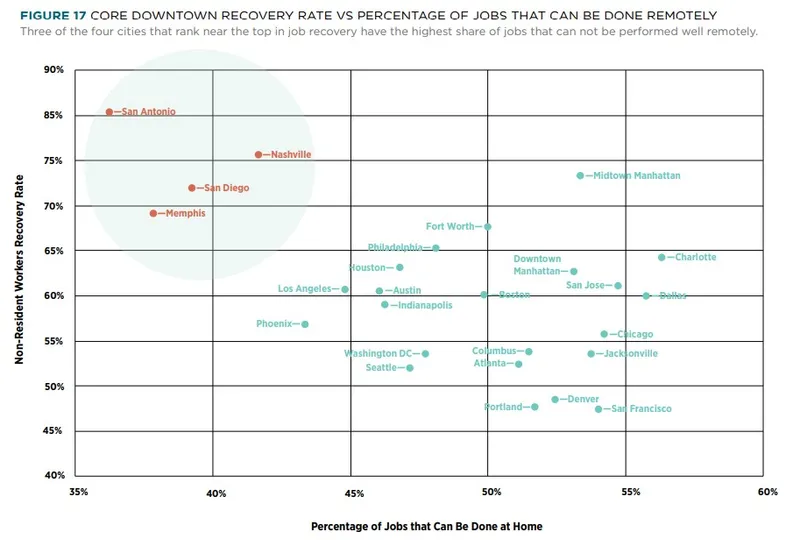
Office occupancy rates aren’t likely to ever rebound to where they were. Cities need to find new ways to fill the urban core with people. An analysis of US downtowns commissioned by Philadelphia’s city centre business group found that cities with the highest rates of worker return after the pandemic were those with the highest concentrations of industries that require face-to-face interactions, namely entertainment and hospitality.
It also found that, unsurprisingly, people who live closer to their place of work are more likely to return to the office.
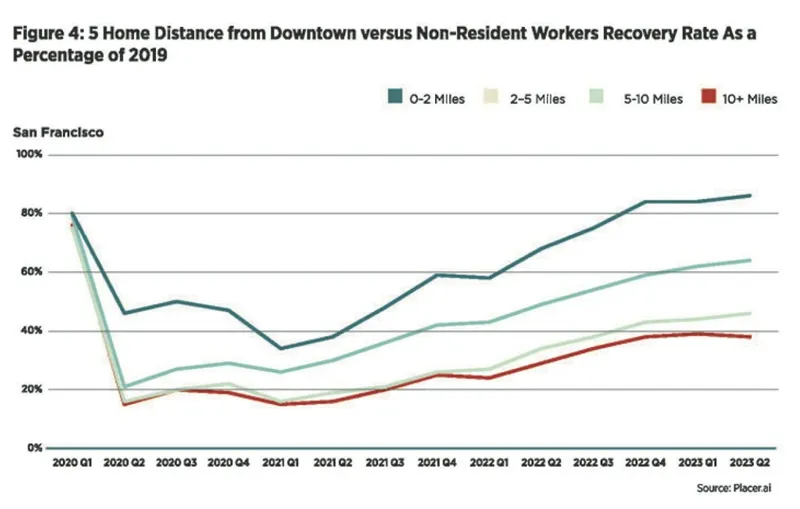
Those stats show a clear model for cities to thrive in the post-Covid age: convert public spaces (such as roads) to support the entertainment and hospitality industries. Create vibrant entertainment districts with pedestrianised streets and al-fresco dining areas, and increase the residential population in and near the city centre by encouraging new developments and office-to-residential conversions.
I think the most significant divide in urban politics comes from people with two alternative visions of the way forward. Do we double down on the old model of the city as a central business district powered by suburban commuters? Or do we try something new?
The future is the past
This new way forward is actually a return to tradition. In ancient cities, the centres functioned more like residential neighbourhoods; commuters were limited by how far they could walk, so people had to live nearby. The industrial revolution upended that millennia-old tradition. Factories located themselves near ports, creating enormous numbers of urban jobs, but filling cities with pollution from industry and overcrowding. The invention of trains, buses and cars allowed people to live further away from the city centre and escape the unpleasantness. The city centre became a business district that people commuted to for work or errands, and then left. Living in the inner city became increasingly rare.
The post-industrial economy is a huge opportunity for modern urbanism. For the first time in centuries, city centres can be nice places to be – if our civic leaders prioritise people-friendly policies. But when we use terms like “CBD”, we ingrain the idea that city centres exist merely for businesses. People become an afterthought in a concrete world of functional efficiency. And when people suffer, so do businesses.

Joel MacManus
Joel MacManus is a senior writer for The Spinoff. He previously worked at RNZ and Stuff, and began his career at Critic Te Ārohi. His writing explores the political, economic and cultural systems that underpin modern New Zealand. He won the 2025 Voyager Media Award for Best Columnist, Opinion or Critique.


