Jim Bolger in his own words

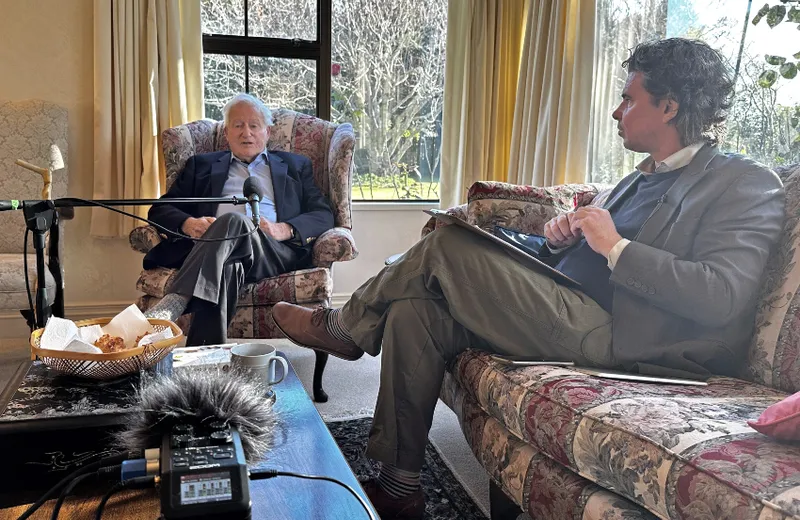
Jim and Joan Bolger in their Waikanae home in June 2025. In the background is a painting of their Te Kūiti farm. (Photo: Toby Manhire)
Excerpts from a conversation with the former prime minister a few months before his death.
In June, Jim and Joan Bolger threw a party at their place to celebrate the former prime minister’s 90th birthday. Eight of his nine children were there; they and a scrum of grandchildren performed a specially composed song to praise and tease him. Filling the house up the road from Waikanae beach were many that had worked for and alongside him over the years.
Former cabinet ministers including his closest friend in politics, Bill Birch, travelled to mark the occasion. So did Doug Kidd and Don McKinnon. And then there were those who’d worked in his office – senior and junior staffers past, whose affection for their old boss had not faded across the years.
One of the things I kept hearing while talking to people for the forthcoming second season of Juggernaut, which tells the story of the Bolger-led government in the 1990s – and again when calling around for memories yesterday following his death – were variations on, “when I spoke to Jim last week …” Even at 90, even with the exhaustions of four-times-daily dialysis, he was in constant touch with an orbit of colleagues – together, as Doug Graham put it, day by day, freshly “solving the world’s problems”.
We went to visit Bolger a fortnight or so after that party, and spent a couple of hours talking to him for the podcast series. He and his wife, Joan, were in excellent form, though his energy came and went. The discussion ranged from his early encounters with politics right up to the geopolitical headlines of the moment.
Below, a series of excerpts from that interview a few months ago.
Jim Bolger on how a farmer from Te Kūiti finds himself on the ninth floor of the Beehive
Because people asked me. I’ve got all these positions, including prime minister, because people asked me to do it. That’s the reality. A group from the local National Party came and asked me whether I’d put my name forward. Before that, I had created some media interest, when I gave a speech on farming politics.
We’d moved from Taranaki to Te Kūiti. Our second son, Paul, had just been born, and going back from the maternity hospital, from one side of Te Kūiti to the other, I saw the local Federated Farmers were having a meeting, so I said to Joan, I’ll go along, just to meet some local people – at that time we knew nobody in north King Country and, and that, in many ways, was the beginning. I went there, and I was immediately put on the committee, because, no doubt I said something, and it went on from that.
I was always prepared to speak out on issues that I thought were important. So I was elected to parliament in 1972 and then moved into various positions, the biggest of which, before I became leader, was minister of labour in Muldoon’s government. Labour relations at that stage were terrible, and there were strikes on every second day and a very aggressive trade union movement. Later, in government, we made changes in the Employment Contracts Act. They were controversial. They were all controversial. But they’re all totally logical.
On the ‘decent society’ slogan at the 1990 election
It was much more than a slogan. It was capturing what I sensed New Zealanders wanted – a hard-to-explain but recognisable decent society, where everyone got a fair opportunity. And that’s what I wanted for the country that I was going to lead, and that’s what we set out to achieve. And I think to a large extent, we did achieve it.
On the immediate aftermath of the 1990 election
The officials asked to see me before I was sworn in as prime minister, just to tell me the truth – how bad the books were.
And the BNZ, then the largest bank in New Zealand, was facing bankruptcy. It was part-owned by the government, so that took a few hundred million [$620m] to resolve as well. I mean, it’s hard, from the perspective of today, to look back to realise the scale of the mess that the New Zealand economy was in. People seemed to have been mesmerised by Roger Douglas, and he proved to be a false prophet.
We inherited an economy in total disarray, I suppose is the right word. And we then had to make corrections. They weren’t popular, but they were necessary. And, you know, New Zealand came out of it strongly.
We had to take some quite drastic steps. And you know, there were those who said we over-corrected. I’m not sure we did, but we had to take big steps to get the New Zealand economy back into shape and facing in the right direction.
On the challenges inherited
There were two big issues. One was to rebuild the New Zealand economy, which was a total mess.
And the second was much more important still, which was to reflect and honestly adjust our attitudes to New Zealand’s history, and that’s when we started Treaty settlements, and to acknowledge the huge mistakes of the early years of European settlement. I mean, clearly you can’t reverse the path of history, but you can adjust to it, and that’s what we were doing with Treaty settlements.
As we sit here today, there are still those within the Act Party who seem not to want to recognise the Māori status in New Zealand. They seem frightened of it.
On whether his Irishness informed his approach to relations with Māori
I think it unconsciously did. My parents did not spend time talking about the terrible English suppression of Ireland. Though I do remember my father talking about the English military, which they described as the Black and Tans. Intuitively I think that did inform me, just as the Irish had been very, very unjustly treated by English colonial attitudes, I could understand where Māori were coming from, or at least partly understand.
On Muldoon
I had a decision to make on Rob Muldoon. I’d got on quite well with him, but I decided he would not be constructive in cabinet, though he was very determined that he would be there. So I offered him a ministerial position outside cabinet, which he wouldn’t accept, and then that triggered a byelection in Tamaki, and that caused a lot of drama – trauma – within the National Party.
On the welfare cuts
It was tough medicine and you knew, of course, it would be unpopular. I mean, we’re all human. We don’t like to face unpopular decisions. But, yes, people were hurt. And you don’t want that. I certainly didn’t want that. And we’re going through a bit of that at the moment.
On Ruth Richardson as finance minister
People liked black and white answers. Ruth was good at giving black and white answers, even if you needed a more subtle answer. Obviously she was upset that she wasn’t reappointed as minister of finance in 1993, but I had decided we needed to take a slightly different approach. And Bill Birch was the man to do that. He took a different type of approach.
I offered Ruth various other posts, but she wouldn’t accept them. She had a very determined personality, and she determined that what she wanted was correct and what the leader wanted was irrelevant. Well, there you go. That’s life.
On reneging on a promise to ditch the superannuation surtax
It wasn’t easy at all. I was totally certain we’d be getting rid of it. That was a big one, because I’d used phrases like no ifs or buts! But when you get there and you find you’ve got no money, you’ve got to adjust.
On the decision to match Labour’s anti-nuclear stance
The New Zealand mind was very clear in its anti-nuclear position by then. They had reached that conclusion, and they were sticking with it. And I can’t say they’re wrong, even this many years later. You’ve got to give credit to the Labour Party for that, they are the ones who brought in the anti-nuclear approach for a start.
But these were intense debates. They weren’t casual discussions. They were absolutely identity issues.
On the nuclear issue, at the moment, with Israel having bombed Iran – they say they don’t want Iran to get nuclear weapons, despite having them themselves. The hypocrisy is self-evident.
On electoral reform
MMP obviously has changed politics dramatically. My hope was that we would not move to MMP, that we would agree to a second house of parliament, which we had abolished in the 50s – a second house of parliament with more authoritative powers than back in the early days when it was just a rubber stamp. That didn’t happen. We moved to MMP, and we’re still struggling a bit with MMP. We’re making it work, but there’s work to be done.
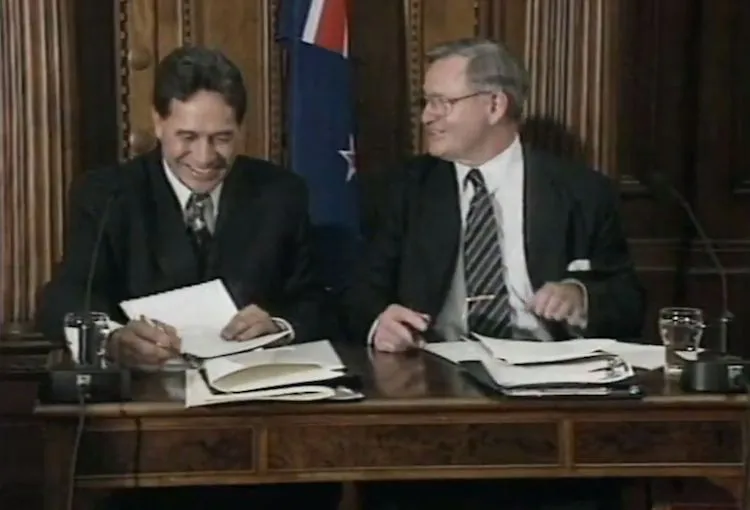
On forming a coalition in 1996 with Winston Peters, whom Bolger had sacked those years before
I had had lots of problems with Winston earlier, as he was sort of trying to position himself to become leader of the National Party. And had he played his cards differently, he probably would have been leader.
But we found a way. Winston and I typically got on quite well on a personal basis, even if in policy terms, we were often different. Once we got past that, life was fine.
On returning from an overseas trip in 1997 to learn his leadership was under threat
Doug Graham said there’s a coup on. And they obviously believe they’ve got the numbers – words to that effect. And I recall going to my office and I rang up Jenny Shipley’s office and we had a chat, and she was absolutely confident she had the numbers. I never, ever saw the numbers. Nobody ever actually produced numbers. But I thought, if that’s what they do when I’m out of the country, then to hell with it, it’s about time I resigned.
Nobody had rung me and said, Jim, look, this coup is being mounted here. They didn’t say they disagreed with me on, say, Treaty issues or anything. So I don’t know, and, frankly, it didn’t matter any more. But, sure, there were those who obviously thought Jenny would make a better leader. Obviously I was getting near the end of my use-by date.
On the state of America
The US is in a total mess. And that is very bad news for the world, because they are the largest economy, they are the largest western nation, and they’re in a total mess. It is, to me, the biggest risk the world faces – something irrational coming out of the United States. Clearly, Donald Trump is a very unique and strange person, and I think Donald Trump doesn’t know what he’s going to do next, much less the rest of us, so the world’s at some risk. The world is in a dangerous position.
On family
We’ve got a wonderful family and just a huge amount of talent. I’m sure Joan would agree, we’ve had this relationship as a total family, that’s been very positive. Just wonderful, frankly. Wonderful. Joan was always there.
Joan: I heard it all!
Jim: Always there.
Joan: I wasn’t prepared to make judgments or anything!
Jim: Always prepared to offer advice, though. No, no, it’s good. The family have been wonderful.
Excerpts have been edited for clarity.
Toby Manhire
Toby Manhire is editor-at-large at The Spinoff. He loves to cast a pod, whether it's Gone By Lunchtime, At Large or Juggernaut. He is a former editor of The Spinoff and has worked as a journalist in NZ and the UK since the last millennium.


