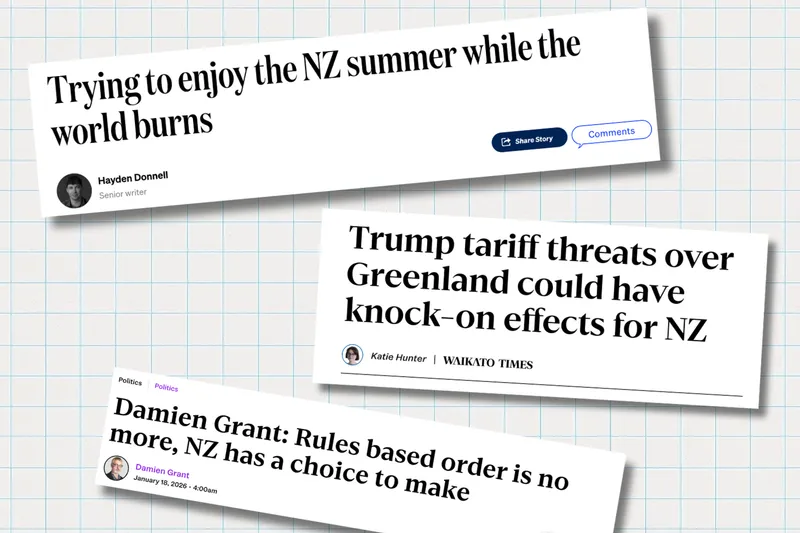
If the rules-based system is really crumbling, what could that mean for New Zealand?

Hmm. (Headline source: Newsroom, RNZ and The Post)
Everybody’s talking about World War Three, but we’re as safe as safe can be… right? We asked some experts.
We’re only three weeks into 2026 and you could be forgiven for thinking the world has gone to hell in a handcart. On January 3, US forces abducted the Venezuelan president and his wife during a “large-scale strike” on the country’s capital, with Donald Trump saying the US will “run” Venezuela and is “not afraid of boots on the ground”. A week later, the US withdrew from 66 international organisations and Trump told the New York Times “I don’t need international law”. This week he announced fresh trade sanctions for countries that oppose the US acquiring control of autonomous territory Greenland.
It’s no wonder that there’s been increased talk of the international rules-based system crumbling. Is it true, and what will the impact on New Zealand be if it continues to deteriorate, or even collapses completely?
Crumbling? Catch me up real quick.
Let’s ask an expert. “What would it mean for New Zealand if the rules-based world crumbles? It could be replaced by a world where great powers effectively have spheres of influence, and middle powers like Australia and small powers like New Zealand have very little say in how the world should be organised,” says political scientist Robert Patman from the University of Otago.
Shocked? Don’t be. “This hasn’t suddenly happened overnight,” says economist Cameron Bagrie. “I think a lot of people have just been slow to wake up to what’s been going on.”
Like a suddenly noticeable crack in a building that’s actually been forming for years, the fissures in the foundation of the rules-based system go back decades, Patman says. “I think the rules-based international order has been in trouble since 9/11, starting with the US’s illegal invasion of Iraq.” That was followed by a succession of landmark events that exacerbated its decline, which have accelerated since 2023.
While previous administrations “paid lip service to an international rules-based order even if they sometimes took steps to undermine it”, Trump doesn’t bother, says Patman. “His foreign policy is geared to dismantling the international rules-based order. He wants the world to be run by great powers, and he’s been quite explicit about that. And in the National Security Strategy (NSS) statement of December 2025, he made it quite clear that international law would not restrain his leadership.” By threatening to take ownership of Greenland, the United States is “effectively declaring war” on the UN Charter and threatening NATO, Patman says, while European leaders rally behind the autonomous territory. “So we are seeing the breakup of the west as we’ve known it.”
Yikes. Is this what you’d call a new order, then?
Some experts certainly do. Economist Shamubeel Eaqub thinks we’re living through a complete rewiring of the global economy, something he describes as a “hinge moment” and a major regime shift. The peace-driven global order that has defined geopolitics, trade, economics and investing since the end of the second world war – “led and held together by the USA, who are now walking away from it” – is ending. “The last 80 years was an aberration, not the norm.”
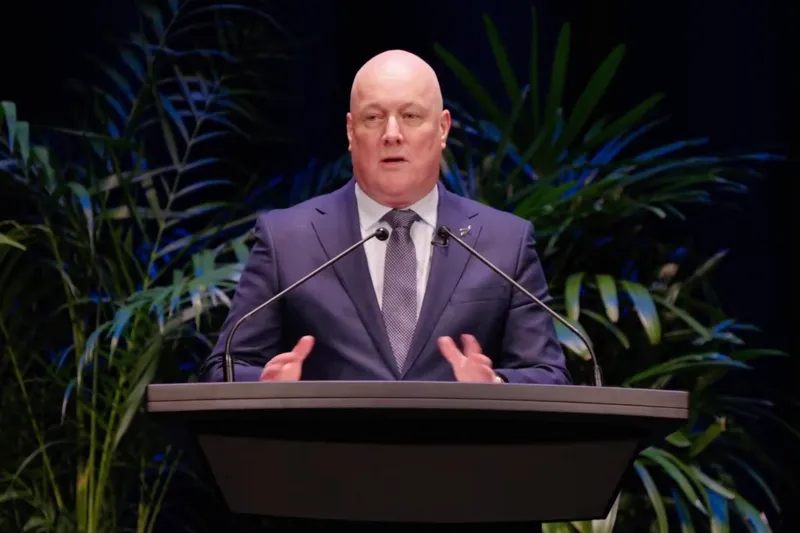
What a new order might look like is uncertain, but Eaqub says to expect more countries taking a nationalist and imperialist approach to international policy. Amid the changing geopolitical situation is the “raging comeback” of tariffs and protectionism, as prime minister Christopher Luxon noted in Monday’s state of the nation speech.
Bagrie points to three big things underpinning the shifting world order: power is now challenging the rules-based system, the security of food, energy and technology is critical, and the concepts of onshoring, friendshoring (sourcing from geopolitical allies) and nearshoring (sourcing from neighbouring countries) are replacing the offshoring model that’s been a key driver of globalisation.
Doesn’t sound too bad. Can we expect onshoring of manufacturing here?
“New Zealand is never going to be able to be self-reliant,” Bagrie says. “We are kidding ourselves. We just don’t have size, we don’t have scope.” New Zealand is always going to be a producer of food and an importer of manufactured goods, he believes. “The question is where are we going to get those manufactured goods and at what price?”
While closer and more stable, nearshoring comes with a cost. “Prices on average will be higher under a less globalised model, which is where we’re heading.” People will also have to get used to more potential volatility. “The cost of living is influenced by what goes on globally. The New Zealand economy is hugely impacted by what’s going on globally.”
Ah, the cost of living.
The crisis that’s become our reality. Higher prices have flow-on social effects, Bagrie notes, pointing to the IMF chief’s 2024 warning of dissatisfied populations and low-growth malaise. “People are grumpy. And there’s no easier way to make people grumpy than to make it more expensive to live, which is what inflation does,” says Bagrie. “We’ve been used to inflation sitting at 2% or below most of the time. It looks like the new normal for inflation is gonna be 2.5 to 3%.”
Eaqub notes that past decades of economic prosperity left many people behind and entrenched inequality, leading to a breakdown in social cohesion, which in turn drives polarisation. While it might seem sudden, he says it’s really more like a “slow rot” that’s been spreading for decades. “New Zealand is not immune.” (A 2025 Helen Clark Foundation report found our social cohesion levels trailed 8% behind Australia’s). “The biggest fracturing is explained by the rich-poor divide, as well as political alliances, ethnicity and age. The more entrenched inequality and poverty become, the bigger the risks to the foundations of national economic prosperity.”
Jeez. So is everything fracturing? It sure feels like it.
Not necessarily. “Scott Bessant, the US treasury secretary, has said there can be no decoupling of the Chinese and American economies, so I think Mr Trump wants a constructive relationship with China on his own terms,” Patman explains. “If relations between China and the United States are good, that makes our situation easier.”
Canadian prime minister Mark Carney said this week that his country’s “recalibrating” relationship with China sets it up “well for the new world order”. New Zealand is also firming up its relationship with our Indo-Pacific neighbours (southeast Asia, northeast Asia, India, China and the Pacific), which Luxon told RNZ last October was “at the heart of our future” and a source of both prosperity through trade and what he described as “real security”.
With all these shifting alliances, University of Canterbury academic economist Laura Meriluoto says that if other markets experience a reduction in demand, New Zealand could benefit from an increased demand for our exports. “Especially countries that don’t want to buy from the US,” she says. “There are some opportunities for exporters and newer, different markets created by that sort of trade diversion.” Asia is our largest trading market, “but it could get larger,” she points out.
China is our biggest trading partner, followed by the US and then Australia. But Bagrie says New Zealand’s connection with the US comes more from the financial world than trade. “We’ve got a hell of a lot of foreign direct investment in the United States and the United States has got a hell of a lot of foreign direct investment in New Zealand,” he explains. “We don’t have an awful lot of foreign direct investment in China.”
Hmm, sounds like there’s a bit of change underway eh.
And some uncertainty too. “Any time there’s a fracturing of the global trading system, that creates more uncertainty,” explains Meriluoto. “Even if the worst what-ifs don’t come to pass, the instability itself has a dampening effect on the trust and confidence of businesses and people.” Shocks can be short lived, however. “We saw that with Trump’s Liberation Day tariffs,” she says. “The financial markets kind of collapsed, but then they came back relatively quickly, so at the end of the day it wasn’t a terrible year.”
Given our isolated location and reliance on imports, New Zealand’s trade routes are vulnerable to disruption (like we experienced during Covid). “That means delays, it means increased cost of transportation,” Meriluoto says. “Exchange rates often also get really volatile,” she adds. “It can be good for us as well; if US exchange rates would plummet, then that would actually mean our currency would get stronger.” That’s a good situation for importers and consumers, but not so good for exporters. “So there’s always two sides to the story.”
But we should be resigned to the fact that certain products will be getting pricier, says Meriluoto. “If things escalate and we have disruptions to those trade routes and trade costs and stuff like that, that’s going to certainly make imported goods more expensive.” Newfound demand elsewhere could push up prices for domestically produced items too.
Gas and petrol are the most vulnerable to price rises when there’s global tension, says Meriluoto, and Bagrie highlights that energy is a major point of vulnerability.
“You look at our net trade, and in regard to energy it’s a pretty big deficit.” As gas supply has dwindled in New Zealand in recent years, coal imports have increased, with Huntly Power Station establishing a stockpile in response to the 2024 electricity supply crunch. It’s one of three important areas of national security, says Bagrie: “Food, we’re secure. Energy we’re not secure, and technology we’ll just piggyback on the western world.” Food is one of our “strategic advantages” since we produce enough for 40 million people.
That’s good. What about our location?
Bottom of the world, mate. New Zealand is around 16,000km from Greenland. Getting to Venezuela would require multiple connections and days of travel. A direct flight to New York takes 16 hours. “Sometimes the tyranny of distance can become an advantage,” Bagrie says. He also notes that even though the rules-based system has been challenged, “it does not mean we’re going to hell in a handbasket”.
Compared to many other places, New Zealand’s a good spot to be. Meriluoto is from Finland. Many of her University of Canterbury colleagues are from abroad too. “We frequently talk about how blessed we are being here, where we’re still kind of isolated from at least the direct effect of global events.”
International tourism contributed $12 billion to our economy in the year ended June 2025, and $1.8 billion of that was from visitors from the US, followed by $1.2 billion from China. The situation in the United States could make a dent in those figures.“If the US economy is not doing well, they’re not travelling because they don’t have money. But at the same time, there are lots of people who want to just get out of the US for a short period of time.” She also thinks we might benefit from international travellers changing their plans, with tourist spend that would have gone to the US diverted elsewhere in the world.
What else has increased?
New Zealand’s military budgets, which the prime minister noted in his speech on Monday as he acknowledged the “rupturing” of the rules-based system, as well as the “rising risk” of a “dangerous miscalculation” in the Indo-Pacific.
Can we expect any change in New Zealand’s defence strategy? “More resources really doesn’t mean much without a strategy to justify it,” says Van Jackson, an associate professor in international relations at Victoria University. “And that’s not going to happen without a national strategy that takes a clear-eyed view of how the world is changing.”
Patman thinks New Zealand needs to “look very carefully at all the military agreements that this government has signed” with the US. The danger is that Trump could pull us or bully us into a direction we don’t want to go.”
He describes the New Zealand government’s strategy to date as a “softly softly approach” designed to stay off the radar screen and “perhaps nudge Trump towards a mellowing of his policies”. Since we were slapped with a tariff anyway, Patman says the approach clearly didn’t work.
Err, so what could New Zealand do?
Jackson sees two courses of action: either stick with the current approach of keeping our head down or “muster a little backbone, work with others who are trying to preserve a semblance of stability and fairness in the world.”
Patman also sees us as being at a foreign policy crossroad. “If we continue to sit on the fence, we could witness a deterioration to the international environment that would directly harm our national interests.” He says New Zealand can’t afford to sit by and watch. “Do we try to curry favour with an administration which is hostile to our values and interests, or do we actively side with those liberal democracies which are now trying to resist Trump? That’s the question that has to be resolved. It is clear that New Zealand cannot credibly do both.”

Emma Gleason
Emma Gleason is a staff writer at The Spinoff and an award-winning fashion journalist. But it’s not just clothes that interest her, you’ll find her exploring tasty cheese, influenza outbreaks and more important things right here. She has experience with some of the country’s leading media outlets as well as the toaster in our kitchen.


