A confident Chris Hipkins lays out how Labour can win in 2026

Chris Hipkins was in a buoyant mood at the Labour caucus retreat.
The Labour leader thinks he’s found a path to victory. He just needs his MPs to stick to the game plan.
Chris Hipkins returned from summer with a pep in his step. He’s in love (you only get engaged for the second time once) and brimming with confidence that he could be the prime minister again by year’s end.
Of course, every politician talks up their chances ahead of an election, but this doesn’t seem like an act. Hipkins believes that Labour can win this thing. He says they intend to do “significantly better” than 40% in the party vote.
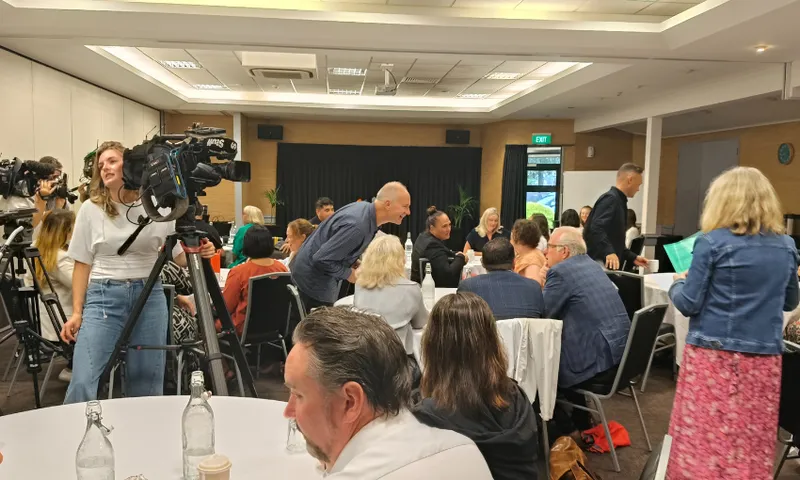
Labour MPs met on Wednesday for their caucus retreat at the world’s most depressing four-star hotel: Quality Hotel Lincoln Green in West Auckland. Was it chosen so Labour could signal their everyman status? Was it a symbolic commitment to the outer Auckland suburbs? Or can they just not afford anything better?
Hipkins addressed his MPs in the conference room. It had fluorescent lights and beige walls. Out the window, there was a constant grey drizzle. The dreary setting only made Hipkins seem more dynamic, like an enthusiastic Michael Scott. It was a complete reversal of Christopher Luxon’s state of the nation speech two days earlier – a much flashier venue but a more dour presentation.
The contrasting vibes betray the fundamentals of the race: most polling shows the coalition government with a narrow but consistent lead. Economists are predicting improvement this year, which should benefit the incumbents. And Labour’s two potential coalition partners, Te Pāti Māori and the Greens, have spent the last year or so in various states of meltdown.
Labour has been an unusually quiet opposition party. Labour MPs barely put out a press release in the first few months of the term while they focused on dissecting what went wrong in their 2023 campaign – they slumped to one of their worst-ever defeats, winning just under 27% of the party vote – and rebuilding for the future.
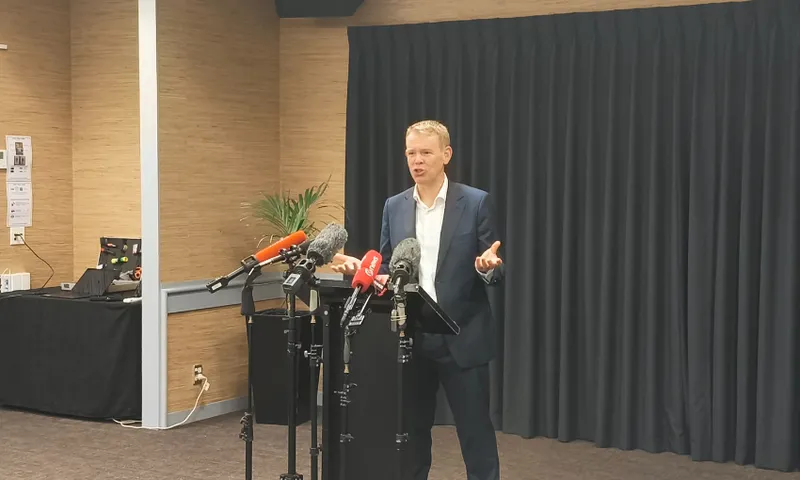
“We understand why New Zealanders didn’t vote for us at the last election,” Hipkins told journalists during a lunch break. “We understand they were looking for something different from us. We have refreshed ourselves. We’ve re-energised ourselves. We’ve changed and we are offering a very different Labour Party at this election to what we’re offering last time.”
There is a refined focus on basic cost-of-living issues. The pull-up campaign posters are a minimalist design with just three words: jobs, health, homes. “We heard very clearly from people at the last election that they didn’t think we were focused enough on the things that matter to them,” Hipkins said.
He drew a direct contrast between National’s laissez-faire economic approach, which seeks growth through low interest rates and private investment, and Labour’s preference for more government intervention. “The current government think job creation is not their job. It is their job,” he said.
To his MPs, he emphasised the need for the party to be a mature, organised government-in-waiting. “We will also make sure that we’re offering New Zealanders a real and compelling alternative, because better is possible,” he said. He repeated some variation of “better is possible” three times throughout his speech – perhaps testing a campaign slogan?
Hipkins also previewed the attack lines the party strategists seem to think work best against Christopher Luxon and the government. The negative emigration statistics are a favourite. “Last year, we lost a record number of Kiwis simply giving up on the country and leaving looking for opportunities elsewhere that they could not find here. That is an absolute indictment of Christopher Luxon and his government.”
Broadly, he wants to position Labour as optimistic and National as pessimistic. “It’s pretty clear that New Zealanders are looking for one thing this year more than anything else, and that is a sense of hope. Because they’re not getting it from this current government,” he said in his speech.
That also works as a premature defence against one of Luxon’s go-to attacks on Hipkins: that poor economic conditions are a hangover from the mismanagement and overspending of the last Labour government. “All Christopher Luxon and National are offering is more blame, more excuses, more negativity, more cuts,” he said during his media standup.
He said the prime minister’s chosen election date of November 7 “suggests that he’s desperate to hold on as long as he can”. (That’s a bit of a reach. November 7 is not a particularly late election date. Toby Manhire predicted it for The Spinoff earlier this month).
Labour’s path to victory in 2026 looks a lot like National’s in 2023: use clear language, a limited set of talking points, and focus on kitchen-table issues while your opponents are distracted by esoteric reforms.
Hipkins’ speech felt half like a coach giving a pep talk and half like a captain demonstrating a drill. This is how I want you to talk for the next year. Do not deviate from the script. The current batch of Labour candidates may not rank among the party’s all-time greats, but they have a vulnerable opponent and a clear game plan. Whether they got the plan right is a conversation for after the election. For now, they just need to stay disciplined and execute.

Joel MacManus
Joel MacManus is a senior writer for The Spinoff. He previously worked at RNZ and Stuff, and began his career at Critic Te Ārohi. His writing explores the political, economic and cultural systems that underpin modern New Zealand. He won the 2025 Voyager Media Award for Best Columnist, Opinion or Critique.


