Britain has binned yet another PM, and the driving force is neither Labour nor Tory

Keir Starmer speaks outside 10 Downing Street to announce his resignation. Photo by Adrian Dennis / AFP via Getty Images
Keir Starmer has announced his resignation after two years. The success of his replacement hinges on battling Reform.
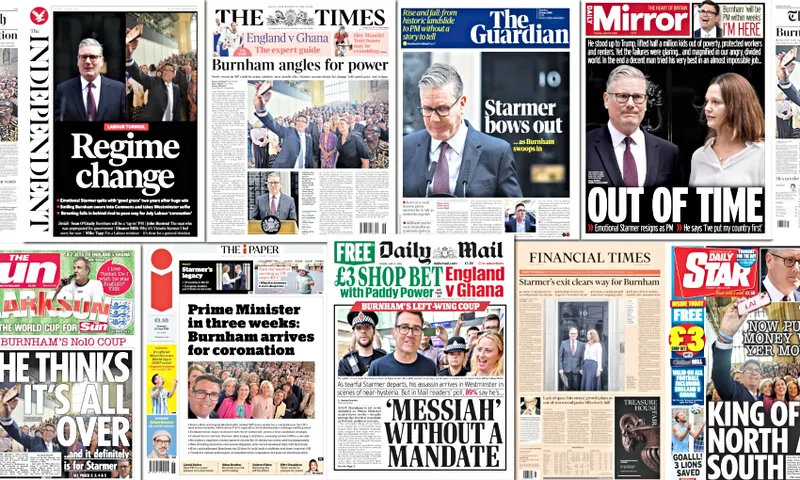
When Keir Starmer led Labour to a landslide victory in 2024, bringing 14 years of Conservative rule to an end, he pledged that the giddy turnover rate at Downing Street would end. Last night, however, not yet two years since he came to office, Starmer said he was packing his bags.
“The question my party is asking now is whether I am best placed to lead us into the next general election,” he said, standing outside No 10. “I have heard the answer of my parliamentary party to that question, and I accept that answer with good grace.”
His decision to stand down from the Labour leadership and accordingly as prime minister came after his messages of defiance to the ambitions of Andy Burnham, freshly restored to the House of Commons, melted in the face of overwhelming demands from his own MPs. His failure, however, could be measured not in overcoming the Conservative opposition, but facing down a new and different challenge: Reform UK, the populist right party, led by Nigel Farage, which has led in almost every opinion poll for the last 18 months.
Today marks 10 years since Brexit – the momentous vote to remove Britain from the European Union. It was that event, and the energies behind it, that forged the UK politics that continue today, said Richard Adams, speaking on the new Spinoff podcast At Large with Toby Manhire.
The “major victim”, however, was the Conservative Party, said Adams, a New Zealand journalist at the UK Guardian. “Nigel Farage came to prominence as a campaigner for Brexit. And then, once Brexit happened, you think, well, what happens to Nigel Farage? Because that’s his whole thing gone. He then started to latch on to a couple of lines: one is that the Conservatives hadn’t done Brexit properly, or they haven’t taken advantage of Brexit.” The other was to double down on immigration fears. “He pointed out very clearly that after Brexit, immigration to the UK actually went up, and there was an obvious reason for that, which was the UK labour market, which had previously relied on a lot of European nationals, no longer could, and so it started to work at attracting people from other parts of the world.”
To get every episode of At Large with Toby Manhire in your podcast feed, follow here for Spotify, or here for Apple. If you like to soak up this sort of thing on YouTube, you can subscribe to the Spinoff here and find all the episodes here.
Those attack lines, combined with a cost-of-living crisis and an embrace of the culture wars, propelled Reform to the political foreground. The perception that the party was drawing numbers away from Labour, just as the Tories had in 2019 and the pro-Brexit camp before then, had “haunted” Starmer, said Adams. “Starmer and his advisers were obsessed with this idea, to the extent that Starmer, who’d never given a memorable speech in his life, can only be remembered for one speech about immigration that made a crass comment about the UK not becoming an island of strangers.” He later apologised for the use of “imagery he borrowed from Enoch Powell”, of “rivers of blood” infamy, “but to the extent that there has been any sort of political policy drive behind Starmer, it’s been about counteracting Reform, and he not only hasn’t been very good at it, it’s probably counterproductive.”
Burnham, currently the mayor of Greater Manchester, was blocked by an anxious Starmer from running in a byelection at the start of the year. When another byelection was triggered last month, however, in Makerfield, on the outskirts of Manchester, another intervention would have been untenable. The question was whether Burnham – previously a Labour minister and unsuccessful in 2010 and 2015 campaigns for the leadership – could overcome a Reform challenger in what would be a two-horse race.
That in many ways worked to Burnham’s advantage in Makerfield, where he won with more than 50% of the vote, a rare feat for a governing party in a byelection. “There are a lot of people out there who really don’t like Reform. They don’t like Nigel Farage, the leader … It’s a difficult trick to pull off on a national level, but the idea that Labour could lead a coalition to keep Reform out is a pretty potent one, and that’s what I think is attractive to a lot of MPs, and apparently 300 MPs have said to Starmer that he had to go. That’s out of a parliamentary Labour Party of 400.”
The extent to which Reform has entered the mainstream at the expense of the Conservatives can be measured in the emergence of a breakaway party, Restore Britain, which regards Reform as insufficiently rightwing. Its candidate finished third in Makerfield, ahead of the Tories.
The new prime minister, who could be sworn in as soon as mid-July should no Labour MP assemble the support of 80 fellow parliamentarians to run against Burnham, will be the seventh in a decade, give or take a couple of days. Not so long ago, Brits had enjoyed making light of the Italians’ tendency to rattle through leaders, said Adams. “Now Italy is a model of stability in comparison to the musical chairs of British politics.”
Burnham’s performance in Manchester has appealed to Labour MPs, and the public more widely, in contrast with a Starmer government that seemed to “lack any central message and any drive”, exacerbated by a perception that Starmer “is not at all charismatic”, said Adams. “People have looked at Manchester and seen what he’s done and thought there is the dynamism that we need. He’s a much more charismatic figure, much more personable.”
Starmer’s downfall was plotted in missteps including a nightmarish saga over winter fuel payment cuts and a view that promises to address a long-running cost of living crisis had been gravely unfulfilled. Then there was the protracted controversy surrounding the posting of Peter Mandelson, shadowy prince of the Blair years, as ambassador to Washington DC, and what was known about his links to the paedophile Jeffrey Epstein.
The prime minister’s own reputation took a battering “as the details came out about an appointment process … which was incredibly transactional and erratic”, said Adams. “You could see the attraction that he would understand [the Trump administration’s] wavelength and be able to talk to them somehow, and that he is the sort of oleaginous character who Donald Trump seems to like, but anyone who looked at Peter Mandelson’s career would see that there were quite a few dangers.”

Toby Manhire
Toby Manhire is editor-at-large at The Spinoff. He loves to cast a pod, whether it's Gone By Lunchtime, At Large or Juggernaut. He is a former editor of The Spinoff and has worked as a journalist in NZ and the UK since the last millennium.


