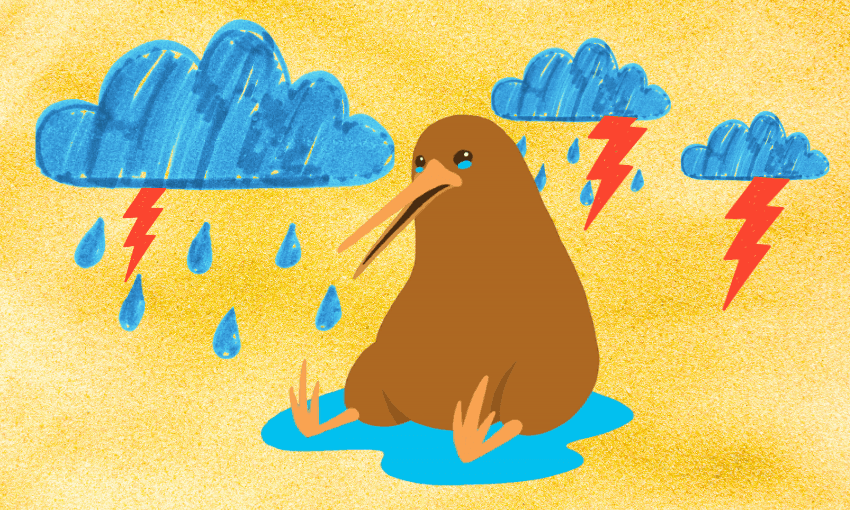

After a tough year, we crawled to the brink of some sunshine, only to be smacked in the face by unseasonal hail.
Pause. Shift your attention to your body. Its rhythms. The in and out of the breath. Now turn your focus slowly to your chest. What is that nagging sensation that will never go away? That’s correct, it’s a burbling wellspring of poisonous resentment over the crappy summer we just had.
It wasn’t supposed to be this bad. “Warm, humid weather is on the way for early summer,” said RNZ in November, before adding a small disclaimer. “With a chance of heavy rain for parts of the country.” Earth Sciences NZ (nee NIWA) talked about La Niña patterns bringing us a lovely potpourri of average temperatures, pleasant northeasterly breezes and normal amounts of rain.

Instead of the medium, possibly good summer we were promised, we got a parade of meteorological disasters interrupted only by storms, high winds, unseasonal cold and even the occasional stretch of sunshine. But where does the 2025/26 summer of shite rank in the great annals of ass? Earth Sciences meteorologist Chester Lampkin has looked through his organisation’s reports on the last 11 New Zealand summers. All had their ups and downs, but he sees 2025/26 standing out for the geographical breadth of its meteorological mischief-making. Every main centre recorded above normal or well above normal levels of rainfall. Record or near-record rainfall was recorded in far-flung locations, from Akaroa and Cheviot in the south to Whitianga, Gisborne and Waiouru in the north. Hokianga, Whitianga and Castlepoint were among six centres to receive their strongest ever wind gusts. “For most Kiwis, over the last 10 years, I would say this would certainly rank as one of the worst summers,” Lampkin says.

But not the worst. That title almost certainly goes to the summer of 2022/23, when the Auckland anniversary weekend floods and Cyclone Gabrielle caused destruction across the upper North Island. Still, that summer’s horrors weren’t evenly distributed. As half of Hawke’s Bay bailed water out of their attics, South Island residents basked in weeks on end of warm, cloudless days. This year, only the people of Northland could say they had anything like as nice a time.

Other years could also lay claim to having bad summers. Lampkin notes 2016/17 was unsettled and the coldest since 2011/12. The following year was the hottest on record, which comes with its own problems. Perhaps it was the hope that worsened 2025/26’s sting though. New Zealanders have spent the last three years on a desperate, fruitless hunt for green shoots. We’ve looked for them in property, manufacturing and trade’s delicate soil as increasingly manic economists have urged us to “survive till ‘25, then “stay in the mix till ‘26” Finally we limped to the brink of a small patch of sunshine only to get hit repeatedly in the face by unseasonal hail.
Lampkin is a man of data and maps. But he recognises that these assessments have an emotional component. In summer, just as in everything else, context is key. He accepts that December 2025 introduced itself to a nation in a long-term fug, and it doesn’t help that we’ve transitioned straight from shivering our way through beach camping holidays to declaring bankruptcy in the forecourt of a Gull station. “I would say that in general, people’s feelings are valid. The stats don’t mean anything when you feel like it was not a great summer,” he says.

Putting feelings aside though, Lampkin still sees an objective underpinning for a nation’s disappointment. It’s that spread of pain. This summer contained some awful weather-related tragedies while also touting a multitude of smaller but still annoying or inconvenient adverse weather events. It overperforms in the aggregate. Forced to put a number on the season for an all-time ass ranking, Lampkin thinks for a time. “Top five,” he concludes. But you have to go back a long way to get to some of the other four. In recent history, summer 2025/26 ascends the list. “For most people alive today, though, this was one of the top one or two worst summers.”