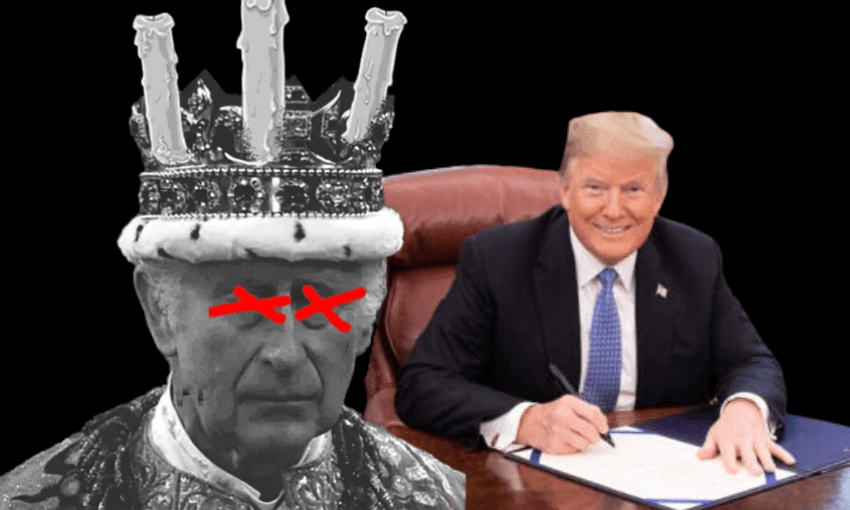



Relations between the United States and the United Kingdom appear to have been repaired thanks in no small part to the highly principled monarch.
It has been just over 60 days since the United States attacked Iran – an escalation widely criticised as a breach of international law. Since then, strikes have reportedly killed senior figures, hit civilian areas, and raised the prospect of regime change.
When close allies, including the United Kingdom and New Zealand, stopped short of backing the move, Donald Trump didn’t hide his frustration.
Of course, the British and its monarchy are an international symbol of righteousness, self-control and virtue. So Britain did what Britain does best. It sent Charles III – by the Grace of God and all the rest of it – across the Atlantic to have a quiet word.
“It is hard not to feel the weight of history on my shoulder,” Charles said in his speech to Congress. I could only wonder why.
Sure, Britain spent over three centuries establishing colonies, protectorates and mandates across every inhabited continent in the world – controlling roughly 25% of the world’s land area at its peak in 1922 – but that was over a century ago, or “just the other day”, as Charles calls it.
Now, the United Kingdom has morals. It is far more principled when it comes to respecting international law and the sovereignty of nations. Prime minister Keir Starmer told the BBC his country is “not going to act [in the US-Iran war] unless there’s a clear, lawful basis”. How far the British have come.
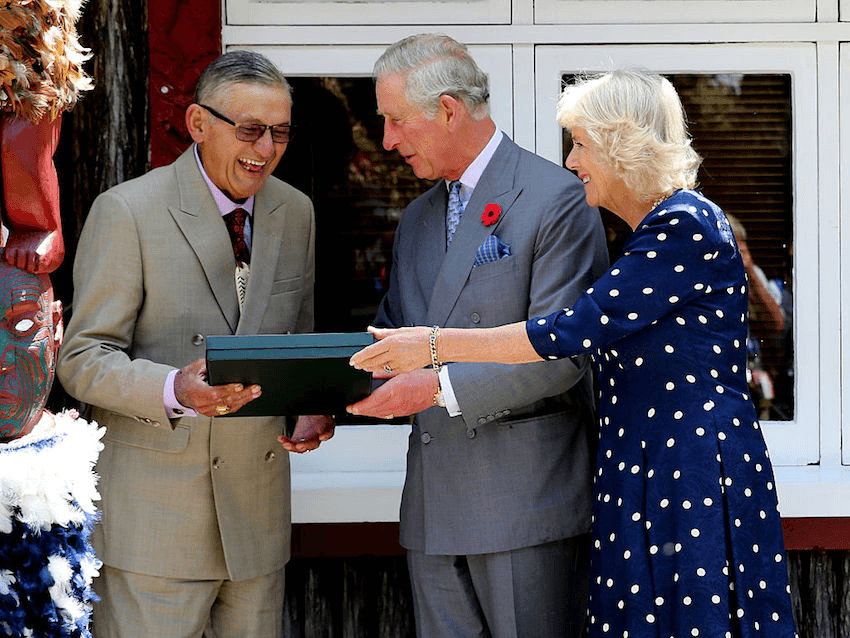
Evidently, Charles – as a constitutional monarch – now acts as a non-partisan head of state for the United Kingdom and 14 other Commonwealth realms, including New Zealand. This means the head of the British monarchy – responsible for colonisation, slavery and genocide – now takes a respectable “middle of the road” approach to politics.
So, given Trump’s disdain with Starmer’s hesitancy to enter the US-Iran war and his recent falling out with Nato, Charles and Camila thought they ought to pay their close ally a visit. Perhaps unsurprisingly, Trump has an affinity for the royal family, so their visit to the United States was widely seen as a soft-power play to help patch things up between the two old foes.
Part of Charles’s speech to Congress reinforced the critical role of Nato in global security and urged unity among allies. Trump has been critical of the 32-member alliance, previously calling it a “paper tiger” and threatening to withdraw America’s membership. Formed in 1949 in response to the threat posed by the Soviet Union, Nato has played a key role in several key conflicts in the last eight decades, including the US-led war in Afghanistan.
As part of his show of support for Nato, Charles touched on Russia’s war with Ukraine, emphasising the need for “a truly just and lasting peace”.
Hearing this made me excited to see how Britain plans to implement a just and lasting peace here in Aotearoa. Perhaps the royals will relinquish the immense wealth and power they stole in their mighty reign of conquest. Maybe they will return what has been stolen from Māori through almost 200 years of colonisation. Maybe the mana motuhake of Māori will once again be formally acknowledged by the British.
Never shy of a quick quip, Charles reminded the Americans during a dinner event they should be grateful for the assistance of the British empire: “If it wasn’t for us, you’d be speaking French.” True. If it wasn’t for them, we’d be speaking Māori.
As part of his nearly 30-minute speech to congress, Charles also dutifully spoke about the environmental degradation impacting ecosystems around the world.

“Our generation must decide how to address the collapse of critical natural systems which threatens far more than the harmony and essential diversity of nature,” Charles said.
My heart rejoiced as the monarch uttered these words. Perhaps some of the Windsor’s $46 billion net worth would be spent eradicating one of the hundreds of invasive species the British brought with them during the colonisation of Aotearoa.
Overall, the monarch’s trip west was seen as a resounding success in repairing British and American ties.
Charles was just a prince in 2019, the last time he was here in Aotearoa. Perhaps his next visit – and first since ascending to the throne – will be one where he unveils his grand plans of restitution for the wrongs of the British. Perhaps it will be a reminder that we should be grateful we’re not speaking French.
Whatever the outcome, we should revel in the fact King Charles – the king of New Zealand – remains a global symbol of power, poise and political pageantry. Lest we become subject to the wicked will of President Trump.